Kaspa activated its Toccata upgrade on June 30, bringing native L1 covenants, Covenant IDs, zero-knowledge proof verification and sequencing facilities to its proof-of-work blockDAG network.
Kaspa activated its Toccata upgrade on June 30, bringing native L1 covenants, Covenant IDs, zero-knowledge proof verification and sequencing facilities to its proof-of-work blockDAG network.
The upgrade expanded what Kaspa can do without changing its underlying UTXO architecture. Yet the KAS price has struggled to turn the technical milestone into a sustained rally.
However, the KAS price is down 0.59% to $0.0253 over the past 24 hours, even as the broader crypto market is up 0.74%. Trading volume is also down 21.69%, pointing to weaker activity behind the move.
Why Has KAS Barely Moved Since the Toccata Upgrade?
The Toccata upgrade worked as planned. Kaspa maintained its 10 blocks-per-second throughput, and the network did not need to replace its UTXO architecture to add programmability. Native covenants, Covenant IDs and L1 ZK verification are now part of the network’s capabilities.
The problem for the Kaspa price is adoption. A technical upgrade can improve the network without immediately creating enough demand for the token. BSCN reported that covenant activity grew by more than 15x during the first weeks after Toccata, but overall network utilization remained low relative to Kaspa’s available capacity.
That helps explain the muted KAS price reaction. There was a short rally around the upgrade, but the token later returned toward $0.025, with its market capitalization near $700 million. CoinMarketCap data also places the KAS price around $0.0253, with a 24-hour trading volume of roughly $4.5 million.
What Did the Toccata Upgrade Actually Change for Kaspa?
Toccata gave Kaspa’s Layer 1 a new programming toolkit. Covenants allow transaction conditions to control how UTXOs can be spent, creating a foundation for more complex applications.
Covenant IDs preserve the identity of covenant instances across UTXO transitions. The upgrade also added OpZkPrecompile, allowing zero-knowledge proofs to be verified directly at the base layer. Partitioned sequencing commitments were included to support applications built around verifiable computation.
In simple terms, Kaspa still has the same proof-of-work engine and high block frequency, but developers now have more tools for creating programmable applications on top of it.
The key question for the KAS price is whether those capabilities turn into sustained transactions, liquidity and applications.
What News Is Pushing KAS Lately?
Toccata remains the biggest development, but mining has also received attention. Binance Pool launched a zero-fee KAS mining promotion from August 5 to November 5, 2026, reducing the pool-fee burden for participating miners.
Kaspa’s mining economics remain important because the network’s hashrate has fallen from previous highs amid price pressure and lower emissions. The combination of lower mining profitability and a KAS price near $0.025 makes miner economics an important metric to watch.
Related Kaspa News: Where Will Kaspa (KAS) Price Go This Week?
Where Could KAS Price Go Next?
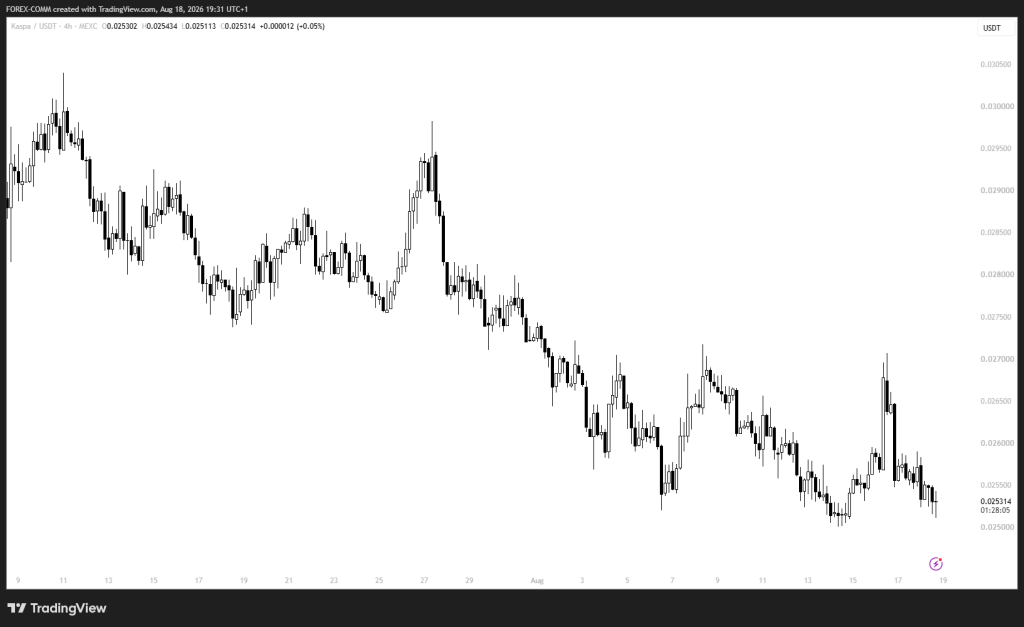
We had a look at the KAS chart, and the technical picture remains bearish. The KAS price has formed a sequence of lower highs from the $0.0300–$0.0305 area in early August toward the current $0.0253 region.
 Source: Tradingview.com
The first support to watch is around $0.0250–$0.0252, close to the latest swing low. If buyers defend that area, KAS could attempt a recovery toward $0.0265–$0.0270, where the chart shows repeated rejection.
A break above $0.0270 would give bulls room to target $0.0280, followed by the $0.0290–$0.0295 zone. A move through $0.0295 would weaken the current bearish structure and bring $0.0300 back into view.
If $0.0250 fails, however, the KAS price could face another leg lower. The chart provides no confirmed reversal yet, so the key test is whether buyers can defend $0.0250 and reclaim $0.0270 with stronger volume.
Frequently Asked Questions
What did the Kaspa Toccata upgrade change
The Toccata upgrade added native L1 covenants, Covenant IDs, zero-knowledge proof verification and sequencing facilities to Kaspa without changing its underlying UTXO architecture.
Why has the KAS price barely moved after the Toccata upgradeThe KAS price has struggled because network capacity has not yet translated into broad usage. Kaspa continues processing around 10 blocks per second, but overall utilization remains low, and KAS trading volume is down 21.69%.
What is the KAS price prediction from hereThe key support zone is around $0.0250–$0.0252. Holding this area could allow KAS to test $0.0265–$0.0270, with higher targets around $0.0280 and $0.0290–$0.0295. Losing $0.0250 would weaken the bullish case and expose KAS to further downside.
Subscribe to our YouTube channel for daily crypto updates, market insights, and expert analysis.
The post Kaspa’s Toccata Upgrade Barely Moved KAS Price – Here’s Why appeared first on CaptainAltcoin.