KAVA traded at $0.0395 at 17:10 UTC on November 14, down 41.9% in 24 hours, after Kava said it was tracking “unexpected behavior originating from a dApp within the Kava ecosystem” and Upbit s

KAVA traded at $0.0395 at 17:10 UTC on November 14, down 41.9% in 24 hours, after Kava said it was tracking “unexpected behavior originating from a dApp within the Kava ecosystem” and Upbit suspended deposits and withdrawals of the token. CoinGecko’s hourly series put the low at $0.0364 in the 12:00 UTC reading, 47% below the $0.0687 high recorded on November 13.
Update, 18:25 UTC: CoinGecko’s latest reading put KAVA at $0.0375, down 44.8% over 24 hours, with market capitalization near $40.5 million on $50.0 million of 24-hour volume, roughly 45% below the November 13 high of $0.0687. The figures below are reported as of the 17:10-17:15 UTC snapshot and are not restated.
Kava named the affected application in a follow-up post: Kava Lend, the chain’s own lending market. The project said the event was “isolated and contained” and was “not an infinite mint”. The clarification arrived at 12:01:50 UTC, 85 minutes after the first exchange notice and 33 minutes after Kava’s first public statement.
For anyone holding KAVA on a venue that has frozen transfers, the order of those disclosures matters more than the headline percentage. The token’s price is now set by whichever venues remain open, and the supply locked inside a suspended exchange cannot arbitrage the difference.
What Kava Has Said, and in What Order
Three disclosures frame the day, and they did not arrive together.
Upbit published a notice suspending KAVA deposits and withdrawals at 19:36:55 Korea Standard Time, which is 10:36:55 UTC. The notice cites the Virtual Asset User Protection Act’s enforcement decree, article 17, clause 2, item (na), and describes the reason as circumstances indicating that a security incident had occurred involving KAVA on the Kava network. Its stated scope is deposits and withdrawals of KAVA only. No restart date is given; the exchange says service resumes after deposit and withdrawal stability is confirmed, through a further notice.
At 20:00 KST, or 11:00 UTC, Upbit added a second notice urging caution in trading. It states that on November 14, circumstances suspected of a security problem on the KAVA chain had been identified, and warns that price volatility may widen.
Kava’s own account lagged the exchange. At 11:28:21 UTC, 51 minutes after Upbit froze transfers, the project wrote on X that teams were tracking unexpected behavior from a dApp and investigating “with high priority”. The follow-up, quoted below, added the two points the market needed: the affected application, and the denial of an infinite mint.
Why KAVA Fell About Eight Times Harder Than Bitcoin
The wider market was weak, but not weak enough to carry a 42% move. Bitcoin traded at $65,080, down 5.4% over 24 hours, and Ether at $1,814, down 6.1%, on the same CoinGecko snapshot. KAVA’s decline was roughly 7.8 times Bitcoin’s, leaving about 36 percentage points that have no market-wide counterpart.
Dollar value disappeared on a similar multiple. Using the chain’s supply of 1,082,846,850.8 KAVA, the token was worth about $74.4 million at the November 13 high of $0.0687. At $0.0395 the same supply is worth $42.8 million. The difference is about $31.6 million, computed from supply multiplied by price at the two reference points.
Turnover points the same way. The 24-hour volume of $51.2 million was 1.20 times the token’s $42.9 million market capitalization, a ratio that usually appears when holders are leaving rather than rotating between assets.
What the data does not establish is who sold. Kava’s statement refers to “the bridging and sale of KAVA tokens on BSC”, which identifies the venue of the selling and not the identity of the sellers or the mechanism that produced the tokens. Those are separate questions, and only the first has been confirmed by the project.
The BSC Leg: 90 Million Wrapped KAVA and a Supply Question
Kava runs as a Cosmos chain with an EVM side, and KAVA also circulates on BNB Smart Chain as a wrapped representation. The BEP-20 contract reports a total supply of 90,023,297.80 KAVA, equal to 8.31% of the 1,082,846,850.8 KAVA recorded by the chain’s own bank module at 17:12 UTC. Both numbers can be read directly: the wrapped supply from the token contract on BscScan, the chain supply from Kava’s public REST endpoint.
That split is the part lending users should watch. Wrapped tokens on BSC are meant to be backed one for one by KAVA locked on the Kava side. If the tokens sold on BSC came out of that pool, the loss lands on the bridge’s backing. If they were created without a matching lock, BSC holds claims that chain-level issuance does not recognize. Neither of Kava’s statements says which happened, and chain supply alone cannot answer it, because a bridge can mint on BSC without touching issuance on Kava.
The “not an infinite mint” line is therefore narrower than it reads. It rules out the failure mode that hit Initia in October, when an L1 and its rollups were halted after a day-zero mint exploit drained $2.7 million. It does not rule out a bridge accounting error, a compromised key holding legitimate minting rights, or a large holder selling bridged tokens that were properly backed. Kava’s second post promised more information; neither statement included a post-mortem, a loss amount, or a contract address.
What Upbit’s Measures Do to a Holder
A deposit and withdrawal suspension is not a delisting, and it is not a trading halt. Holders can still sell KAVA on Upbit against the pairs the exchange lists, now under a caution designation, but they cannot move coins on or off the venue.
The practical effect is a one-way valve. Supply already sitting on the exchange can be sold, supply held elsewhere cannot be brought in to sell, and buyers on Upbit cannot move purchased coins out. Because arbitrage needs working deposit and withdrawal channels, a freeze of this kind normally opens a gap between the venue’s price and global composites, and the direction of that gap depends on which side of the valve is crowded.
Upbit’s first notice adds two operational details that matter to anyone with coins in transit. Deposit return procedures are also paused for the duration, and withdrawal address registration may be suspended as well, with both resuming in sequence after withdrawals reopen. The exchange says it will work with the project team and publish changes through the same notice.
Kava Lend’s Balance Sheet After the Incident
Kava Lend is a small protocol. DefiLlama recorded $7,418,336 of value in it on November 13; the latest reading is $5,548,600, of which $112,934 is classified as borrowed. That is a 25.2% decline, calculated from the two readings.
The number needs care. A dollar-denominated total falls when the assets inside it fall in price, so part of that decline is KAVA’s own 42% move rather than capital leaving. The protocol’s remaining value is also only about 13% of KAVA’s $42.9 million market capitalization, which is one reason the token’s reaction has been larger than the balance-sheet change. What would confirm a drain is a token-denominated outflow, and Kava’s statements have not included one.
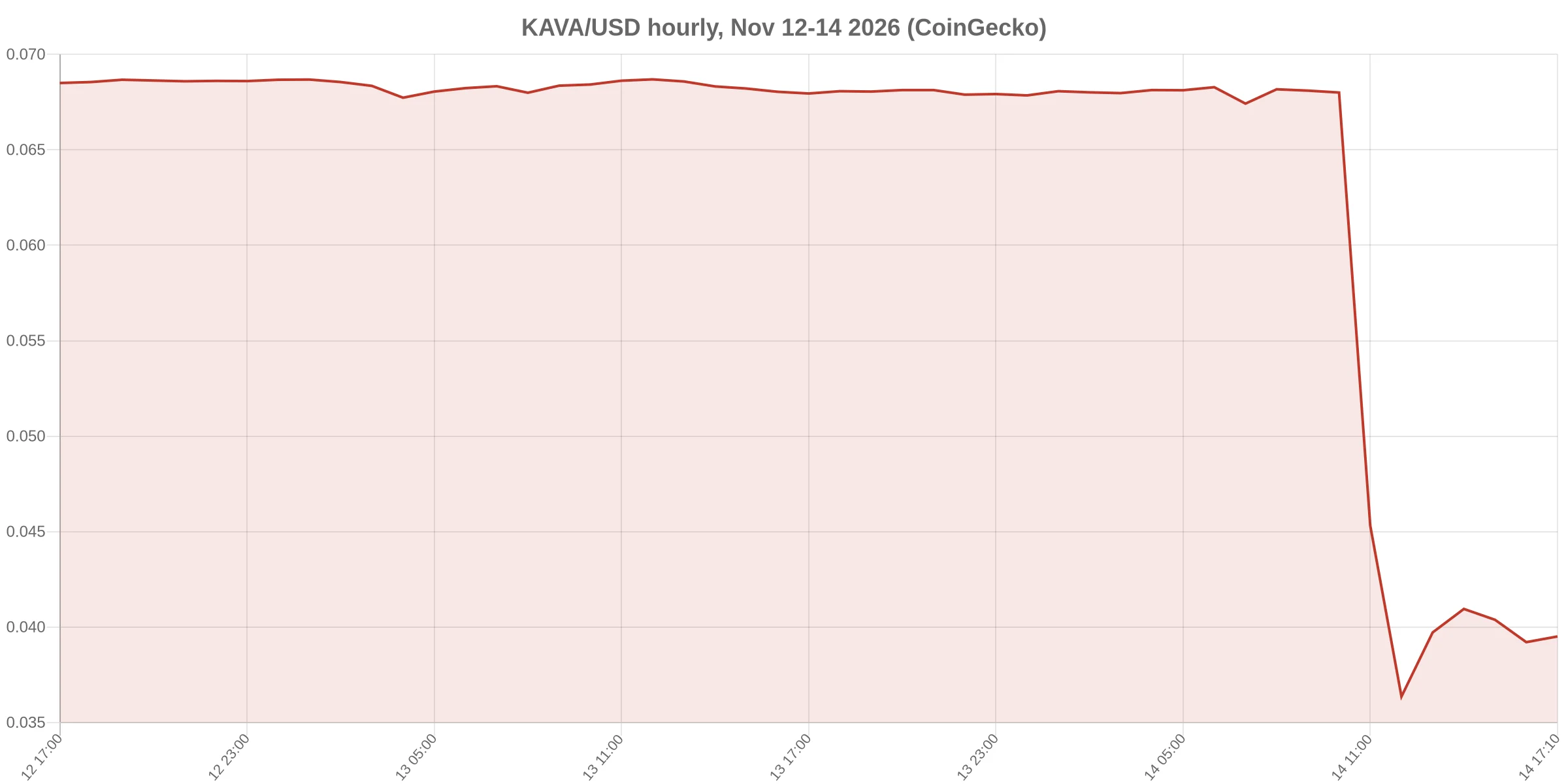
KAVA/USD, hourly, November 12 to 14, 2026. The break occurs in the 11:00 UTC hour of November 14.
Data: CoinGecko, DefiLlama, BscScan.
Which Levels Matter Now
Two reference points come from CoinGecko’s hourly series, and both are observations rather than forecasts. The first is $0.0364, the November 14 low printed in the 12:00 UTC reading, one minute before Kava’s clarifying post. The second is $0.0687, the November 13 high, a level the token held for roughly two days before the incident.
The distance between them, 47%, is the damage the market has priced so far. Recovering the upper reference would require traders to discount the incident entirely, which normally takes a published accounting of the loss and a clear statement that depositor funds are whole. Losing the lower reference would leave KAVA in price discovery beneath its recorded range, with the caveat that a venue-specific freeze can print prices that do not reflect the global composite.
Volume is the third input. With $51.2 million traded against a $42.9 million market cap, the float turned over once in a day. Sustained turnover at that ratio without a new low would be the first sign that forced selling has found a floor. Turnover collapsing alongside a lower low would point the other way.
What Would Change the Picture
Four disclosures would move this from an incident to an accounted loss.
The first is Kava’s own reconstruction: the amount bridged, the bridge or contract path involved, and whether backing exists for the wrapped supply on BSC. The second is Upbit’s resumption notice, which the exchange has tied to confirmed stability rather than a date. The third is movement in the BSC contract’s supply, since a fall from 90.0 million would mean wrapped tokens are being burned against redemptions and the representation is still functioning. The fourth is whether Kava Lend reopens deposits and borrowing, and on what terms.
Until then, the defensible statement is narrow. An incident inside Kava Lend coincided with the sale of bridged KAVA on BSC and a 47% drawdown from the November 13 high. Available evidence does not establish the size of any loss to lenders, the identity of the sellers, or whether the bridge’s backing is intact. Readers tracking the KAVA thesis through the cycle can compare today’s price with the scenarios laid out in our KAVA price prediction, though those projections assumed a functioning lending market.
Frequently Asked Questions
What is KAVA’s price today?
KAVA traded at $0.0395 at 17:10 UTC on November 14, down 41.9% over 24 hours, with an intraday low of $0.0364 recorded in CoinGecko’s 12:00 UTC reading. Market capitalization stood near $42.9 million on 24-hour volume of $51.2 million.
Why did KAVA crash today?
Kava said it was tracking unexpected behavior from a dApp in its ecosystem and later identified Kava Lend, its lending application, as the affected area. Upbit suspended KAVA deposits and withdrawals at 10:36 UTC and added a trading caution notice at 11:00 UTC. Kava also acknowledged on-chain activity involving the bridging and sale of KAVA tokens on BNB Smart Chain. Bitcoin fell 5.4% over the same period, far less than KAVA’s 41.9%.
Was Kava hacked, or was it an infinite mint?
Kava explicitly denied an infinite mint, saying the event is isolated and contained within Kava Lend. It has not published a root cause, a loss amount, or a contract address. The Kava chain’s bank module reported 1,082,846,850.8 KAVA in supply at 17:12 UTC, consistent with no new chain-level issuance, but that does not by itself rule out a bridge accounting failure on BNB Smart Chain.
Did Upbit delist KAVA?
No. Upbit suspended KAVA deposits and withdrawals and placed the asset under a trading caution notice. Trading continues against the pairs the exchange lists. The exchange has not given a restart date, saying transfers resume once deposit and withdrawal stability is confirmed.
Is it safe to move KAVA to an exchange right now?
Upbit’s notice says deposit return procedures and withdrawal address registration are paused while transfers are suspended, so coins sent to a frozen channel may not be credited until processing resumes. Check each venue’s own notice before moving KAVA, and treat a suspended channel as one that cannot be relied on for arbitrage or exit.
How large is Kava Lend compared with KAVA’s market cap?
DefiLlama’s latest reading for Kava Lend is $5,548,600, down from $7,418,336 on November 13. That is about 13% of KAVA’s $42.9 million market capitalization, which helps explain why the token moved far more than the protocol’s dollar-denominated balance sheet.
This article is not investment advice. It reports verified market and on-chain data as of 17:15 UTC on November 14, 2026, and the incident remains under investigation by the project and by exchanges.
