Inside KiiChain: Architecture and How It Functions Stablecoins have solved digital-dollar access — the global stablecoin market hit roughly $310 billion in Q1 2026, with 99% of it pegged to t
Inside KiiChain: Architecture and How It Functions
Stablecoins have solved digital-dollar access — the global stablecoin market hit roughly $310 billion in Q1 2026, with 99% of it pegged to the US dollar.
But dollars aren't what most people spend day to day. Latin America alone processed $324 billion in stablecoin transactions in 2025, yet payroll, supplier payments, and local trade still run in pesos, reais, and other local currencies.
KiiChain is a Layer 1 blockchain built to close that gap: an on-chain FX layer connecting global stablecoin liquidity with the local currencies emerging markets actually use.
What the Project Is and How It Works
KiiChain is a Cosmos SDK chain secured by CometBFT consensus, with dual execution environments — an EVM module for Solidity contracts and standard Ethereum tooling, and a CosmWasm module for Rust-based contracts — running side by side and able to call into each other. IBC connects it to over 100 other Cosmos-ecosystem chains.
In practice, the chain aggregates liquidity from USD stablecoins (USDT, USDC) and local fiat-backed stablecoins (COP, BRL, MXN, and others) into a single, chain-agnostic pool.
That pool is what lets swaps and settlement happen 24/7 with on-chain finality, instead of routing through correspondent banks.
Mainnet launched December 12, 2025. Staking and governance live from genesis, and a public Oro testnet has already drawn more than 366,000 participants ahead of that launch as per official website
What It Solves
Traditional FX infrastructure has four structural problems, per KiiChain's own framing: FX desks are open only a narrow slice of the day (roughly 23.8% availability), cross-border settlement often takes a day or more, spreads in emerging markets run 1–5%, and rebalancing depends on centralized banking processes between counterparties.
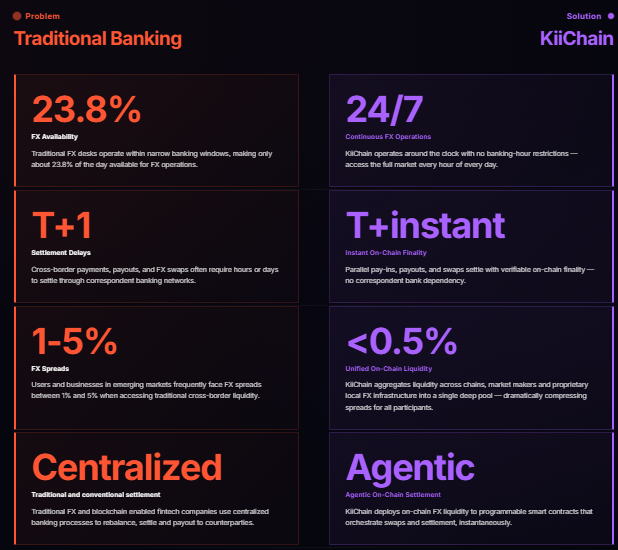
KiiChain's pitch is that these aren't patchable bugs — they're consequences of infrastructure built for a pre-internet banking system — and its answer is always-on settlement, unified liquidity to compress spreads, and parallel (not sequential) processing of pay-ins, payouts, and swaps.
The KII Token: Utility and Tokenomics
KII is the network's native asset, with a fixed maximum supply of 1,800,000,000 tokens — all minted at genesis, with minting disabled at the protocol level so supply can't expand later. Its utility centers on:
Gas — every network transaction is paid in KII
Staking — the only asset eligible for validator bonding and delegation; validators and delegators earn a share of transaction fees plus a finite, pre-allocated genesis fee pool
Governance — bonded KII carries voting rights on protocol parameters, validator set size, and upgrades (governance has no authority over KiiGlobal the company)
RWA protocol fees — applications using the Kii RWA Protocol pay usage fees in KII
Fee discounts — users who settle KiiChain App service fees in KII get a flat discount
Structurally: the validator set is capped at 25 at genesis (with room to scale toward 300), with a 50,000 KII minimum self-bond.
Governance proposals need a 20,000 KII deposit, 40% quorum, and majority Yes to pass. The whitepaper is explicit that KII carries no dividend, profit-share, redemption, or equity/debt rights — it's designed as network gas and stake, not a yield instrument.
The Public Sale
KiiChain opened its public KII sale via the Sonar platform on August 3, 2026, following 9,450 registrations since sign-ups opened July 28 — the sale runs through August 11, with the Token Generation Event expected mid-August.
Key numbers:
$26 million raised in KiiChain's private funding round (Pre-Mainnet), backed by Nimbus Capital, Super Cycle Capital, WTG Ventures, In On Capital, Kahuna, and Latam Nodes
Sale structure: fixed-price, 3 tiers, with FDV (fully diluted valuation) discounts by tier — Silver at $175M FDV, Gold at $140M FDV, Platinum at $105M FDV
Minimum participation: $10, accepting USDC and USDT
Vesting: a one-year cliff followed by two years of daily vesting for sale participants
KYC required throughout, with identity, AML, and jurisdiction-based restrictions applying
As with any pre-mainnet-maturity token, prospective buyers should treat FDV-based pricing as a valuation assumption set by the issuer, not a market-discovered price — there's currently no live secondary market for KII to benchmark against.
Roadmap
KiiChain's public roadmap shows a multi-year build-out: KiiChain Devnet and the OTC-to-KIIEX transition in earlier phases, a KIIEX beta that processed over $50 million in whitelist-only volume, a mobile wallet, and successive testnet upgrades (V1 through V3) adding the EVM module, RWA protocol, Oracle, and PayFi modules.
The current phase centers on the incentivized Oro testnet, the public sale, mainnet launch, KIIDEX integration for RWA product listings, PayFi module integration, KIIEX API expansion to 30+ countries, and pursuit of a DASP license in El Salvador covering both KIIEX and KiiChain.
Why It Stands Out in a Crowded Market
The Layer 1 space is saturated with general-purpose chains competing on the same axes — throughput, developer tooling, ecosystem incentives.
KiiChain's differentiation is narrower and more specific:
Vertical focus over general purpose. Rather than competing to be "everything infrastructure," KiiChain is built around one problem — FX settlement for emerging markets — with liquidity aggregation and stablecoin routing as first-class protocol features, not something a dApp has to build on top.
Compliance built into the base layer. KYC, KYB, and regulated-asset standards are described as protocol-level rather than bolted on, which matters for the institutional and fintech counterparties KiiChain is courting — a segment many permissionless DeFi chains aren't designed to serve.
Dual EVM/CosmWasm execution with Cosmos-native IBC. Most chains pick one execution environment; KiiChain runs both side by side with cross-calls between them, while retaining native IBC connectivity to the broader Cosmos ecosystem — giving builders more surface area without a bridge dependency for that connectivity.
Real operating history before the token. The KIIEX exchange predates the chain's public token, with cited figures like $50M+ in whitelist-beta volume, 200+ enterprise clients, and $2M in reported annual recurring revenue — traction that's unusual for a pre-mainnet Layer 1 token sale.
That said, none of this guarantees an edge.
KiiChain is competing against both general-purpose chains adding stablecoin/FX features and other emerging-market-focused projects, and its moat depends on execution — regulatory approvals in each jurisdiction, actual liquidity depth in local-currency pairs, and adoption by the fintechs and institutions it's targeting.
The mainnet is young, and much of the roadmap above is still in progress rather than delivered.
Conclusion
KiiChain is making a focused bet: instead of competing as another general-purpose Layer 1, it's building the settlement rails specifically for stablecoin-to-local-currency FX in emerging markets. With mainnet already live, real pre-token operating history through KIIEX, and a public sale now underway, the project has more traction than most pre-launch tokens. Whether that translates into lasting liquidity and adoption will depend on execution across the jurisdictions it's targeting — something only time and usage data will confirm.
Disclaimer
This article is for informational purposes only and does not constitute financial, investment, or legal advice. Cryptocurrency investments, including participation in token sales, are subject to high market risk and potential loss of capital. CoinGabbar does not endorse any specific project or token. Readers are strongly advised to conduct their own research (DYOR) and consult a qualified financial advisor before making any investment decisions.
