The fall of Bitcoin revives Robert Kiyosaki’s ambitions, but also a strategic question: how far should an investor convinced of the long-term value of an asset wait before strengthening their
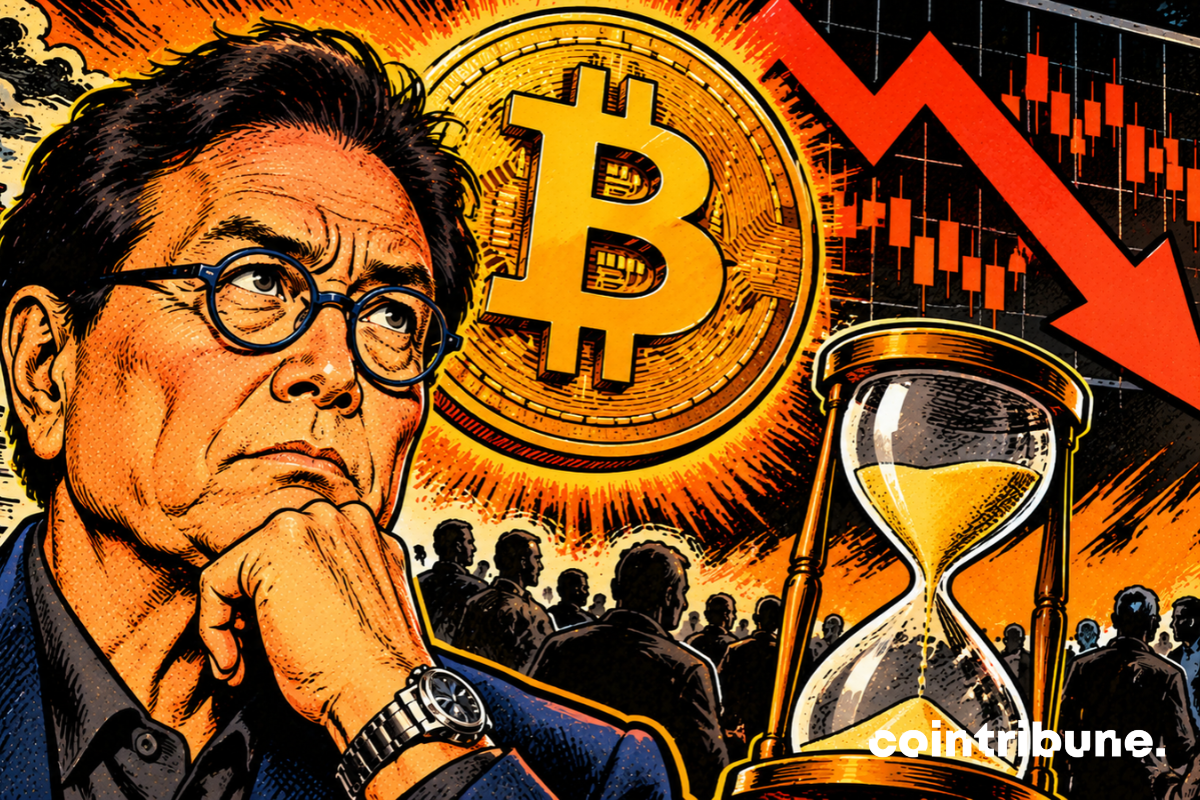
The fall of Bitcoin revives Robert Kiyosaki’s ambitions, but also a strategic question: how far should an investor convinced of the long-term value of an asset wait before strengthening their positions? On November 20, the author of “Rich Dad Poor Dad” invited buyers to wait until the end of the crash. This position reveals an interesting contradiction between his investment philosophy and the difficulty of determining the true bottom of a market.
In brief
- Robert Kiyosaki advises waiting for the crash to end before buying Bitcoin.
- His previous purchases illustrate the difficulty of choosing the right time to invest.
- Bitcoin’s scarcity remains at the heart of his conviction despite market risks.
Between long-term conviction and caution in the face of the fall, Kiyosaki changes tempo
Robert Kiyosaki remains convinced of Bitcoin’s potential. However, his latest message on X is not an invitation to immediately buy the dip. The author prefers to wait until the market has finished its correction before strengthening his positions.
Your 1st cryptos with SwissborgThis link uses an affiliate program.
To justify this caution, he reprises a well-known expression among investors: “never try to catch a falling knife”. His reasoning relies on a simple risk: buying too early during a fall may expose to further losses if sellers continue to dominate the market.
His message fits into a particularly difficult context for investors :
- Bitcoin fell below 56,000 dollars during the sharp correction phase ;
- The crypto market recorded about 2.54 billion dollars in liquidations over 24 hours ;
- Long positions accounted for nearly 2.27 billion dollars of these liquidations ;
- Gold and silver also faced selling pressure.
This simultaneity of declines shows that assets usually presented as stores of value are not spared by movements of distrust. However, for Kiyosaki, the correction does not call into question the fundamental interest of Bitcoin. It mostly changes the timing at which he wants to intervene.
His past purchases show that the entry point remains a difficult equation
The investment path claimed by Robert Kiyosaki helps better understand this strategy. The author states having started buying Bitcoin around 20,000 dollars after a previous crash. He presents this experience as an illustration of the value of waiting for markets to regain some balance before taking position.
However, his later interventions show that his purchases are not systematically limited to the bottom points. In February 2026, he notably declared having acquired a Bitcoin around 67,000 dollars when the market was already experiencing turbulence. In June and July 2025, he also mentioned new purchases at levels exceeding 107,000 and 110,000 dollars respectively.
These different prices illustrate a reality often neglected in investment discourse: even the most convinced supporters of an asset do not necessarily have a foolproof method to determine its best purchase price.
Waiting for the end of a crash can help avoid premature entry. This strategy also carries a risk: missing part of the rebound if the market recovers before investors have identified a true turnaround.
The problem is all the more important because the bottom generally only becomes obvious retrospectively. A stabilization of prices does not necessarily guarantee that sellers have finished their operations.
Is Bitcoin’s scarcity enough to justify new accumulation?
Beyond the purchase timeline, Robert Kiyosaki maintains a central argument: the limited quantity of bitcoins. The protocol sets a maximum issuance of 21 million BTC. About 20 million have already been created, which reinforces, according to him, the interest in this crypto compared to traditional currencies.
The author regularly criticizes the US Federal Reserve, banks, and bond markets. He believes that growing national debt and monetary policies weaken savers’ purchasing power. In this perspective, Bitcoin represents a monetary alternative with an offer that cannot be increased at will.
He nevertheless acknowledges that his next investment might not produce the expected results. He mentions both the possibility of a disappointing operation and that of the best investment of his life.
This reservation deserves attention. Bitcoin’s programmed scarcity guarantees neither a price increase nor protection against short-term losses. The recent correction precisely reminds that an asset’s monetary characteristics and its market behavior are two different realities.
For investors, the true lesson of Kiyosaki’s message therefore goes beyond the simple invitation to buy after a crash. It mainly reminds that believing in an asset’s potential does not exempt reflecting on the price paid, the risk borne, and the investment horizon.