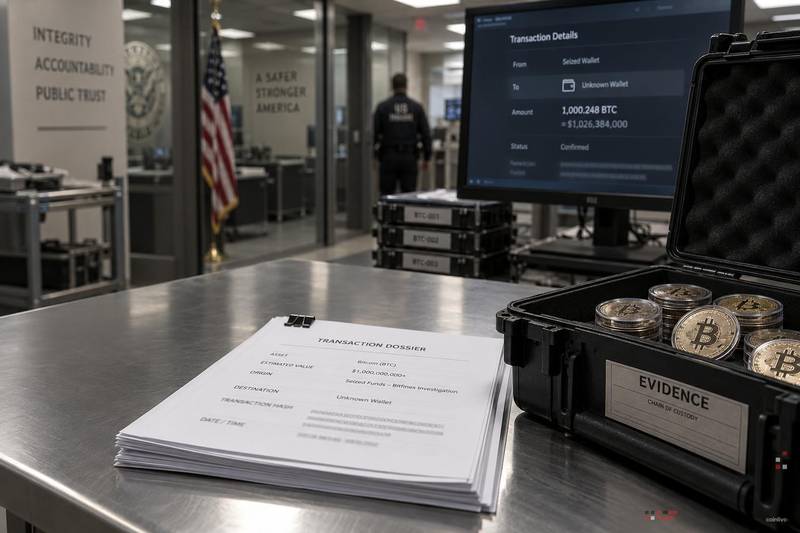
Kraken is removing 14 more crypto assets. Trading in them ends on October 23, 2026 at 4 p.m. German time, withdrawals stay open until January 29, 2027, and after that the exchange liquidates
Kraken is removing 14 more crypto assets. Trading in them ends on October 23, 2026 at 4 p.m. German time, withdrawals stay open until January 29, 2027, and after that the exchange liquidates whatever is still sitting in customer accounts. If you hold one of these tokens, two doors are open to you: sell while trading is still running, or withdraw while the payout window is still open. Let both pass and you end up with whatever the forced liquidation leaves behind, and Kraken itself writes that this proceed may be "significantly below recent reference prices" and "in some cases minimal or zero".
The affected tickers are BMB, ELX, APU, BDXN, DUCK, BOS, U, OBOL, IDEX, FIS, COPM, UXLINK, ALTHEA and NOBODY. Eleven of them have a euro pair on Kraken, which puts them directly in the accounts of European investors. We looked at how much is actually still traded in those euro pairs and which token can still be bought somewhere else after the cut-off date. The answer changes the order of the steps for several of the 14 assets.
The 14 crypto assets Kraken is removing on October 23
The exchange names fourteen tickers in its notice: BMB (Beamable), ELX (Elixir), APU (Apu Apustaja), BDXN (Bondex), DUCK (DuckChain), BOS (BitcoinOS), U, OBOL (Obol), IDEX, FIS (StaFi), COPM, UXLINK, ALTHEA and NOBODY. The notice carries an October 7 date, so it is current, and for that date it is the only authoritative source there is: an exchange decides for itself what it lists, and announces it on its own help page.
Delisting does not mean a token disappears. It continues to exist on its blockchain exactly as before. What disappears is only the one place where you could buy, sell and store it at Kraken. That distinction carries the whole decision you now face: from here on, the value of your holding depends on whether another trading venue exists, not on whether Kraken still lists it.
The mix is typical of a removal cycle. It includes two meme tokens, a staking protocol, a bridge infrastructure, an older decentralised exchange and several projects whose trading volume has melted away over months. Kraken does not justify each choice individually in the notice, but does point explicitly to "limited or inactive markets" for several of the assets.
Three dates, three consequences: trading halt, withdrawal deadline and forced liquidation
The sequence is staggered, and each of the three dates takes a different option away from you:
- October 23, 2026, 4 p.m. German time: deposits and trading are switched off. From that moment you can no longer sell the tokens at Kraken, nor deposit any more. Your holding stays visible in the account.
- January 29, 2027, 4 p.m. German time: withdrawals are switched off. Until then you can still send the tokens to your own wallet or to another exchange. After that you cannot reach them at all.
- February 1 to 12, 2027: Kraken liquidates all remaining holdings automatically and credits the proceeds.
A good three months sit between the first date and the second. That span is the real buffer, and it is routinely underestimated because the first date is so much closer. After October 23 you are not in trouble, you have only lost the option to sell at Kraken. The exchange itself advises moving affected holdings out "as early as possible", and for the assets with thin markets that is more than boilerplate.
We described what the last stage of this sequence looks like in practice during the previous cycle: how forced liquidation works at Kraken explains the mechanics step by step.
Eleven of the 14 tokens have a euro pair on Kraken
For European investors the first question is whether the token trades against the euro at all, or only against the dollar. A look at Kraken's trading pair list on Wednesday midday shows that eleven of the 14 assets have a euro pair, namely ELX, APU, BDXN, DUCK, BOS, U, OBOL, IDEX, FIS, ALTHEA and NOBODY. Only BMB, COPM and UXLINK trade exclusively against the dollar.
One detail stands out: the euro pair for BOS is already set to post only. In that state the exchange accepts only orders that will not execute immediately. Selling at the market price is therefore already impossible there, even though the official trading halt does not take effect until the end of October. If you wanted to sell BOS against the euro, you have to go through the dollar pair or withdraw the token.
All ten remaining euro pairs were still trading normally on Wednesday. That is the good news at this point, because it means the selling door is technically open. How far open it really stands only becomes clear in the next section.

Around 22,300 euros changed hands in the eleven euro pairs of the affected tokens within 24 hours, spread across 436 trades.
22,300 euros in 24 hours: how thin the euro pairs really are
We added up a full trading day's turnover for all eleven euro pairs, as of Wednesday, October 8. Together they came to roughly 22,300 euros, spread across 436 individual trades. For comparison: that is the daily take of a single busy market stall, divided across eleven trading pairs on one of Europe's largest crypto exchanges.
The distribution behind that figure is even more lopsided than the total. The strongest pair, APU against the euro, contributed roughly 12,300 euros on its own, more than half. Behind it come BDXN at around 2,600 euros and FIS at around 2,550 euros. At the other end sits OBOL against the euro with about twelve euros of turnover from five trades across an entire day. BOS against the euro recorded not a single one.
These numbers answer the question behind every delisting notice: can I get rid of my holding at all before trading closes? In a pair where five trades come together in a day, a sale of a few hundred euros is no longer something that goes through at the quoted price. A larger order eats its way down the order book, and the closer October 23 comes, the more sellers meet the same thin demand. So if you plan to sell, sell early and in parts rather than dumping everything on the final day.
Which exchange is suitable for the move depends less on the name than on whether the token is listed there at all and whether the exchange is licensed in the EU. Our crypto exchange comparison ranks the providers by fees, licensing and withdrawal routes.
What forced liquidation means and why the proceeds can be "minimal or zero"
Forced liquidation means the exchange sells your remaining holding without your involvement and credits you the proceeds. Kraken has scheduled this for the period from February 1 to 12, 2027. Formally, then, you do get money, and that is exactly what misleads people.
Kraken itself puts it unusually plainly in the notice: the proceeds may be "significantly below recent reference prices" and "in some cases minimal or zero", because several of these assets have "limited or inactive markets". The figures from the previous section show why. When twelve euros change hands in a pair on a normal day, there will be no buyer in February 2027 who takes over the pooled remaining holdings of every customer at the quoted price. In that situation the price on your account overview is an accounting figure, not a price you can actually realise.
There is also a timing effect that is easy to overlook: the liquidation falls in February 2027, and therefore in a different tax year than a sale in October 2026. What that means for you is covered in the tax section further down.
U and COPM: why two of the 14 assets cannot be pinned down cleanly
For twelve of the fourteen tokens, market value, daily turnover and trading venues can be assigned unambiguously through the usual market data sites. For U and COPM that does not work, and that is a signal rather than an omission.
Several projects use the ticker "U". A search for it leads to a token with a market value in the billions that has nothing to do with the asset traded at Kraken. Kraken's own price for U stood at $0.000262 on Wednesday. At the unit volumes traded there, that works out to a daily turnover in the low four-figure dollar range. A micro-cap, in other words, not a billion-dollar project. For COPM the price is $0.00030 and the daily turnover under a thousand dollars.
The practical lesson is a simple one: with small-cap assets, always check the contract address and not the ticker before you send a token anywhere. Two projects sharing the same ticker is the rule in crypto markets, not the exception, and a transfer to the wrong contract address cannot be reversed.

For ALTHEA, Kraken is currently the only trading venue at all; for BMB and NOBODY, only a decentralised exchange remains after October 23.
ALTHEA, BMB and NOBODY: three tokens have no second centralised exchange
The follow-up question after every delisting is: where to, then? For the twelve assets that can be identified we checked which trading venues still listed them on Wednesday. For nine of them the answer is reassuring; for three it is not.
- ALTHEA is currently listed at exactly one trading venue, and that is Kraken. After October 23 no public market remains for this token at all, neither centralised nor decentralised.
- BMB and NOBODY each sit at two venues: Kraken and one decentralised exchange. Once Kraken drops out, the only route left runs through a decentralised exchange with your own wallet.
- ELX has a second centralised exchange in Gate, and DUCK likewise. IDEX, FIS and UXLINK reach three centralised venues, BDXN four, OBOL and BOS five. APU, with thirteen trading venues, is the broadest asset in the field.
That produces a clear order of priority. With ALTHEA you decide before October 23 whether to sell the holding at Kraken or keep it afterwards as a pure blockchain position with no market access. With BMB and NOBODY you have to plan a token move to your own wallet if you want to hold them, because the route via a decentralised exchange necessarily runs through a wallet you control yourself. For the other eight, a transfer to an exchange that already lists the asset is enough.
We already worked through exactly this gap between "removed" and "not tradable anywhere else" during the 21-token cycle in September: 16 of 21 Kraken assets had no fallback exchange at the time. At three out of twelve, the October cycle is considerably milder.
Your own wallet or another exchange: the difference for the holding period
There are two routes for the move, and they differ in effort, risk and tax treatment.
The route to another exchange is the more convenient one. You need a verified account there, the right deposit address and the correct network. The most common and most expensive mistake is the wrong network: a token issued on Ethereum is lost if you send it to an address on a different chain. So always send a small test amount first, and the rest only after it arrives. Check as well whether the destination exchange holds an EU licence, because with a provider lacking European authorisation you carry the enforcement risk alone in a dispute.
The route to your own wallet is the only one that preserves your ability to trade for BMB, NOBODY and every other asset with a decentralised market. It asks more of you: you hold the access yourself, and a lost recovery phrase means total loss. Which devices are suitable and what they cost is set out in our hardware wallet comparison.
For tax purposes both routes are identical and harmless: a transfer between accounts and wallets that belong to you is not a disposal. The holding period continues unbroken and the acquisition date stays the same. All that matters is that you document the transfer, so that you can later prove to the tax office that no sale took place here.
Sale, transfer and forced liquidation: the tax consequences under section 23 of the Income Tax Act
In Germany, crypto assets count as other assets. A sale within one year of purchase is a private disposal under section 23 of the Income Tax Act; once a year has passed the gain remains tax-free. For gains inside that window an exemption threshold of 1,000 euros per year has applied since 2024: stay below it and you pay nothing, go above it and the entire amount is taxable.
That leaves three distinct situations for the 14 removed assets:
- Selling at Kraken up to October 23, 2026. If you have held the token for less than a year, the result counts towards the 2026 tax year. For most of these small-cap assets that will be a loss, and losses from private disposals can be offset against gains from other private disposals in the same year. So if you realised gains inside the one-year window elsewhere in 2026, a sale now may well be worth using.
- Transferring to your own wallet or another exchange. Not a taxable event; the holding period keeps running. You postpone the decision without triggering anything for tax.
- Forced liquidation in February 2027. This counts as a disposal as well, but it falls in the 2027 tax year and at a price you do not set. If you want to offset a loss deliberately in the current year, do not wait for it.
Each of these situations needs documentation: acquisition date, acquisition cost and the transaction itself. Kraken makes the trading history available for export, and you should pull it before the account ends rather than after. A portfolio tracker takes the matching work off your hands by merging exchange exports and wallet addresses into one continuous history. For larger amounts or an unclear acquisition history, a tax adviser is the better investment than any piece of software.
July, August, October: three Kraken cycles running with their own deadlines
This cycle is not the only one currently running, and the deadlines are easy to mix up. Kraken has announced several removal rounds since the summer; they are being processed in parallel and each carries its own cut-off dates.
The July cycle and the August cycle covered 21 assets each; their withdrawal deadlines fall in November and December 2026. We described what the August cycle looks like in an individual case using one affected token: withdrawals for VANRY are already blocked. There is no September cycle; no separate notice falls in that month. The trading halt on September 11 belonged to the previous cycle, which we reported on here: Kraken removes 21 tokens.
So always check which cycle your token belongs to before you write down a deadline. October 23 applies exclusively to the fourteen tickers named here. An asset from an earlier round may well have a different cut-off date, and a glance at the exchange's notice costs less time than a missed withdrawal.
The full breakdown with all three dates is in Kraken's own notice on the October cycle.
Kraken delisting: after October 23, withdrawal is the only option
The selling door closes on October 23, the withdrawal door only on January 29. Miss the first and you lose the choice of price; miss the second and you lose access altogether. Work through it in this order:
- Check your holdings and decide, by October 23. Look in your Kraken account to see whether any of the fourteen assets is in there. If you decide to sell, place the order early, and in parts for the thin pairs. You will find another exchange for the later move in the exchange comparison.
- Prepare the move, by mid-January at the latest. Set up the destination account or the wallet, check network and address, send a test amount and only then the rest. Which providers hold an EU licence is shown in our overview of regulated exchanges; for the route into self-custody, the hardware wallet comparison helps.
- Secure your records before the account is empty. Export the trading history as a file from your account and assign an acquisition date and cost to every position. A tax tool brings exchange exports and wallet addresses together and saves you the manual work in the spring.
A total loss is possible with small-cap assets of this size, even without anyone making a mistake. A market in which five trades come together in a day can stop existing altogether at any time.
(As of October 8, 2026. This article is not investment advice. Prices and fee structures change; check the terms with the provider before you buy.)