Why Is Kraken Rebuilding Its Trading App Around AI? Kraken is planning to relaunch its mobile app with agentic trading features at the center of the user experience, making it the latest cryp

Why Is Kraken Rebuilding Its Trading App Around AI?
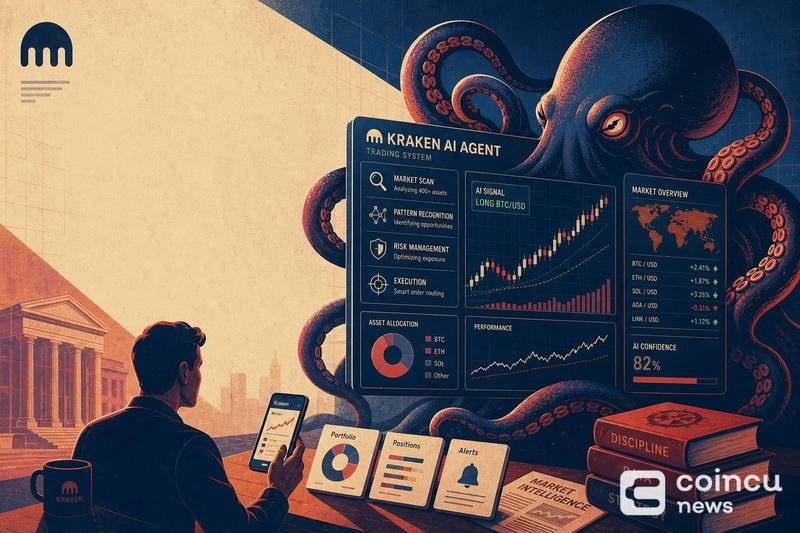
Kraken is planning to relaunch its mobile app with agentic trading features at the center of the user experience, making it the latest crypto exchange to move artificial intelligence from a support function into the trading workflow itself. The planned system will include autonomous AI agents that can monitor markets, suggest trades, and execute transactions on behalf of users. The tools are also expected to follow user prompts and learn from outcomes, giving the app a more active role in portfolio management than a standard trading dashboard or chatbot. Kraken described the relaunch as a deeper rebuild rather than an added AI layer. “Unlike other trading platforms, this won’t be an AI assistant or a copilot bolted onto the old version of the app,” the company said in a blog. “The financial intelligence is built into the fabric of Kraken itself. That’s what will make it feel alive.” The shift shows how
crypto exchanges are trying to change the way users interact with volatile markets. Instead of asking customers to move between price charts, news feeds, order tickets, and research screens, exchanges are building systems that can interpret portfolio goals, filter market information, and turn user intent into executable trading actions.
How Would Agentic Trading Change The User Experience?
Agentic trading differs from basic AI assistance because it can move beyond answering questions or summarizing information. Kraken’s planned system is designed to monitor markets in the background, respond to user goals, and provide recommendations based on portfolio context and risk preferences. That could make the trading app feel more like a managed financial interface than a self-directed exchange screen. Users may be able to set objectives, receive market insights, and allow the system to act within defined guardrails. Kraken framed the experience as one that adapts around the user from the moment the app opens. “From the moment you open the new Kraken app, it responds to you. You set what you’re working toward, and the app shapes itself around you, then works in the background around the clock to help you get there,” the company said. The model could appeal to users who want faster market interpretation but do not want to manually track every asset, headline, and technical level. It may also increase engagement by making the platform feel more personalized and less dependent on static watchlists or generic notifications.
Investor Takeaway
Kraken’s AI relaunch points to a broader change in exchange competition. Trading platforms are no longer competing only on fees, asset listings, and liquidity. They are increasingly competing on how much decision support and automated execution they can safely build into the customer experience.
Why Are Other Exchanges Moving In The Same Direction?
Kraken’s move comes as
major crypto exchanges are adding AI features to retain users and widen the role of their platforms. Gemini opened its platform and APIs to users’ agentic setups in April. Coinbase later unveiled Coinbase Advisor, an AI-powered advisory feature described as a more advanced robo-advisory tool. OKX and Binance have also been adding
AI capabilities across their platforms. The pattern reflects a clear commercial incentive. AI tools can make exchanges stickier by giving users more reasons to stay inside one platform for research, allocation, execution, and portfolio monitoring. For active traders, the value lies in faster market response. For less experienced users, the appeal is simplified decision-making and personalized guidance. But the same features also increase regulatory and operational risk. If an AI system recommends trades or executes on behalf of users, exchanges must define who is responsible for suitability, disclosures, execution quality, and losses created by automated actions. That makes guardrails, risk settings, and legal entity separation central to the product design. Kraken said investment advice on crypto assets is provided by Payward Interactive, Inc., while investment advice on securities is provided by Kraken Adviser LLC, an SEC-registered investment adviser. The company said Payward Interactive and Kraken Adviser are separate legal entities.
What Are The Risks For Users And Regulators?
The main risk is that automation can make trading easier at the same time it makes responsibility harder to assign. A user may set broad goals, but an AI agent could still recommend or execute
trades during fast-moving market conditions. That raises questions about consent, risk tolerance, explainability, and how the system responds when markets gap or liquidity deteriorates. Guardrails will be critical. Kraken’s system is expected to include safety features linked to users’ risk tolerance, which could limit how much autonomy the agent has and what kinds of actions it can take. Those controls may determine whether agentic trading becomes a mainstream exchange feature or remains a restricted tool for more sophisticated users. The timing also matters. Kraken has been launching new products across derivatives, decentralized exchange access, tokenized IPO exposure, lending programs, and other platform upgrades. The company, founded in 2011, has also been preparing for a potential public offering. For investors, the AI push adds another layer to the
crypto exchange business model. Exchanges that can combine trading, advisory tools, execution, and automation may capture more user activity and higher platform loyalty. But as AI systems move closer to actual trade execution, regulators are likely to focus more closely on disclosures, conflicts, customer protections, and the line between software support and financial advice.