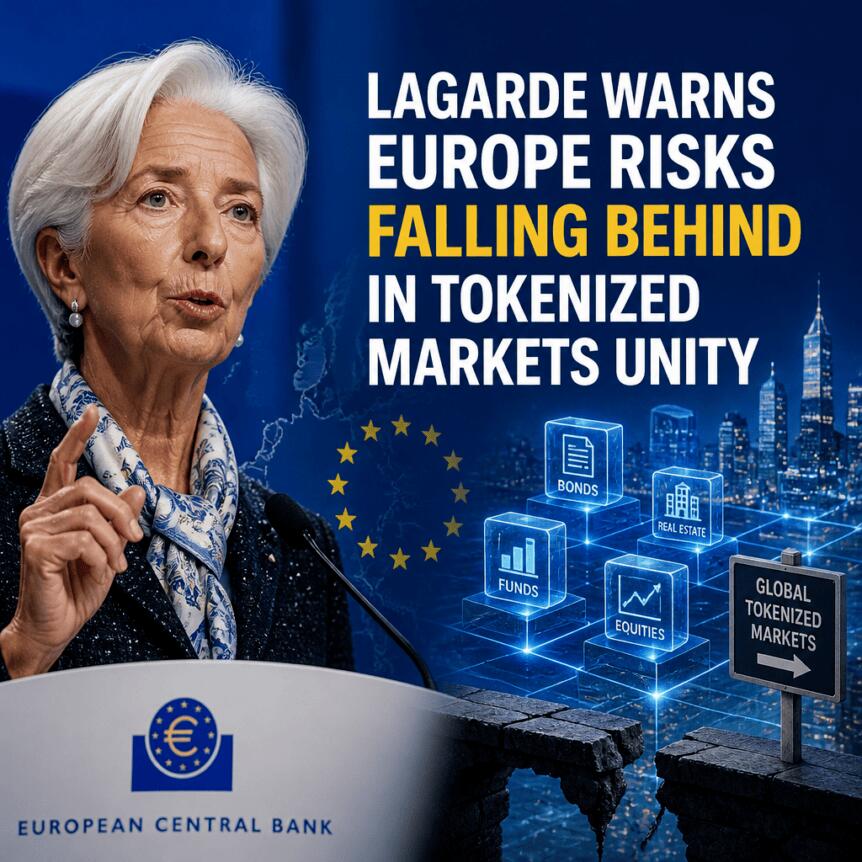
European Central Bank (ECB) President Christine Lagarde has warned that Europe risks fragmenting tokenized securities markets unless policymakers establish common rules for how these assets a
European Central Bank (ECB) President Christine Lagarde has warned that Europe risks fragmenting tokenized securities markets unless policymakers establish common rules for how these assets are issued, traded and settled. Speaking at the Frankfurt European Banking Congress on Friday, Lagarde argued that without harmonized standards, the technology behind tokenized finance could still lead to incompatible systems across trading platforms.
Lagarde tied her call for interoperability to recent growth in the sector. She said the global market for tokenized assets was worth about 23 billion euros in March—roughly five times its size a year earlier—underscoring how quickly tokenization is moving from experimentation to real-market deployment.
Key takeaways
- Lagarde said Europe needs common rules for tokenized securities to prevent incompatible standards from emerging across platforms.
- She linked the urgency to rapid market growth, citing a 23 billion euro tokenized-asset market in March.
- The ECB’s Eurosystem is using projects such as Pontes and Appia to enable settlement in central bank money and develop standards.
- Lagarde emphasized legislators’ role alongside the ECB in setting the required regulatory and governance framework.
Why interoperability is now a policy priority
Lagarde’s core message was that blockchain-based market infrastructure could, in theory, allow securities to be issued, traded and settled on a single platform. However, she cautioned that this promise depends on shared standards. As tokenized securities adoption expands, different platforms may implement different technical or regulatory requirements, making it harder—possibly impossible—for trades to clear and settle across ecosystems.
In her remarks, she framed the issue as one of market design rather than pure technology. Building a “single market” for tokenized assets, she argued, requires more than the ability to move assets on-chain; it requires rules that allow counterparties to transact and settle reliably regardless of which platform a market participant uses.
“Common rules will be needed too, and those lie with legislators,” Lagarde said, positioning the ECB’s role as complementary to broader legislative action.
Central bank money settlement with Pontes
The Eurosystem has been working to bring tokenized securities settlement closer to existing central banking infrastructure. In September, it launched Pontes, an initiative designed to give financial institutions a pathway to settle tokenized securities trades using central bank money.
Earlier in November, the European Stability Mechanism (ESM) used Pontes to settle a digital bond transaction. Lagarde said the amount was 1 billion euros (about $1.1 million), illustrating that central-bank-linked settlement is no longer limited to prototypes or small-scale pilots.
For investors and market participants, this matters because settlement finality and settlement currency are central to reducing operational and counterparty risk. If tokenized trading expands but settlement mechanisms remain fragmented, liquidity could become harder to mobilize across venues—exactly the dynamic Lagarde warned against.
Appia and the push for shared standards
Alongside Pontes, the Eurosystem is pursuing a second line of work through Appia. According to the ECB’s approach described in earlier coverage, Appia focuses on developing common standards for tokenized securities.
Lagarde said the project aims to publish a blueprint in 2028. That timeline signals that standard-setting is expected to take time—reflecting the reality that interoperability involves governance decisions, legal alignment, and technical specifications that multiple actors must accept.
What remains uncertain is how quickly those standards can be translated into enforceable requirements across jurisdictions and trading venues. Lagarde’s remarks suggest that without coordinated progress, the market could still evolve in a way where technical progress outpaces regulatory alignment—creating competing standards that later become costly to reconcile.
The growth of tokenized assets raises the stakes
Lagarde anchored her warning in the sector’s pace of expansion. She said the global market for tokenized assets stood at about 23 billion euros in March, five times the size from a year earlier. Such growth typically draws more participants and more platform development, which can accelerate innovation—but also intensify the risk of fragmentation if each new system makes its own assumptions about how tokenized assets should function.
By framing tokenization as a market-structure challenge, not just a technical one, Lagarde effectively highlighted a tension: tokenized securities are advancing through practical settlement pilots like Pontes, while the wider ecosystem still depends on common rules to scale safely and efficiently.
Her emphasis on legislators indicates that the eventual outcome will depend on how regulators translate interoperability needs into frameworks that market infrastructures must follow. The ECB can support and coordinate technical and operational development, but legal harmonization is required for platforms to connect seamlessly.
Going forward, investors and builders should watch two things: whether the standard-setting work under Appia leads to widely adopted specifications by the proposed 2028 blueprint timeline, and how lawmakers in Europe respond to Lagarde’s push for common rules that prevent settlement fragmentation across tokenized securities platforms.
This article was originally published as Lagarde Warns Europe Risks Falling Behind in Tokenized Markets Unity on Crypto Breaking News – your trusted source for crypto news, Bitcoin news, and blockchain updates.