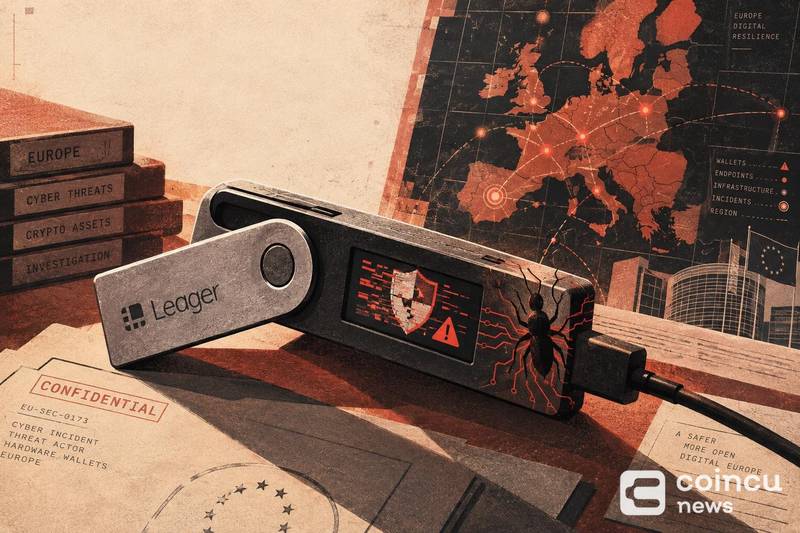
Two Ledger hardware wallet devices in Europe were reportedly found to contain spyware in what investigators are treating as a suspected supply-chain compromise, raising urgent questions about
Two Ledger hardware wallet devices in Europe were reportedly found to contain spyware in what investigators are treating as a suspected supply-chain compromise, raising urgent questions about physical device integrity for crypto holders who rely on hardware wallets as their primary security layer. No device model, discovery date, malware family, or independent technical confirmation has been provided in available reporting, and Ledger has not publicly confirmed the incident at the time of writing.
What the Reported Ledger Spyware Discovery Involves
According to the circulating report, two Ledger wallet devices located in Europe were found to contain spyware, with the incident characterized as a suspected supply-chain attack rather than a remote software vulnerability. The distinction matters: a supply-chain compromise implies that malicious code or hardware modifications were introduced before the devices reached end users, not through a firmware update pushed by Ledger after purchase. For related coverage, see XRP Ledger Confirms No New XRP Created, Fixes Vulnerabilities.
The number of affected devices cited in the report is two. Extrapolating that figure to a broader population of Ledger users or European buyers is not supported by the available information. Whether additional devices have been examined, whether the two reported units share a common distributor or reseller, and whether any user funds were accessed as a result of the spyware remain unconfirmed as of this report. For related coverage, see Bitmine Immersion Technologies (BMNR) Announces ETH Holdings Reach 6.03 Million Tokens, and Total Crypto and Total Cash & Marketable Securities Holdings of $16.2 Billion.
Ledger has previously disclosed unauthorized hardware implant activity in a separate supply-chain attack, establishing that physical tampering with its devices is not a theoretical risk. That prior disclosure involved a hardware implant rather than software-based spyware, though both attack categories exploit the same distribution pathway between manufacturer and end user.
How a Supply-Chain Compromise Can Reach a Hardware Wallet
A supply-chain attack on a hardware wallet targets the chain of custody between the point of manufacture and the moment a user first powers on the device. Because hardware wallets derive their security value from physical isolation, any compromise introduced before that first power-on can undermine the device's entire threat model without triggering standard firmware verification checks.
Potential exposure points
Possible insertion points for spyware or hardware modifications include the manufacturing facility, third-party component suppliers, packaging and fulfillment operations, logistics handlers, regional distributors, and secondary resellers including third-party online marketplaces. The current report does not identify which stage of the supply chain is implicated in the two European devices. Earlier Ledger supply-chain reporting has focused on official reseller channels in Europe as a vector, though that prior incident involved different attack mechanics.
What evidence would confirm the pathway
Determining where in the chain spyware was introduced typically requires forensic analysis of the device firmware, comparison against a known-good binary hash, examination of packaging tamper seals, and tracing the device's serial number through Ledger's distribution records. None of those forensic details are present in the current report, meaning the "suspected supply-chain" characterization is preliminary rather than confirmed.
Security Implications for Ledger Owners and Prospective Buyers
Because the spyware's capabilities have not been described in available reporting, assessing the impact on affected users is not possible at this stage. Spyware on a hardware wallet could theoretically target the private key generation process, intercept PIN entry, exfiltrate the device seed during setup, or relay signing operations to a remote party, but whether the software found on these two devices performs any of those functions is unknown.
What is confirmed is the geographic scope cited in the report: Europe. That does not establish that all European Ledger buyers are at risk, nor does it rule out affected devices in other regions. A prior Ledger supply-chain incident resulted in a reported loss of approximately $17.7 million in Bitcoin, illustrating that compromised hardware wallets can produce material financial harm when the attack reaches users who store significant holdings.
Questions users should ask before moving funds
Holders with Ledger devices purchased through resellers, secondary marketplaces, or any channel other than Ledger's direct store should verify three things before initiating any transaction: whether the device's packaging showed signs of tampering at the time of receipt, whether the device's firmware version matches the latest release listed on Ledger's official support pages, and whether any official advisory or device recall has been issued by Ledger in connection with this report. As of this writing, no such advisory has been confirmed in public channels.
What Users Can Do While the Report Is Under Investigation
Any Ledger device that exhibits unexpected behavior, shows firmware not matching Ledger's official release notes, or arrived in packaging that appeared opened or resealed should be treated as potentially compromised and taken offline. Moving funds from a potentially compromised device to a wallet generated on a clean, verified device is a reasonable precaution, but that action is irreversible: once funds move, the transaction cannot be recalled if the decision later proves unnecessary.
Under no circumstances should a recovery phrase be entered into any website, application, or support chat, regardless of whether the requester claims to be Ledger or an affiliated service. Ledger's support documentation explicitly states that the company will never ask for a seed phrase. Phishing campaigns frequently exploit high-profile hardware wallet security stories to target users who are already anxious and looking for remediation steps.
When to seek official support
Users who believe their device may be affected should document their purchase channel, order confirmation, and any packaging irregularities before contacting Ledger through its official support portal. Preserving that documentation is useful both for Ledger's internal investigation and for any potential dispute resolution. Attempting independent firmware flashing or disassembly without guidance from Ledger support risks destroying forensic evidence that investigators may need to trace the supply-chain pathway.
FAQ: Ledger Wallet Spyware and the Suspected Supply-Chain Incident
How many Ledger devices were reportedly affected?
The current report cites two devices, both located in Europe. That figure represents the number disclosed in reporting at the time of writing, not a confirmed total from a completed investigation. The actual number of affected devices could be higher or lower depending on the scope of any ongoing forensic review.
Does the report confirm that Ledger users lost funds?
No. Available reporting confirms only the presence of spyware on two devices. No confirmed account compromise, unauthorized transaction, or fund loss has been attributed to this specific incident in current reporting. The capabilities of the spyware and whether it was ever activated against the device owners are unknown.
Is every Ledger wallet or European buyer affected?
No evidence supports that conclusion. The report is geographically framed as occurring in Europe and numerically limited to two devices. Drawing broader conclusions about Ledger's entire product line or all European purchasers is not supported by the available information. Ledger manufactures millions of devices, and a two-device incident, while serious if confirmed, does not constitute a systemic product-wide compromise absent further evidence.
What should a user do if a device appears compromised?
Pause use of the device, avoid entering any PIN or recovery phrase on it or on any connected application, document the purchase history and packaging details, and check Ledger's official website and support channels for any advisory specific to this report. Do not rely on third-party instructions circulating on social media or in Telegram groups, as those environments are frequently used to distribute phishing attacks during hardware wallet security incidents.
What should buyers watch for in the coming days?
The key triggers to monitor are: an official Ledger statement confirming or denying the report, any disclosure of the device model or firmware version implicated, identification of the specific reseller or distribution channel through which the two devices were sold, and the release of technical indicators, such as a firmware hash or network address associated with the spyware, that would allow independent researchers to assess broader exposure. The absence of an official advisory from Ledger does not confirm the report is false; it means the investigation, if one is underway, has not yet produced public findings.
Additional source references: source document 1, source document 2.
Disclaimer: This article is for informational purposes only and does not constitute financial or investment advice. Cryptocurrency and digital asset markets carry significant risk. Always do your own research before making decisions.
The post Ledger Wallets in Europe Reportedly Hit by Spyware was initially published on Coincu.