Read this article on bsc.news @LidoFinance ($LDO) is the largest protocol in decentralised finance by assets held, but its governance token sits far down the market cap rankings. The gap show
Read this article on bsc.news
@LidoFinance ($LDO) is the largest protocol in decentralised finance by assets held, but its governance token sits far down the market cap rankings. The gap shows how little of a protocol's activity can reach the token that governs it.
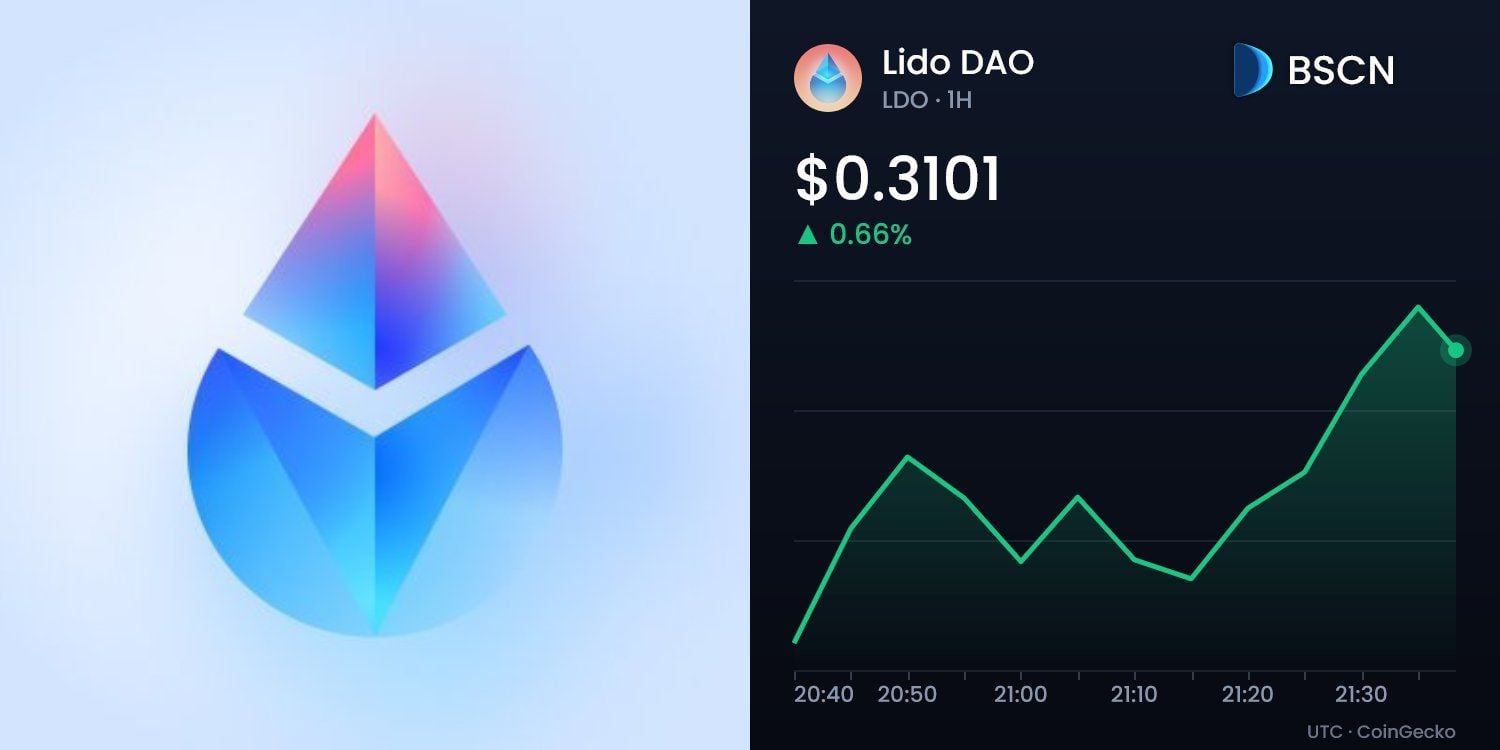
Lido holds close to $20 billion in staked assets, more than any other DeFi protocol, according to DefiLlama data. Among liquid staking protocols tracked by DefiLlama, Lido ranks #1 by TVL. $LDO trades at $0.31, giving it a market cap of about $257 million and a rank of 144th. That means the protocol holds more than 75 times the value of its token.
Most Rewards Go to Stakers
The size of the protocol does not translate into large earnings for Lido itself. In the third quarter, Lido took in $128 million in staking rewards and paid $121 million of that to stakers and node operators. That left about $7 million in earnings.
The structure explains part of the gap. LDO is the governance token of Lido, and holders vote on how the protocol runs and spends its fees.It is a separate token from stETH, with a supply of 1 billion, and it earns nothing from staking. Staking rewards accrue to holders of stETH, the token Lido issues for staked ETH, rather than to LDO holders.
DefiLlama's current figures point to the same pressure on fees. Over the past 30 days, Lido generated $55.96 million in fees, of which $3.4 million was protocol revenue.
Buybacks Step Up, but Remain Small
Lido spent $5.1 million buying back $LDO in the third quarter, up from about $2 million the quarter before. The purchases are small against the token's market value. The DAO has also looked at larger measures. In March it proposed spending up to 10,000 stETH, roughly $20 million at ether prices near $2,000, to buy its own governance token, which it described as historically depressed in value. That proposal was reported by CoinDesk.
A separate automated buyback, known as NEST, is tied to protocol revenue. It buys only from fees above $40 million a year. That threshold limits how much revenue can flow back to the token when fees are low.
For $LDO holders, the central issue is whether buybacks can grow enough to narrow the gap between the protocol's scale and the token's valuation. For now, the data show a protocol that is large by assets and small by retained earnings.
Sources
DefiLlama: Lido protocol TVL, revenue and fees
CoinDesk: Lido DAO proposes $20 million LDO buyback
Phemex Academy: What Is Lido DAO (LDO)?
See more news on bsc.news