A Malaysian man has reportedly lost $3.05 million in what he describes as a crypto wallet hack. The incident has not been independently verified, and the cause of the loss has not been confir
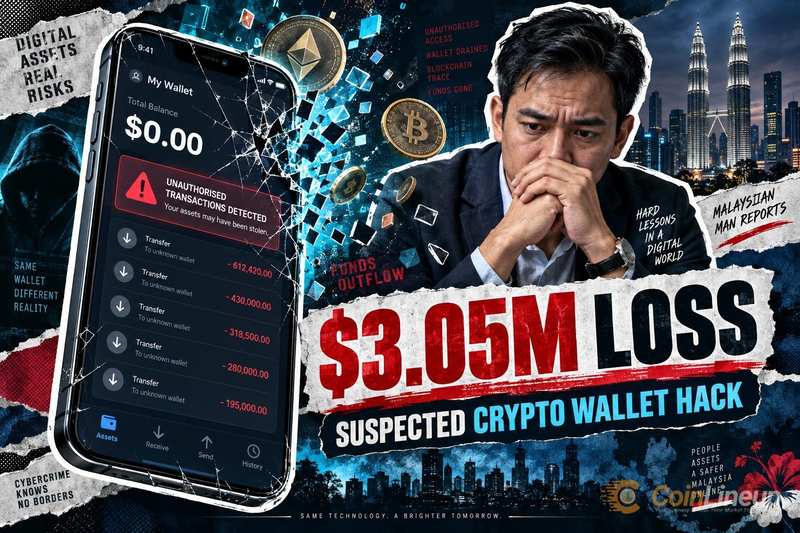
A Malaysian man has reportedly lost $3.05 million in what he describes as a crypto wallet hack. The incident has not been independently verified, and the cause of the loss has not been confirmed by investigators or official authorities at the time of writing.
What the Report Says
According to the report, the individual claims that approximately $3.05 million disappeared from his crypto wallet. He suspects the loss resulted from a hack, meaning someone may have gained unauthorized access to his wallet and transferred the funds without his knowledge. For related coverage, see XRP ETFs Keep 13-Week Inflow Streak as Rivals Lose $1.25B.
The word "suspected" is important here. It means the cause has not been officially established. No law enforcement findings, transaction records, or technical evidence have been made public to confirm how the loss occurred. For related coverage, see Ethereum Below 50-Day SMA: Selling Pressure Grows.
Details about which cryptocurrency was held, which wallet service was used, or when the alleged breach took place have not been provided in available reports. Recovery efforts and any ongoing investigation remain unclear.
Why a $3.05 Million Wallet Loss Matters for Everyday Crypto Holders
A $3.05 million loss, if confirmed, illustrates how high the stakes can be when crypto wallet security fails. Unlike a bank account, there is no customer support line that can freeze a transaction or reverse a transfer. Once crypto leaves a wallet, recovery is rarely possible without identifying the recipient.
Crypto wallets work like a personal safe with a unique key (called a private key). If someone else gets that key, they can drain the wallet completely and the original owner has no technical mechanism to stop it. This is why protecting wallet credentials is treated as the single most important security practice in crypto.
Cases involving phishing attacks, where scammers trick users into entering their wallet credentials on fake websites, have resulted in enormous losses. A probe into an $86 million theft linked to a fake Ledger hardware wallet site shows how convincing these schemes can be, even for experienced users. Similarly, COLDCARD publicly warned Bitcoin users about a phishing scam targeting wallet recovery phrases through a compromised social media account.
What Remains Unknown
Without verified transaction data, a confirmed wallet address, or an official police or cybersecurity report, key questions about this incident cannot be answered. It is not known how the attacker allegedly gained access, whether the funds have moved further, or whether any recovery is being attempted.
Attribution in crypto theft cases can take weeks or months. Blockchain analysis firms trace funds by following wallet-to-wallet movements, a process that requires time and expertise. On-chain investigators have traced funds in major cases, such as $12 million linked to the 2025 Bybit theft, but such work depends on public blockchain data that has not been released for this incident.
Until official findings are published, the $3.05 million figure and the suspected hack claim should be treated as an unconfirmed allegation, not an established fact.
Practical Steps for Anyone Holding Crypto
Incidents like this one are a reminder that crypto security is the holder's responsibility. No institution stands between your wallet and a thief. If you hold crypto, the most important protections are storing your private key or seed phrase (the 12-24 word backup phrase for your wallet) offline, using hardware wallets for large amounts, and never entering wallet credentials on any site you did not navigate to directly.
Treat any unsolicited message asking you to verify, recover, or confirm your wallet as a potential scam. Legitimate wallet providers do not ask for your seed phrase, ever.
Additional source references: source document 1, source document 2.
Disclaimer: This article is for informational purposes only and does not constitute financial or investment advice. Cryptocurrency and digital asset markets carry significant risk. Always do your own research before making decisions.
Read original article on coinlineup.com