Bitcoin miner MARA Holdings saw its shares jump in Thursday’s early trading after the company outlined a major plan to build a Texas “digital infrastructure” campus designed to support both A
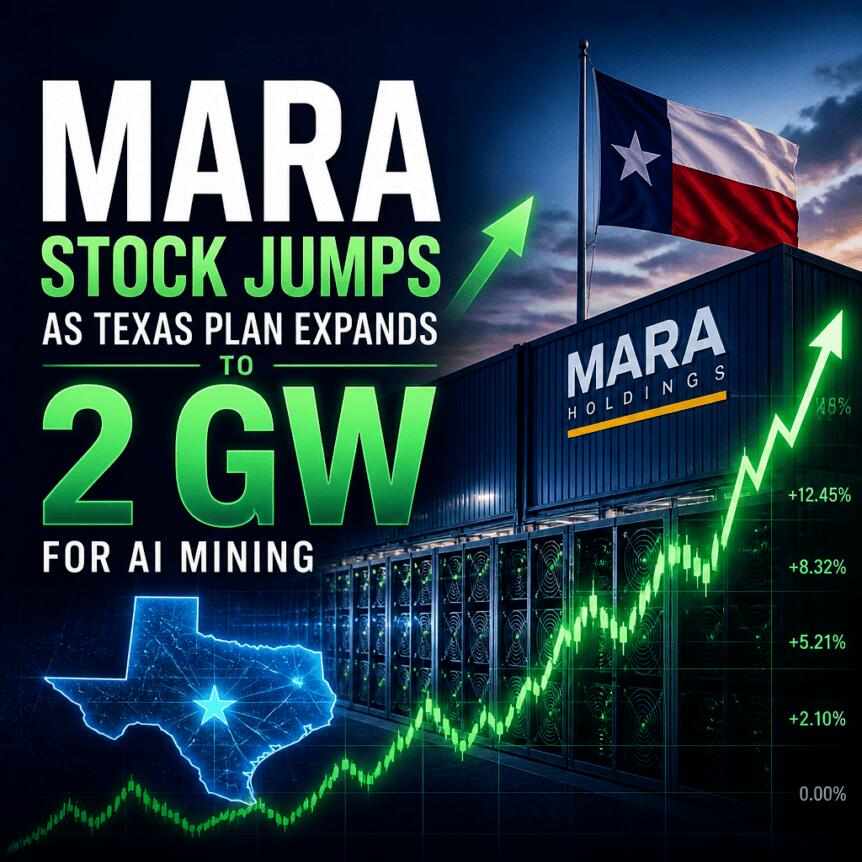
Bitcoin miner MARA Holdings saw its shares jump in Thursday’s early trading after the company outlined a major plan to build a Texas “digital infrastructure” campus designed to support both AI computing and Bitcoin mining. The move targets access to up to 2 gigawatts (GW) of power—an increasingly scarce input for AI data centers.
According to MARA, the project centers on a 1,200-acre site in Matagorda County, roughly 90 miles southwest of Houston. The company expects initial access to 1 GW of grid capacity by October 2027, with availability potentially rising to 2 GW by April 2028, enabling expansion of high-performance computing alongside mining operations.
Key takeaways
- MARA announced plans for a 1,200-acre Texas site with expected access to 1 GW of grid capacity by October 2027 and up to 2 GW by April 2028.
- The company says the campus is intended to serve both AI/high-performance computing workloads and Bitcoin mining.
- After full energization, the site is projected to more than double MARA’s potential power capacity to about 4.8 GW.
- HIF USA is set to retain a minority stake if MARA leases with a high-performance computing tenant, and neither party disclosed financial terms.
- MARA’s broader push follows earlier acquisitions, including a 505-megawatt power plant and a co-located Ohio data center deal.
A power-heavy bet on AI computing
MARA’s announcement frames the Texas campus as an infrastructure play rather than a straight mining expansion. The company described development as a “digital infrastructure campus” that can host high-performance computing capacity while also supporting Bitcoin mining once the site is fully operational.
The early-stage development plan hinges on grid access. MARA said it expects 1 GW of grid capacity by October 2027 and up to 2 GW by April 2028. If and when the project reaches full energization, it is expected to more than double MARA’s potential power capacity to around 4.8 GW.
In separate reporting on its share performance, the news also notes that MARA said the project remains subject to regulatory approvals. The company indicated construction would be phased over multiple years.
Ownership structure and leasing dependency
The project includes a relationship with HIF USA. Under the terms MARA described, HIF USA will retain a minority ownership stake if MARA signs a lease with a high-performance computing tenant.
The companies did not disclose transaction financial terms. For investors, the key variable is the leasing plan: the minority-stake condition tied to HPC tenants highlights how MARA’s AI-collocation thesis depends on securing counterparties willing to commit to capacity on the timeline needed for data center development.
How miners are repositioning toward AI and HPC
The strategy fits a broader trend in crypto infrastructure. As demand for data center capacity has surged, some Bitcoin miners have begun expanding into AI and high-performance computing rather than relying solely on mining hardware.
Instead of repurposing chips and racks built specifically for mining, these companies aim to leverage power assets already designed for crypto operations—such as grid connections, substations, and energized sites. The rationale is straightforward: AI workloads require far higher and more reliable power delivery than many mining facilities were originally built to support.
CoinShares has estimated that mining infrastructure typically costs about $700,000 to $1 million per megawatt, while liquid-cooled AI infrastructure can range from $8 million to $15 million per megawatt for hyperscale-grade requirements. These figures underline why conversions can be expensive—particularly because AI customers typically expect higher power density and uptime.
Even with the costs, multiple publicly traded miners have recently announced large AI-oriented deals. CoinShares cited expansions and lease agreements across the sector, including hosting and data center arrangements that tie miner-hosted infrastructure to AI compute demand.
MARA’s expansion stack: from power generation to computing campuses
MARA’s Texas plan follows earlier steps to strengthen its power and compute footprint. In April, the company announced it would acquire Long Ridge Energy & Power, a transaction reported at roughly $1.5 billion. That deal included a 505-megawatt gas-fired power plant and a co-located data center in Ohio.
Earlier this year, MARA also disclosed that it acquired a 64% stake in French computing infrastructure operator Exaion. Taken together, the acquisitions and the new Texas site suggest a continued shift toward owning or controlling the energy and infrastructure needed to support both mining and high-performance computing.
From a market perspective, the timing also matters. Many AI buildouts are constrained by permitting, grid interconnection, and power availability—areas where miners that already operate or plan energy-heavy facilities may attempt to move faster than purely new data center developers.
Sector positioning and what investors will watch next
MARA is described as the fourth-largest publicly traded corporate holder of Bitcoin by BitcoinTreasuries.NET data, holding 36,303 BTC. The company is also noted as the sixth-largest holding in the CoinShares Bitcoin Mining ETF, where it accounts for 4.76% of assets based on Yahoo Finance figures.
For the next phase of this story, the most important uncertainties are regulatory approvals and the pace of phased construction toward the stated grid milestones. Investors and operators will likely focus on whether MARA secures high-performance computing tenants early enough to align leases with the planned power ramp-up—especially since the ownership treatment with HIF USA is tied to signing such agreements.
This article was originally published as MARA Stock Jumps as Texas Plan Expands to 2 GW for AI Mining on Crypto Breaking News – your trusted source for crypto news, Bitcoin news, and blockchain updates.