Key Takeaways On Binance’s USDT perps, metals draw the most volume per asset, then oil, then equities, then altcoins. CryptoQuant’s Ki Young Ju says crypto exchanges are turning into RWA exch
Key Takeaways
- On Binance’s USDT perps, metals draw the most volume per asset, then oil, then equities, then altcoins.
- CryptoQuant’s Ki Young Ju says crypto exchanges are turning into RWA exchanges.
- The metric is volume per individual contract, not total category volume.
CryptoQuant CEO Ki Young Ju’s read is blunt: “Crypto exchanges are evolving into RWA exchanges.”
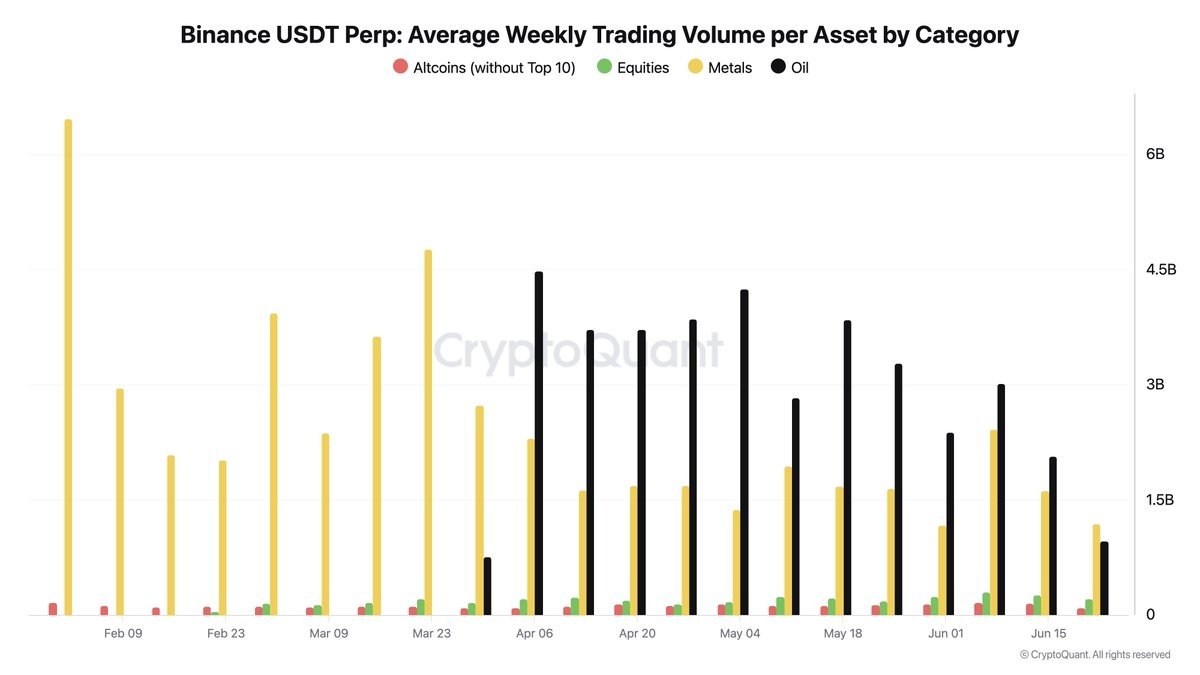
Metals led from February through late March, peaking around $6 billion per asset in early February, likely tracking gold’s rally. Oil entered meaningfully from April, reaching peaks above $4.5 billion per asset in the April-to-May window, driven by geopolitical volatility around the US-Iran situation. Both have since pulled back but remain well above altcoin volumes on a per-asset basis. The altcoin figures are barely visible throughout, consistently near zero next to the commodity categories, while equities are thin but gradually picking up as Binance expands its stock-perp listings.
Why “Per Asset” Is the Right Lens
The metric matters here. Binance lists hundreds of altcoin perps, so measuring total altcoin volume would inflate the comparison. Ki Young Ju instead measures average volume per individual contract, which normalizes for the number of listings and reveals where real demand concentrates. On that basis, a single oil or gold perp attracts more trading activity than the average altcoin perp by a wide margin.
Binance was built as a crypto exchange, but its derivatives infrastructure is now being used more intensively for traditional commodity and equity exposure than for most of its crypto listings. The platform hasn’t changed, trader behavior has. Users are coming to a crypto exchange to trade gold and oil, settling in USDT, because the 24/7 access, leverage, and low friction beat traditional commodity futures for a global retail and semi-institutional audience.
That’s the heart of Ju’s framing. As he puts it, “crypto exchanges are evolving into RWA exchanges,” not because crypto is losing relevance on these platforms, but because the platforms themselves are becoming broader financial infrastructure. The same rails built for speculative tokens are now carrying gold, oil, and stocks, and the volume says traders prefer them that way. It’s one more sign that the line between crypto venues and traditional markets is quietly dissolving, from the inside out.
READ MORE:
 Bitcoin and Ethereum Bounce After a $1 Billion Liquidation Day
The Bigger Migration
This Binance snapshot fits a broader 2026 shift. Research from Crypto.com on real-world-asset perpetuals frames the trend as crypto exchanges absorbing liquidity that used to sit in traditional venues, driven by the capital efficiency of crypto-native rails: round-the-clock access, leverage, and stablecoin settlement that sidesteps the friction of rolling legacy futures contracts.
According to that research, the shift may run deeper than convenience. It argues these RWA perpetuals have started acting as a kind of leading indicator, capturing price discovery on weekends when traditional commodity markets are closed, and signaling the direction of Monday’s opening prices in legacy markets with notable accuracy. If that holds, instruments built on crypto exchanges would be helping set the tone for the very TradFi benchmarks they mirror, a reversal of the usual direction of influence. That’s the report’s finding rather than a settled fact, but it points to how seriously the migration is being studied.
The scale backs the framing. The report notes monthly volume for these “TradFi perps”, metals, oil, and equity indices, crossed the $100 billion mark in early 2026, with per-asset volume now dwarfing the average altcoin. Stablecoins like USDT and USDC act as the universal settlement layer, removing the need for off-ramps or wire transfers, and as exchanges keep prioritizing these products, from commodity perps to pre-IPO contracts, the platform’s identity is pivoting from a crypto-only venue toward something closer to a global clearinghouse for real-world-asset volatility.
This article is for informational purposes only and does not constitute financial advice. Consult a professional before making investment decisions.The post Metals and Oil Now Out-Trade Most Altcoins on Binance appeared first on Coindoo.