Michael Saylor has entered Bitcoin’s governance dispute, warning that consensus changes aimed at unwanted blockchain data may create a larger problem. His criticism comes as BIP-110 approache
Michael Saylor has entered Bitcoin’s governance dispute, warning that consensus changes aimed at unwanted blockchain data may create a larger problem. His criticism comes as BIP-110 approaches an activation window with weak miner backing, raising questions about network unity, transaction safety, and control over Bitcoin’s block space.
Saylor Rejects BIP-110 as an Unnecessary Fix
The proposal is a temporary soft fork designed to restrict certain forms of arbitrary data stored through Bitcoin transactions. Supporters say tighter rules would discourage inscriptions and other data-heavy activity they consider spam. Critics argue that fee-paying transactions should remain valid when they follow Bitcoin’s existing rules.
Saylor belongs to the second camp. He says BIP-110 would turn a policy disagreement into a consensus change that could reject transactions considered valid today. Bitcoin is not facing an inflation bug, broken signature system, or double-spend failure, so he believes the threshold for changing consensus must remain exceptionally high.
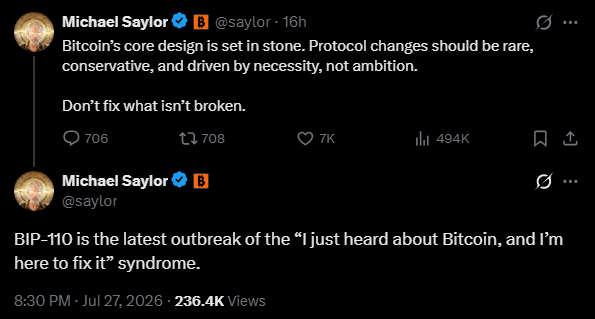
That distinction is important. Individual nodes can filter transactions from their mempools, and miners can choose what enters a block. Consensus rules go further because upgraded nodes may reject the entire block.
What the Proposal Would Change
BIP-110 would place temporary limits on transaction structures associated with large data storage. The rules affect output scripts, OP_RETURN data, and some Taproot constructions. Older unspent outputs would remain spendable under previous rules. The restrictions would expire after about 1 year unless extended.
Its authors acknowledge that the measure cannot eliminate spam completely. Determined users could disguise data as financial information or divide it across several transactions. The aim is instead to show that large file storage is not an intended Bitcoin use.
Supporters call that sensible housekeeping. Opponents see a slippery slope where subjective views about transaction purpose begin shaping consensus.
Miner Signaling Is the Critical Indicator
The clearest market indicator is miner signaling. BIP-110 sets a 55% threshold, equal to 1,109 of 2,016 blocks in a difficulty period, for miner-driven lock-in. Recent tracking has placed support far below that target, often below 1% despite brief fluctuations in shorter measurement windows.
Low signaling shows whether enough hash power is prepared to enforce the rules. Traders should watch hash rate, node adoption, exchange readiness, block signaling, transaction fees, and chain liquidity. Bitcoin’s price may stay calm until operational risk becomes visible.
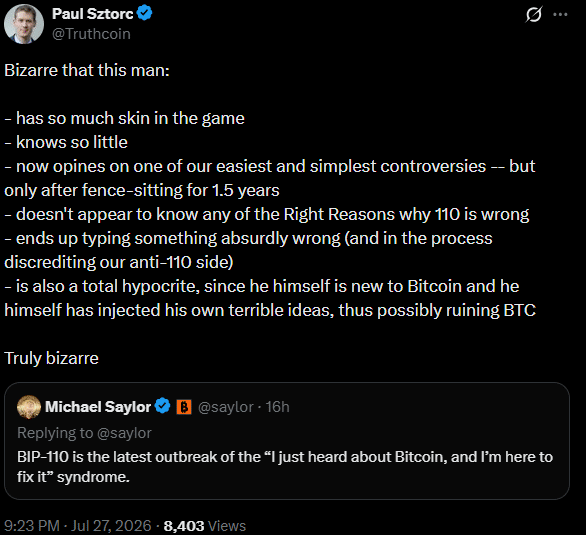
A mandatory-signaling stage is expected near block 961,632 in August 2026, with enforcement potentially following around block 965,664 in September. Nodes enforcing BIP-110 could reject non-signaling or non-compliant blocks. Without broad miner participation, the result may be a small minority chain rather than a change to Bitcoin’s dominant network.
Why a Chain Split Matters to Traders
A split could create a difficult transition. Exchanges may pause deposits and withdrawals while deciding which chain carries the strongest proof of work. Wallet providers could issue warnings, miners might reorganize blocks, and users could experience slower confirmations.
Thin order books can amplify volatility. Funding rates, futures open interest, exchange inflows, and transaction fees may offer early clues. Rising inflows can suggest selling pressure, while excessive leverage can worsen a modest move.
Weak support makes a dominant-chain takeover unlikely. The immediate risk is deadline confusion and temporary service disruption.
Bitcoin Governance Faces a Familiar Test
Who decides what Bitcoin is for? Developers write code, miners produce blocks, nodes enforce rules, and users assign value. No group has complete control, which protects decentralization but makes upgrades slow.
Saylor’s position follows a conservative principle. Consensus should change only when the threat is clear, technical agreement is broad, and the benefit outweighs fragmentation risk. Supporters respond that doing nothing is also a choice because data-heavy transactions may increase storage demands for node operators.
Conclusion
The dispute is ultimately about the limits of Bitcoin governance. Saylor sees BIP-110 as an unnecessary intervention, while supporters describe it as a temporary defense of scarce block space. With miner signaling still weak, activation faces a steep climb. Hash power, node behavior, exchange policies, and chain liquidity will show whether the disagreement remains theoretical or becomes an operational market event.
Frequently Asked Questions
What is BIP-110?
It is a proposed temporary Bitcoin soft fork that restricts certain methods of storing non-financial data.
Why does Michael Saylor oppose it?
He believes it could invalidate valid transactions without fixing a critical Bitcoin failure.
Could it split Bitcoin?
Yes. Enforcing nodes could separate from the dominant chain if miners and users follow different rules.
Glossary of Key Terms
Soft fork: A rule change that makes some previously valid blocks invalid for upgraded nodes.
Miner signalling: Information placed in blocks to show support for an upgrade.
Hash rate: The computing power used to secure Bitcoin and produce blocks.
UASF: A user-activated soft fork enforced by participating nodes on a preset schedule.
Disclaimer: This article is for informational purposes only and is not financial or investment advice. Cryptocurrency markets and protocol changes carry substantial risk.