Monero released point version 0.18.5.4 of its software on Saturday, and the price of XMR stands at $558.19, at the top of its weekly range. The two together are the occasion for this article:
Monero released point version 0.18.5.4 of its software on Saturday, and the price of XMR stands at $558.19, at the top of its weekly range. The two together are the occasion for this article: a maintenance release that leaves the network rules untouched, and a coin up 6.93 percent over the week while Bitcoin gives up 1.37 percent over the same stretch.
A point version is an interim release that fixes bugs without changing the rules of the network. If you hold XMR in self-custody, no deadline applies to you, but you should know which version you are running. If you want to buy XMR from Germany, you run into an entirely different problem, and it has nothing to do with this release.
Monero 0.18.5.4 fixes bugs in DNSSEC, checkpoints and block lists
The release is called “Fluorine Fermi, Point Release 5.4” and describes itself as a bug-fix version. Two corrections head the release notes: the daemon again validates DNSSEC signatures for checkpoints, block lists and update queries correctly, and the JSON interface again accepts numbers in text form.
DNSSEC is a signature over entries in the Domain Name System proving that an answer really comes from the responsible server and was not altered in transit. The daemon is the program that keeps a copy of the Monero blockchain in the background and coordinates with other nodes. Checkpoints are fixed verification points in the blockchain at which a node checks whether it sees the same history as the rest of the network. A block list records entries that have been reported as problematic.
A node that does not validate a signature cleanly will, in the worst case, accept manipulated checkpoints. An attacker would need control over the victim’s name resolution to pull that off, and that is laborious. The weakness is fixed now all the same.
The previous version 0.18.5.3 appeared on 6 October and was marked as strongly recommended by the developers. Eleven days lie between the two releases, a short gap for software of this kind.
The official source for the current version
The authoritative source is the project’s download page. It carries the current files for Windows, macOS, Linux and the command-line tools. Get the software only from there or from the project’s repository, never through a link in a search ad: fake wallet pages have surfaced in the top search results several times in recent weeks.
Monero price this week: $558 and a gain of 6.93 percent in seven days
XMR trades at $558.19 and €496.61 according to CoinGecko, as of Saturday morning at 8:56 a.m. German time. Over 24 hours it is down 0.17 percent, over seven days up 6.93 percent, over 14 days up 2.11 percent and over 30 days up 11.07 percent. The range in the past 24 hours ran from $545.30 to $569.82.
With a market value of around $10.5 billion, Monero ranks 13th among the largest crypto assets. Daily turnover is about $93.77 million, and 18,818,637 XMR are in circulation. That leaves it 30 percent short of the record high of $797.73 reached on 14 January 2026.
How the week compares with the broader market
The comparison is what makes this week notable. Bitcoin stands at $81,519 and is down 1.37 percent over seven days, Ethereum loses 2.68 percent, XRP 6.96 percent and Cardano 10.74 percent. Among the 25 largest crypto assets, apart from the stablecoins and the tokenised credit product Figure Heloc, only three are up on the week: TRON at 1.31 percent, LEO Token at 1.62 percent and Monero, the last of these clearly in front.
Why XMR is climbing against a falling market
No single cause can be demonstrated, and Monero has no inflow data of the kind that exists for the Bitcoin ETFs. One obvious explanation does not hold either: Zcash, the other large privacy asset, trades at $1,161.83 and is down 4.80 percent over the week. There is no question, then, of strength across the whole group.
One structural property can be demonstrated. Monero has no running calendar of token unlocks. At many younger projects, fresh supply from team and investor allocations reaches the market every week and can be sold. That pressure is absent here. It explains no single day’s move, but it does explain why an asset of this kind need give up less in weak market phases than a token with a running unlock schedule.
The levels over the longer run, not just today’s reading, are tracked on our continuously maintained Monero forecast page.
A point release without a consensus change: the difference from a network upgrade
A distinction is worth drawing here, because the two are often conflated. A network upgrade, a hard fork in technical language, changes the rules by which blocks count as valid. Anyone who does not update their software then ends up, after the cut-off date, on a blockchain the rest of the network no longer recognises. With a point release that does not happen.
The release notes for 0.18.5.4 name no consensus change and no cut-off date. The only announced break lies further ahead: acceptance of numbers in text form at the JSON interface, which this version restores, is due to disappear with version 0.19. That affects programs talking to a node over that interface, not users of an ordinary wallet.
For holders, that means no deadline is running. An up-to-date software version remains the cheapest security measure available all the same.
Monero in Germany: six large exchanges no longer list XMR
The real bottleneck for German investors lies not in the software but in access. On 5 October 2026 cryptoticker.io found that six large trading venues no longer offer XMR to customers from Germany; the details are in our article on why Monero has disappeared from the large exchanges.
The reason is regulatory, not technical. A trading venue licensed under the EU regulation on markets in crypto-assets must be able to attribute transactions to a customer. At Monero, ring signatures and encrypted amounts hide the sender, the recipient and the size of a payment. A ring signature mixes the real signer of a transaction among several possible signers, so that from outside it cannot be told which of them paid. For a supervisor who has to enforce anti-money-laundering duties, that is where the conflict arises.

In Europe it is supervisory law that decides where Monero remains tradable.
MiCA and the anti-money-laundering regulation: the 1 July 2027 cut-off
MiCA is the EU regulation on markets in crypto-assets and governs who may offer crypto services in the European Union. For Monero a second layer comes on top: the European anti-money-laundering regulation provides that from 1 July 2027 providers may no longer work with anonymity coins. An anonymity coin is a crypto asset whose protocol deliberately hides the parties to a payment and the amounts involved.
What that date means in concrete terms was set out by cryptoticker.io on 23 August 2026 using Zcash as the example; the same logic hits Monero. The order matters here: providers are meant, not ownership. A ban on holding self-custodied XMR is not in the regulation.
In practical terms this framework shifts the question from buying to custody. If the route through a licensed European exchange narrows over the medium term, what counts is how well you can manage your holdings without an exchange. An overview of the devices for that is in our hardware wallet comparison, and anyone looking for a licensed trading venue for the rest of a portfolio will find one in the overview of regulated crypto exchanges.
Self-custody of XMR: seed, view key and the software version
Monero works with two different keys, and many holders do not know the distinction. The spend key confers control over the balance. The view key allows only a look at incoming payments, without access to the money. A view key is therefore the right tool when a tax adviser or an accounting program is to get sight of the account without gaining control over it.
The recovery phrase, the seed, is 25 words long at Monero and is not interchangeable with the 12- or 24-word phrase of other wallets. Lose it and you lose the balance; store it digitally and malware will take it sooner or later. Paper or stamped metal, kept separately from the device, remains the state of the art.
What happens at the first start after an update
One point about the software version regularly causes alarm in practice. A wallet that keeps its own copy of the blockchain downloads many blocks after a longer break. Expect a wait, then, at the first start after an update before the balance is shown in full again. An empty balance in that state is normal and not a sign of a loss.
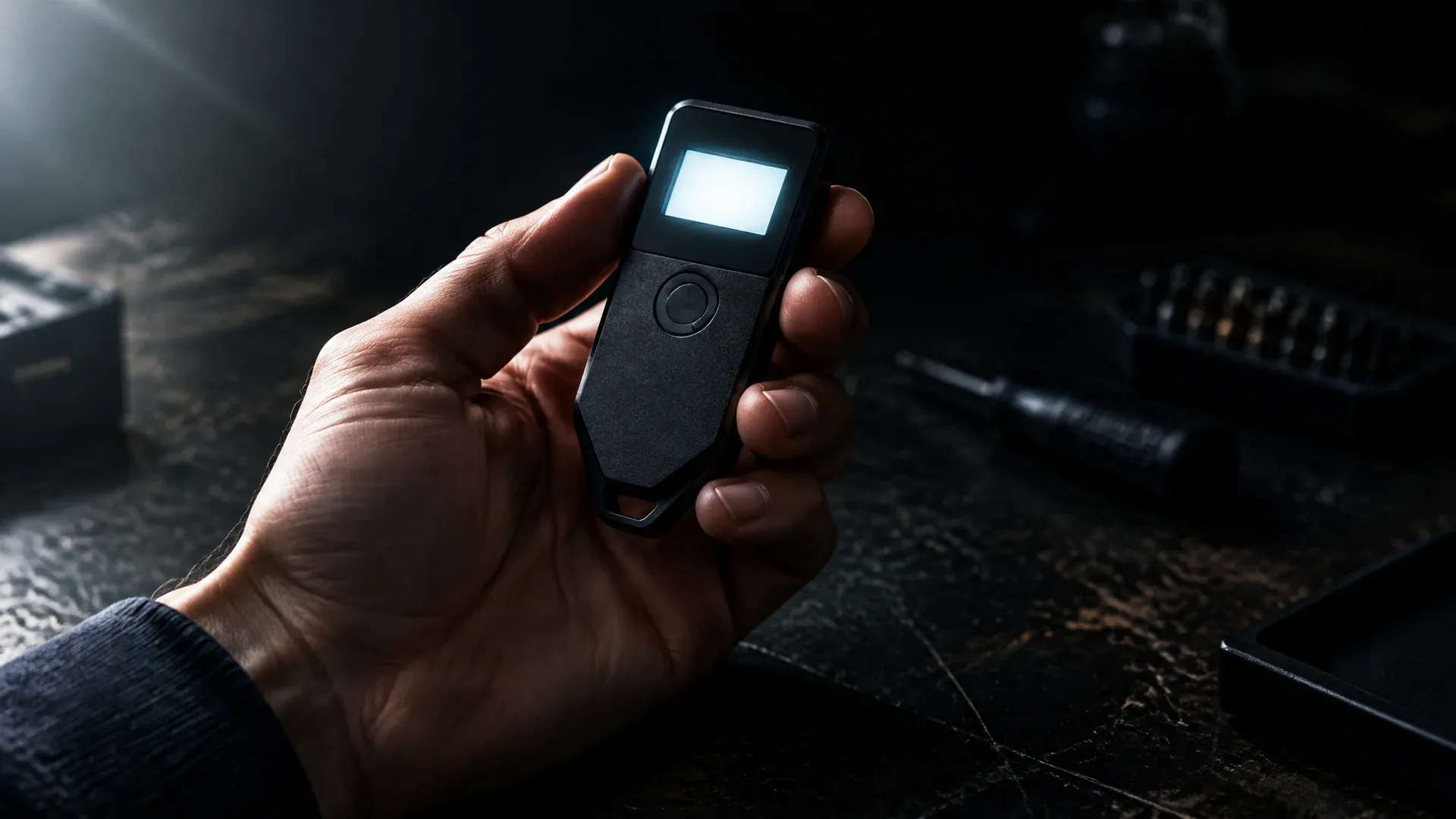
At Monero two keys separate control over the balance from mere sight of incoming payments.
Holding period and tax: how the tax office treats XMR gains
For crypto assets held privately, Germany applies the private disposal transaction under section 23 of the Income Tax Act. After a holding period of more than one year, a gain on sale is tax-free. Within the year the personal tax rate applies, provided the total of all such gains in a year exceeds the exemption threshold.
At Monero a further feature complicates the proof: the blockchain does not reveal the amounts. A holding period therefore cannot simply be documented later through a public blockchain explorer. All the more important are your own records of every inflow, every outflow and the price at the time. The view key from the previous section is the right tool for that. Which programs keep such records is shown in our overview of crypto tax tools.
Switching your own wallet, say from desktop software to a hardware device, is not a sale; the holding period keeps running.
Weekly high $558, weekly low $520: the range of the past seven days
The daily values of the past seven days give, according to CoinGecko, a weekly low of $519.73 on 11 October and a weekly high of $558.15 today, Saturday. The price therefore stands at the top of its weekly range.
As an observation, not a price target: above the current quotation lies the round $600 mark, and only then the area around the January high at $797.73. On the downside, the weekly low at $519.73 is the next point of reference; below it begins the zone from which the 30-day calculation draws its gain of 11.07 percent. Which of these levels holds is not known in advance.
Monero update: below $520 the weekly gain loses its floor
Three steps follow from this article:
- Check your software version. Look up which version your Monero wallet is running, and get 0.18.5.4 only from the official download page. If you would rather keep your holdings on a device than on your computer, the choice is in the hardware wallet comparison.
- Clarify your route of access. Before buying more, the question is whether your own trading venue still offers XMR at all, and for how long. For the rest of a portfolio, the overview of regulated crypto exchanges is worth a look.
- Catch up on your records. Note inflows, outflows and prices while they can still be attributed, because the blockchain will not supply them later. Suitable programs are listed in the overview of crypto tax tools.
(As of October 17, 2026. This article is not investment advice. Prices and fee structures change; check the terms with the provider before you buy.)