Monero fell overnight into November 15, 2026 to its lowest level since late August. The Monero price slid from $536 to $457.07 within 24 hours, a drop of 14.7 percent from high to low. By Sun
Monero fell overnight into November 15, 2026 to its lowest level since late August. The Monero price slid from $536 to $457.07 within 24 hours, a drop of 14.7 percent from high to low. By Sunday midday XMR was back at $504.01, or €457.23, according to CoinGecko, 6.1 percent below the previous day. The setback is part of the broad crypto crash that has engulfed almost every major coin since the weekend.
For investors in Europe, three questions now arise: how much further can Monero fall, how hard is the sell-off hitting leveraged positions, and where can XMR still be traded at all now that the EU is gradually narrowing the room for privacy coins at regulated providers? This article puts the day's figures in context, each with its source.
Monero price crash on November 15: price, daily range and volume
The CoinGecko data paint a clear picture. The 24-hour high was $536.00 and the low $457.07. At midday on Saturday Monero still stood around $535, and in the early evening at $508. Then things moved quickly: late on Saturday evening it was $477, at midnight $470. The intraday low came during the night, and the price has since recovered by 10.3 percent.
Market capitalisation is around $9.49 billion, and Monero worth about $168 million changed hands in 24 hours. There are 18.83 million XMR in circulation. Over seven days the coin is down 16.1 percent, over 30 days 10.2 percent. Over twelve months, by contrast, Monero is still up 21.1 percent.
We described how the previous day's move unfolded on November 14 in Monero slips below $470. Since then XMR has fallen well below the $470 mark once more and then reclaimed it.
When Monero was last this low
In CoinGecko's daily prices, the last value below today's low dates from August 28, 2026, at $454.81. The price has thus fallen back to the level from which the climb above $500 began in September. The highest daily close of the past twelve months came on January 15, 2026 at $705.59, the lowest on February 6, 2026 at $292.32.
Why is Monero falling? The sell-off across the crypto market
There is no Monero-specific trigger this weekend. Neither exchanges nor the project itself have published any news that would explain the decline. Monero is falling with the market: bitcoin lost 2.6 percent in 24 hours, ether 4.0 percent, Solana 4.4 percent and Avalanche 9.9 percent (CoinGecko, Sunday midday).
Sentiment is at rock bottom. The Fear and Greed Index from alternative.me stands at 10 points on November 15, after 13 the day before. Readings below 25 count as extreme fear. Cryptoticker summarised the reasons behind the broader market move, including concern over a further US Federal Reserve rate hike and outflows from spot ETFs, overnight into November 15 under Fed rate fears and ETF outflows. Our page on the causes of the crash gives an overview of why bitcoin is falling.
To understand how such a sell-off feeds on itself, look at liquidations. When leveraged long positions are forcibly closed, additional selling pressure builds. Our analysis from the morning of November 15 on crypto liquidations shows that mainly longs on bitcoin and ether were hit.
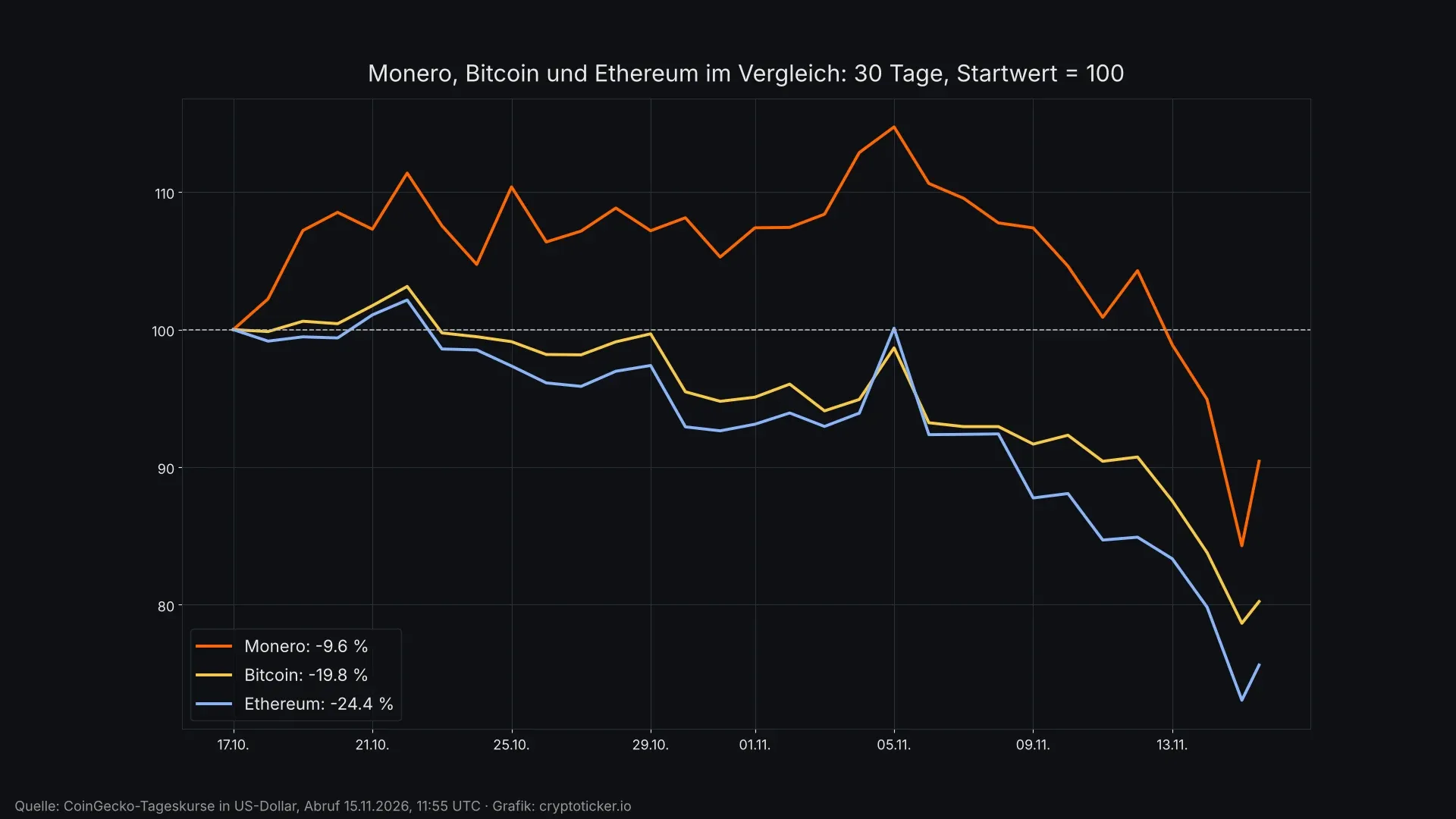
Over 30 days Monero has lost only half as much as bitcoin. Source: CoinGecko daily prices, as of November 15, 2026.
Monero vs bitcoin and Ethereum: the privacy coin holds up better
The one-month comparison stands out. Setting the price on October 17, 2026 at 100, Monero stands at around 90 on November 15, bitcoin at about 80 and Ethereum at just under 76. Measured by CoinGecko's daily prices, XMR lost 9.6 percent over this period, bitcoin 19.8 percent and Ethereum 24.4 percent.
Until November 12 Monero was even up against October 17, while the rest of the market was already sliding. That relative strength has melted away in recent days. Since November 5 the gap to bitcoin has narrowed, and the slump overnight into Sunday was sharper for XMR, at 6.1 against 2.6 percent in 24 hours, than for the largest cryptocurrency.
The data alone do not reveal a reason for the resilience so far. All that can be documented is that Monero has performed much better than most major coins over twelve months and is now 36.8 percent below its record high of $797.73 set on January 14, 2026. For comparison, bitcoin trades 48 percent below its record, according to CoinGecko.
What is Monero? Ring signatures, stealth addresses and hidden amounts
Monero (XMR) is a cryptocurrency that obscures transactions by default. A privacy coin is a cryptocurrency whose blockchain does not openly show the sender, recipient and amount of a payment. With bitcoin, by contrast, every transaction is publicly visible.
According to the project site getmonero.org, Monero relies on three techniques. Ring signatures mix the real signature in with several others, so it is impossible to tell who paid. Stealth addresses generate a one-time address at the recipient for every payment. RingCT hides the amount transferred. Together these building blocks make Monero the best-known privacy coin.
That very feature is also the biggest regulatory risk for investors. Exchanges in the EU must be able to trace payment flows, and that is hard to square with a currency that deliberately covers its tracks.
Will Monero fall below $450? Key levels from the price history
The chart does not yield a forecast, but it does yield a list of levels where buyers and sellers have met in the past. The most important lies just below the price: XMR reclaimed the round $500 mark on Sunday morning. If it holds, many traders will read the recovery from the low as a counter-move.
Below that come the intraday low of $457.07 and the daily close of August 28, 2026 at $454.81. This zone around $455 is the next support. If Monero falls below $450, the price history since August offers little support until the area around $400, which XMR last overcame in August. On the upside, the 24-hour high of $536 is the first hurdle.
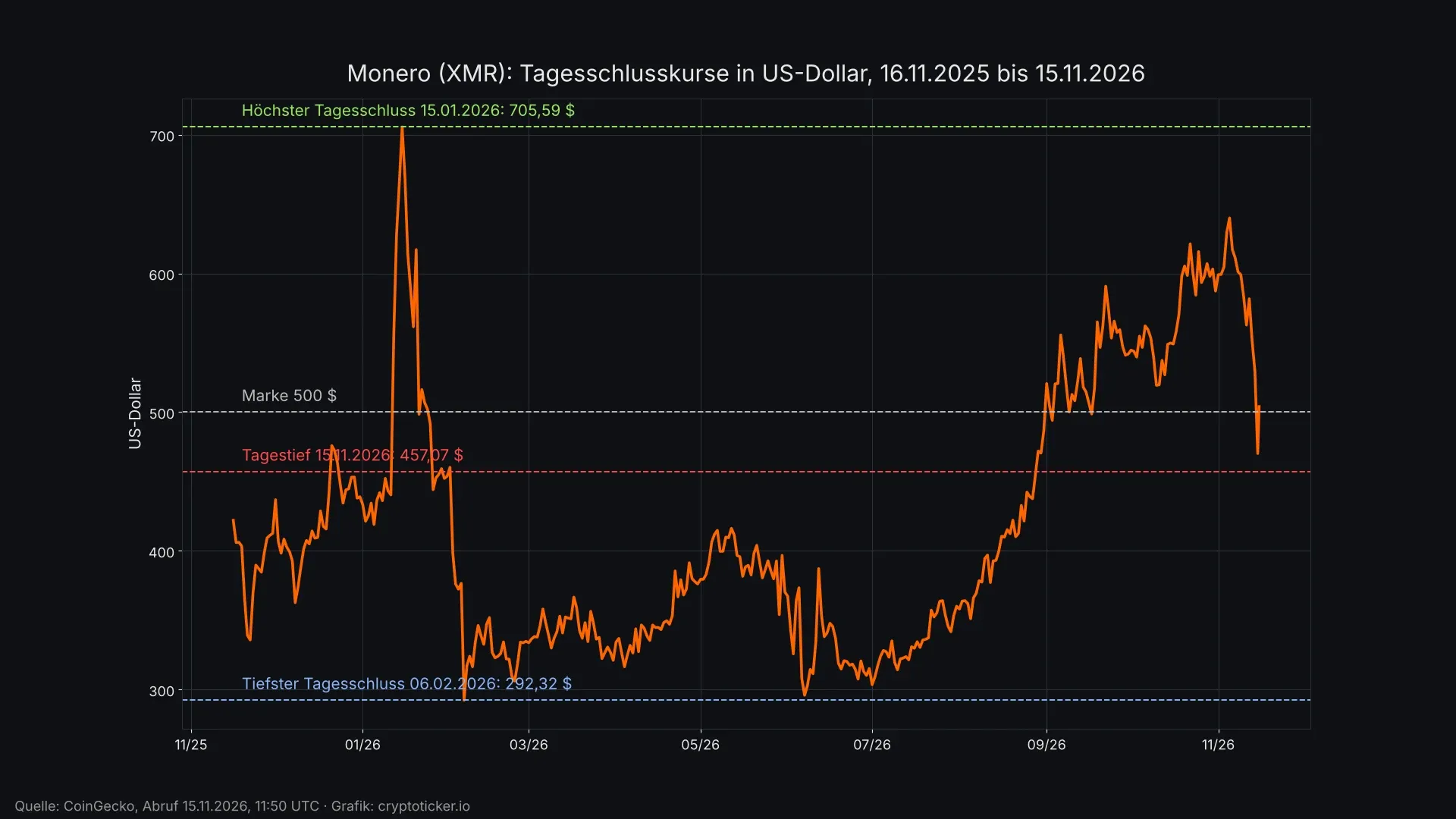
Monero over twelve months: the intraday low of November 15 is at the level of late August. Source: CoinGecko, as of November 15, 2026.
Monero derivatives: open interest and funding on Hyperliquid and Kraken
Open interest shows how much leverage is still in the market. It is the total value of all open futures contracts on a coin that have not yet been closed. You can find a detailed explanation in open interest explained.
On the decentralised derivatives exchange Hyperliquid, open interest in the XMR perpetual stood at around 182,900 XMR on Sunday midday, a good $92 million at a price of $504. Trading volume there over the past 24 hours was $69.9 million. The funding rate, the fee that the long and short sides pay each other at regular intervals, was 0.00125 percent per hour and thus slightly positive. Longs are still paying shorts, without this pointing to a pronounced bet in either direction. Hyperliquid caps leverage on Monero at five times.
On Kraken Futures, the XMR perpetual showed a 24-hour low of $454.79, a high of $535.49 and open interest of around 4,630 XMR. The large derivatives provider OKX, by contrast, offers no XMR contract.
Leverage on Monero: what 5x and 10x mean with a 14.7 percent range
The daily range from $536 to $457 shows how quickly leveraged positions disappear in a crypto crash. A long position bets on rising prices, a short position on falling ones. We explain how both work in long and short in crypto.
A worked example without fees and without maintenance margin: anyone who went long at $536 at midday on Saturday with tenfold leverage would have lost their entire stake on a 10 percent fall in price. That threshold lay at around $482 and was breached in the evening. With fivefold leverage, the theoretical limit is a 20 percent decline, around $429. The position would have survived the low but lost a good 70 percent of the stake along the way. In practice liquidation kicks in earlier because the exchange requires a minimum margin.
Conversely, a long with fivefold leverage from the low of $457 up to $504 would have returned around 51 percent on the stake. That symmetry is deceptive, because nobody knows the low in advance. Leveraged products and CFDs are complex instruments with which a large share of retail investors lose money. Only commit capital you can afford to lose.
Anyone who still wants to trade Monero derivatives will find the fees, leverage limits and security features of the decentralised providers in our comparison of the best perp DEXs. For CFDs on cryptocurrencies via a regulated broker, see the crypto broker comparison.
Trading Monero in Europe: MiCA exchanges and the EU anti-money laundering regulation
Before you buy XMR after the setback, check whether your exchange lists Monero at all. Not every regulated exchange in the EU offers privacy coins. Our overview of the best regulated crypto exchanges shows which platforms hold a MiCA licence and what they offer. What the licence means in practice for providers is covered in our article on the MiCA licence and the obligations for crypto companies.
There is also a fixed date. The EU anti-money laundering regulation (Regulation (EU) 2024/1624, AMLR for short) bars crypto service providers from keeping anonymous accounts or processing privacy coins such as Monero and Zcash. Cointelegraph reported this in May 2025, citing the regulation. According to the European Crypto Initiative, as quoted by the German-language Bitcoinblog on May 5, 2025, the rules apply from July 10, 2027. They affect providers such as exchanges and custodians, not private individuals with their own wallet.
For holders, that means Monero held at an EU exchange is a position with an expiry date, provided the provider still lists XMR today. Whether and when individual exchanges end trading earlier is up to them.
Sell or hold Monero? Two scenarios after the crash
There is no recommendation here, but there are two conditions on which you can base your decision.
Recovery scenario: Monero stays above $500
If XMR holds the reclaimed $500 mark and the broader market calms down, the plunge to $457 would have been a typical overnight sell-off that forced leveraged longs out of the market. The next hurdle would then be the previous day's high of $536. Many investors see Monero's better performance against bitcoin and Ethereum over 30 days as an argument for this view.
Continuation scenario: Monero falls below $455
If the price drops back below the zone around $455, the late-August level would be broken. The Fear and Greed Index at 10 shows that sentiment is already extremely poor. Extreme fear can lead to further forced selling before a bottom forms. We describe how earlier downturns in the broader market played out on our page on the bitcoin bear market.
Monero price: the recovery will be decided above $500
- Watch the price and the levels: see whether XMR closes above $500 or falls below $455. Put the move in context with our Monero price prediction before you trade.
- Check the exchange: make sure your provider lists Monero and holds a MiCA licence. Our crypto exchange comparison gives an overview of the platforms' fees and offerings.
- Limit leverage: if you use derivatives, work out the liquidation threshold beforehand. You will find the providers and their leverage limits in the perp DEX comparison.
(As of November 15, 2026. This article is not investment advice. Prices and fee structures change; check the terms with the provider before you buy.)