Over the past eighteen months, investors had become conditioned to think about markets through one lens: monetary policy. Every inflation report, every Federal Reserve speech and every employment number was dissected for clues about interest rates and liquidity.
Executive Summary
June 2026 did not produce a single defining event.
It produced a defining shift.
Over the past eighteen months, investors had become conditioned to think about markets through one lens: monetary policy. Every inflation report, every Federal Reserve speech and every employment number was dissected for clues about interest rates and liquidity.
That framework still mattered.
But during June, it stopped being sufficient.
Instead, the market's attention shifted toward something that had been quietly rebuilding beneath the surface: geopolitical risk.
Military tensions in the Middle East, uncertainty surrounding global energy supplies, and renewed concerns over shipping security transformed the investment landscape. Oil prices became more volatile. Inflation expectations proved stickier than many economists anticipated. Central banks found themselves navigating not only slowing economies but also rising geopolitical uncertainty.
The result was a month in which investors were forced to reassess risk across every major asset class.
Stocks no longer traded solely on earnings.
Bonds no longer moved only because of inflation.
Bitcoin no longer reacted only to crypto-native news.
June reminded markets that in an interconnected financial system, geopolitics can quickly become macroeconomics.
The Market's Biggest Story Wasn't The Fed
Entering June, the consensus was remarkably clear.
Most investors believed the second half of 2026 would be dominated by one question:
When will the Federal Reserve begin easing monetary policy?
Lower inflation, softer economic growth and slowing hiring had created optimism that interest-rate cuts were approaching.
Portfolio positioning reflected that expectation.
Technology stocks remained resilient.
Bitcoin continued attracting institutional capital.
Treasury yields drifted lower as markets anticipated easier financial conditions.
Then geopolitics returned to the center of the conversation.
Events across the Middle East rapidly displaced monetary policy as the dominant short-term market driver.
Instead of debating the next Federal Open Market Committee meeting, traders began tracking military developments, diplomatic negotiations and shipping activity around one of the world's most important energy corridors.
The market narrative had changed.
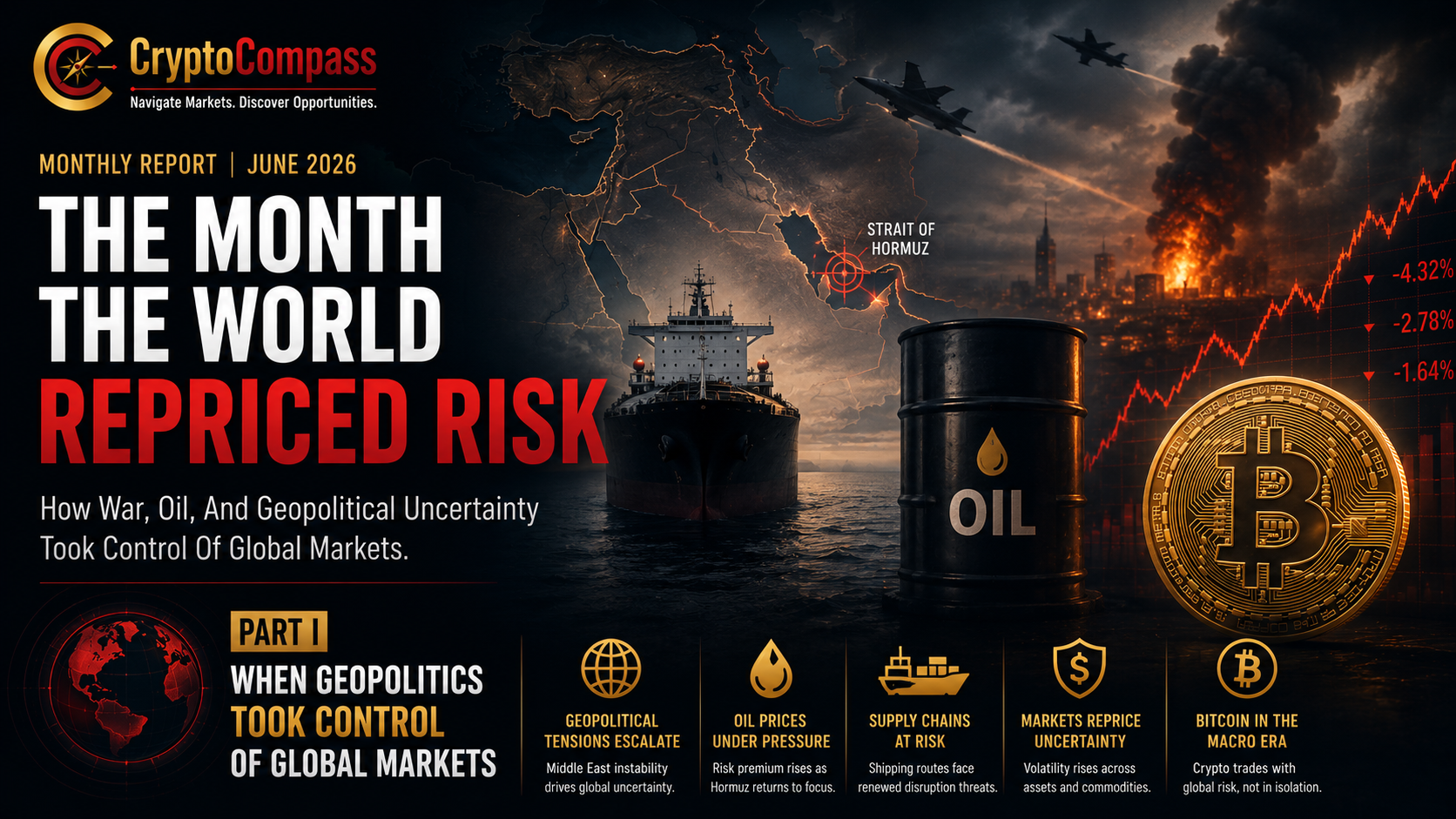
The Strait Of Hormuz Returned To The Global Spotlight
Few locations carry as much economic significance as the Strait of Hormuz.
Roughly one-fifth of global seaborne crude oil exports pass through the narrow waterway connecting the Persian Gulf to international markets.
For decades, the Strait has represented one of the world's most important geopolitical chokepoints.
Throughout June, renewed tensions involving Iran and the United States brought the region back into focus.
Although energy exports continued, markets quickly began pricing a higher geopolitical risk premium.
This distinction is important.
Financial markets do not wait for disruption.
They price the probability of disruption.
Even without a single barrel of oil being removed from the market, uncertainty alone can influence prices.
Insurance costs rise.
Shipping companies review routes.
Commodity traders demand higher compensation for risk.
Investors reduce leverage.
Capital rotates toward defensive assets.
Markets react not because supply has already changed, but because expectations have.
Oil Became A Monetary Policy Story
Oil is often viewed as a commodity.
In reality, it functions as one of the world's most important macroeconomic indicators.
Higher energy prices rarely remain confined to energy markets.
Transportation costs increase.
Manufacturing becomes more expensive.
Consumer prices rise.
Businesses face tighter margins.
Inflation expectations move higher.
Central banks become more cautious.
This chain reaction explains why oil prices matter far beyond the energy sector.
Every sustained increase in crude prices complicates the Federal Reserve's path toward lower interest rates.
A geopolitical event thousands of kilometers away can ultimately influence borrowing costs for households, corporations and governments around the world.
By the end of June, investors increasingly recognized that the road to lower interest rates would not depend solely on domestic economic data.
It would also depend on geopolitical stability.
Markets Began Pricing Probability Instead Of Reality
One of the defining characteristics of modern financial markets is that prices rarely reflect the present.
They reflect expectations about the future.
This principle became particularly evident throughout June.
Corporate earnings remained broadly resilient.
Consumer spending showed few signs of collapse.
The global economy continued expanding, albeit at a slower pace.
Yet investor sentiment became noticeably more cautious.
Why?
Because markets were not reacting to today's economic conditions.
They were pricing tomorrow's risks.
That distinction explains why periods of heightened geopolitical uncertainty often produce significant market volatility even when underlying economic fundamentals remain relatively stable.
Professional investors understand that risk management begins long before the worst-case scenario materializes.
June demonstrated exactly that behavior.
Bitcoin Is Now Part Of The Macro Conversation
Perhaps the clearest sign of crypto's maturation came from Bitcoin's behavior during June.
Previous market cycles were largely driven by internal industry narratives.
Exchange failures.
Token launches.
Regulatory announcements.
Retail speculation.
Today's Bitcoin market is fundamentally different.
Institutional ownership has expanded dramatically through spot ETFs, corporate treasury allocations and professional asset managers.
As a result, Bitcoin increasingly responds to the same macroeconomic forces influencing equities, bonds and commodities.
When geopolitical tensions pushed investors toward defensive positioning, Bitcoin experienced volatility alongside broader risk assets.
Yet it consistently outperformed many speculative segments of the digital asset market.
This divergence reinforces a broader trend that has become increasingly visible throughout 2026.
Capital is becoming more selective.
Rather than abandoning crypto entirely during periods of uncertainty, institutional investors are increasingly concentrating exposure in Bitcoin while reducing allocations to higher-risk digital assets.
That behavior would have been difficult to imagine only a few years ago.
The Return Of Risk Premiums
Throughout much of the post-pandemic recovery, investors benefited from declining inflation, improving supply chains and expanding liquidity.
Risk premiums gradually compressed across nearly every asset class.
June interrupted that trend.
Geopolitical uncertainty reintroduced variables that investors had largely discounted.
Energy security.
Shipping routes.
Military escalation.
Commodity volatility.
Inflation persistence.
These risks did not replace traditional macroeconomic indicators.
They joined them.
From this point forward, investors are likely to evaluate monetary policy through a broader framework—one that includes geopolitical developments alongside employment, inflation and economic growth.
CryptoCompass View
June will likely be remembered as the month when geopolitics reclaimed its influence over global markets.
Not because it fundamentally changed the global economy overnight.
But because it reminded investors that financial markets do not operate in isolation.
Oil influences inflation.
Inflation influences central banks.
Central banks influence liquidity.
Liquidity influences Bitcoin.
This chain of causality has become one of the defining characteristics of the current investment cycle.
For crypto investors, understanding digital assets increasingly requires understanding the forces shaping the global economy beyond blockchain itself.
June was not simply another volatile month.
It marked a shift in how risk is priced.
And that shift may define the second half of 2026.
Next in Part II: The Return of Liquidity — How softer U.S. economic data, changing expectations for Federal Reserve policy, and shifting Treasury yields reopened the debate over global liquidity and why that matters for Bitcoin, equities and digital assets.