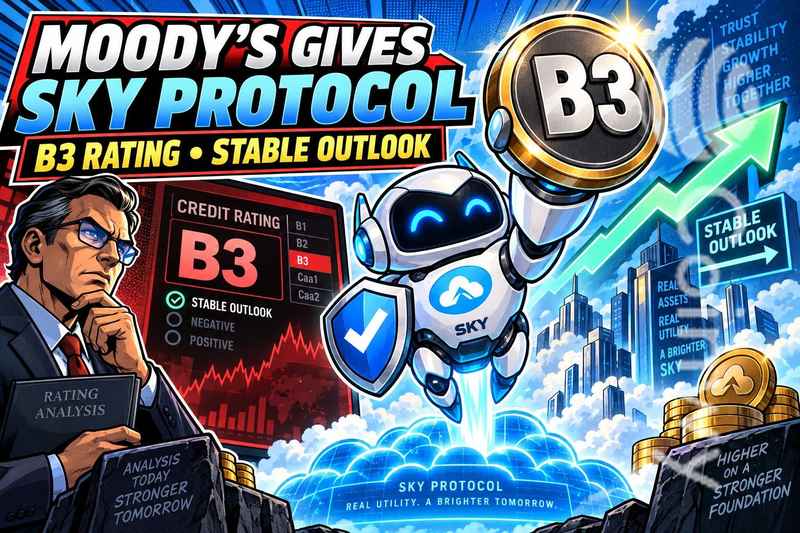
Moody's has assigned Sky Protocol a B3 issuer rating with a stable outlook, marking one of the first formal credit assessments applied to a decentralized finance protocol by a major ratings a
Moody's has assigned Sky Protocol a B3 issuer rating with a stable outlook, marking one of the first formal credit assessments applied to a decentralized finance protocol by a major ratings agency. The designation places Sky Protocol within Moody's speculative-grade tier and signals that the agency sees the issuer's financial obligations as manageable under current conditions, though not without meaningful risk.
What Moody's Assigned and What It Means
A B3 issuer rating sits in the lower end of Moody's speculative-grade scale, sometimes referred to informally as "junk" territory. It indicates that while the rated entity can meet its obligations, it faces substantial credit risk compared with investment-grade issuers. The designation is a formal opinion on creditworthiness, not a buy or sell signal for the underlying token. For related coverage, see Whale Alert Flags 614 BTC Move From Coinbase Institutional.
The stable outlook attached to the rating means Moody's does not currently expect to change the rating in the near term, barring material shifts in the protocol's financial profile or operating environment. A stable outlook can move to positive or negative if conditions change, so it carries no permanent guarantee. For related coverage, see U.S. Spot XRP ETF Crashes 40%: What Happened.
Sky Protocol is the rebranded iteration of MakerDAO, the Ethereum-based protocol behind the DAI stablecoin. Applying a traditional credit rating framework to a decentralized on-chain entity is a relatively novel exercise. The B3 designation reflects both the protocol's scale, visible in its total value locked on DeFiLlama, and the inherent uncertainties that come with assessing smart-contract-based systems under conventional credit methodology.
Why the Rating Matters for Stakeholders
For institutional investors and lenders considering exposure to Sky Protocol, a formal Moody's rating provides a standardized reference point that did not previously exist for most DeFi protocols. Credit ratings are often a prerequisite for participation by regulated financial entities, meaning the B3 designation could broaden the pool of counterparties willing to engage with the protocol formally.
At the same time, a B3 rating carries real limitations. It sits below the investment-grade threshold that many institutional mandates require, which could restrict rather than expand participation for the most risk-constrained capital allocators. The SKY token's market profile on CoinGecko gives additional context on the protocol's market standing, though a credit rating and a token's market capitalization measure different dimensions of risk. Broader stablecoin issuers are also navigating formal institutional and regulatory frameworks, as seen with Tether's MoU with Kazakhstan's National Bank to explore stablecoin frameworks.
The rating does not capture on-chain operational risk, smart contract vulnerability, or governance dynamics in the way that protocol-specific audits or on-chain analytics would. Stakeholders relying solely on the Moody's grade without examining protocol-level fundamentals, such as collateralization ratios and governance participation, would be working with an incomplete picture.
Broader Context for Crypto Credit Assessments
The Sky Protocol rating is part of a slow but visible shift toward applying traditional financial infrastructure to crypto-native entities. Stablecoin issuers, crypto exchanges, and now DeFi protocols are increasingly subject to formal credit reviews as institutional interest in the sector grows. Moves by regulated institutions into digital assets, including banks expanding crypto access to millions of retail customers, are creating downstream demand for the kind of standardized risk assessments that ratings agencies provide.
Whether the B3 rating ultimately supports or constrains Sky Protocol's institutional relationships will depend on how counterparties weight it relative to protocol-specific data. A credit rating translates DeFi risk into a language that traditional finance recognizes, but that translation remains imperfect. The stable outlook gives the protocol room to improve its standing over time. Market participants tracking large institutional crypto activity, including significant government and institutional wallet movements, will likely watch whether the rating influences on-chain behavior or protocol governance decisions in the weeks ahead.
Disclaimer: This article is for informational purposes only and does not constitute financial or investment advice. Cryptocurrency and digital asset markets carry significant risk. Always do your own research before making decisions.
Read original article on coinwy.com
Read also :