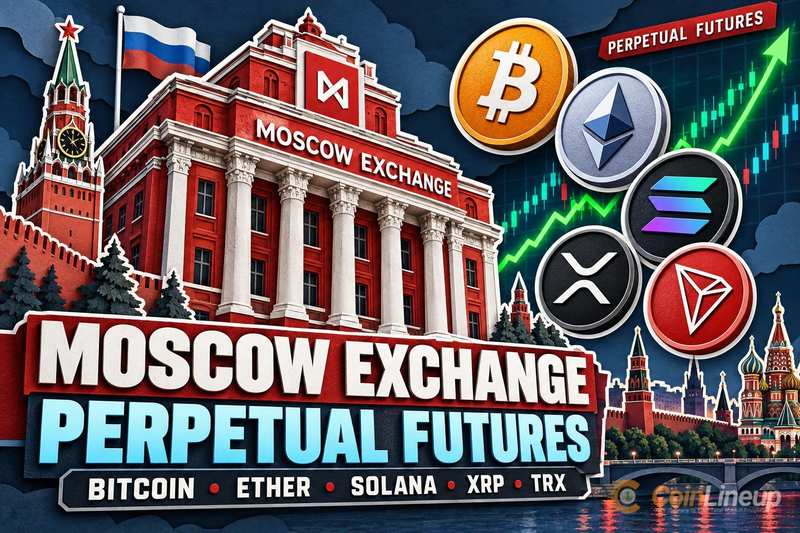
Moscow Exchange has announced plans to launch perpetual futures contracts tied to five major cryptocurrencies: Bitcoin, Ether, Solana, XRP and TRX. The proposed products would give traders on
Moscow Exchange has announced plans to launch perpetual futures contracts tied to five major cryptocurrencies: Bitcoin, Ether, Solana, XRP and TRX. The proposed products would give traders on Russia's largest stock exchange a way to speculate on crypto prices without owning the underlying assets.
What Moscow Exchange Is Proposing
Perpetual futures are a type of derivative, which is a financial contract whose value is based on something else. Unlike standard futures, perpetual futures have no expiry date, meaning a trader can hold the position as long as they choose. For related coverage, see Bitcoin ETF Outflows Erase Monday Rebound Before Fed.
Moscow Exchange has stated plans to offer these products for Bitcoin (BTC), Ether (ETH), Solana (SOL), XRP and TRON (TRX). The announcement describes a proposal, not a live product. Final contract details, including trading pairs, leverage limits, and settlement terms, have not been confirmed. For related coverage, see Celsius Estate Sues BitMEX Over $495M Bitcoin Liquidations.
This move follows the exchange's earlier steps into digital assets. Moscow Exchange previously outlined plans to build crypto indexes tracking SOL, XRP, TRX and BNB, signaling an ongoing effort to develop structured crypto products for Russian market participants.
The Five Assets in the Proposed Lineup
The five proposed underlying assets span several of the largest blockchain networks by market presence. Bitcoin and Ether are the two largest cryptocurrencies by market capitalization. Solana, XRP and TRX each represent major networks with active user bases and significant trading volume globally.
By covering all five, Moscow Exchange's proposed lineup would touch both proof-of-work and proof-of-stake networks, as well as blockchains focused on payments, smart contracts (automated programs that run on a blockchain), and high-speed transactions.
What This Could Mean for Traders
Perpetual futures let traders take a long position, betting prices will rise, or a short position, betting prices will fall, without buying the actual cryptocurrency. This is similar to how stock traders can use options or futures to gain exposure to a company without buying its shares.
However, derivatives trading amplifies both gains and losses. A position that moves against a trader can result in losses greater than the initial amount placed. Traders new to derivatives should understand that higher potential returns come with higher risk of loss.
Russia's broader regulatory direction has been moving toward structured crypto access. The Russian Central Bank proposed allowing Bitcoin, Ether and USDT trading on regulated exchanges, pointing toward an environment where licensed venues like Moscow Exchange could play a central role in how Russian residents access crypto markets.
Availability of the proposed perpetual futures products will depend on Moscow Exchange publishing final product specifications and receiving any necessary regulatory clearance. Until those details are confirmed, traders should treat this as a planned offering, not a live one.
For anyone considering crypto derivatives for the first time, understanding how futures products bridge crypto and traditional finance is a useful starting point before committing any capital.
Additional source references: source document 1, source document 2.
Disclaimer: This article is for informational purposes only and does not constitute financial or investment advice. Cryptocurrency and digital asset markets carry significant risk. Always do your own research before making decisions.
Read original article on coinlineup.com