The rule for MSCI non-operating companies decides whether a listed firm counts as a real business or behaves more like a fund. The index provider adopted it for its Global Investable Market I
The rule for MSCI non-operating companies decides whether a listed firm counts as a real business or behaves more like a fund. The index provider adopted it for its Global Investable Market Indexes. Firms that fail lose their place in benchmarks that passive funds copy. This guide explains the test for MSCI non-operating companies, its five ratios, and what the November 2026 review means for investors.
Key takeaways
- A firm fails if business assets are 50% or less of its total, and it trips 4 of 5 ratio flags.
- Current index members get looser limits and are deleted only after two failed annual filings in a row.
- Strategy, Metaplanet and Yellow Cake are set to be removed at the November 30, 2026 close.
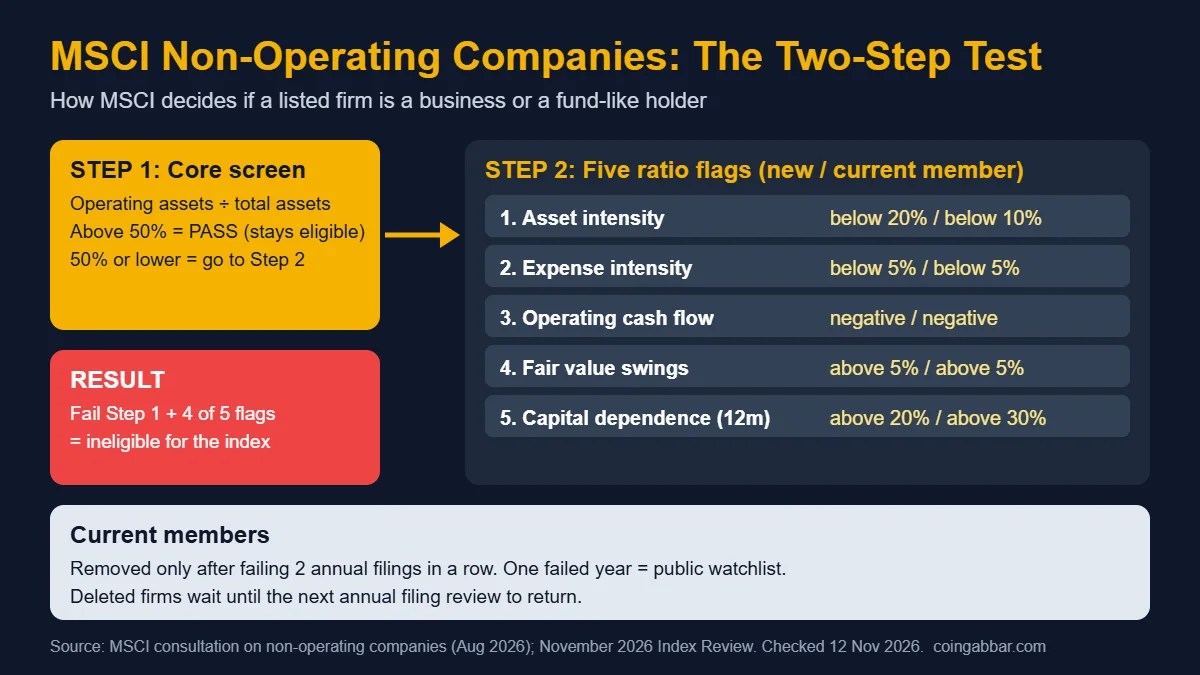
Infographic: the two-step screen and five ratio flags, as set out in the MSCI consultation of August 2026.
What Are MSCI Non-Operating Companies?
MSCI is a global index provider. Index funds and ETFs buy the stocks in the benchmarks they track, much like a crypto index fund follows a basket. A seat in a major benchmark therefore brings steady, rule-based demand for a stock.
Among MSCI non-operating companies, most of the value comes from holding assets rather than running a business. Think of a firm that raises money mainly to buy and hold Bitcoin or uranium. The rulebook describes such firms as spending little on daily operations and leaning on outside capital to grow.
Funds, investment trusts and business development companies were already kept out. The new screen adds a numbers-based check for ordinary firms that look similar. That is why it matters to every crypto treasury company listed today.
How Does the Operating Assets Ratio Work?
Step one divides a company's operating assets by its total assets. Operating assets are what a business uses to make its products. Think of plants, equipment or stock in trade.
A Bitcoin reserve held as a store of value is not part of that group. Neither is a stockpile of uranium bought to hold.
This first check for MSCI non-operating companies is a cut-off. Above 50%, the company passes and stays eligible. At 50% or lower, it moves to step two, because failing step one alone does not remove anyone.
What Are the Five MSCI Exclusion Criteria?
Step two applies five ratios, set out in the consultation document on the MSCI index consultations page.
Each ratio raises a flag when a limit is crossed.
Ratio
What it measures
Flag for new entrants
Flag for current members
Asset intensity
Operating assets / total assets
Below 20%
Below 10%
Expense intensity
Operating expenses / total assets
Below 5%
Below 5%
Cash flow
Operating cash flow
Negative
Negative
Fair value swings
Fair value gains or losses on held assets / total assets
Above 5%
Above 5%
Capital dependence
Capital raised in 12 months to buy assets / total assets
Above 20%
Above 30%
Source: MSCI consultation on non-operating companies, August 2026. Checked November 12, 2026.
Fail step one and trip at least four of these five flags, and a firm becomes ineligible under the rule for MSCI non-operating companies.
What Do the Key Terms in the Test Mean?
Fair value gains are paper profits or losses that appear when a held asset changes in price. A firm sitting on Bitcoin books large swings every quarter.
Capital dependence measures how much new money a firm raised to buy assets. Treasury firms often sell shares or bonds for exactly this purpose.
New entrants are firms not yet in the index, while current members are already inside. The two groups face different limits, as the next section shows.
How Do New Entrants and Current Members Differ?
Index providers want to avoid constant swaps in and out of their benchmarks. So firms already inside get gentler treatment.
A new entrant is judged on its latest annual filing, using the stricter limits. A current member is deleted only if it fails on its last two annual filings in a row, using the looser limits in the table.
That buffer gives members a full year to change course. It also explains why the November 2026 decisions surprised few people who had tracked the August proposal.
What Is the Watchlist and Can a Company Return?
A current member that fails on only its latest filing goes onto a public watchlist instead of being deleted. If it fails again the next year, it is removed.
In the May 2026 simulation, Center Laboratories, Lydia Holding and SharpLink were the watchlist names. SharpLink is an Ether treasury company, so the screen for MSCI non-operating companies is not limited to Bitcoin.
Re-entry is slow. A deleted company cannot be added back until the next annual filing review, and it must then pass the screen as a new entrant.
Why Were Some Firms Deleted and Others Watchlisted?
The index provider tested its ACWI IMI index using May 2026 data. That is its broadest global benchmark, covering large, mid and small caps.
Strategy, Metaplanet and Yellow Cake landed in the deletion group. A current member is deleted only when its last two annual filings both fail, and these three met that bar.
SharpLink and two other firms failed only once. So they went to the watchlist instead, with one more year to fix their numbers.
Which Companies Are Set to Leave in the MSCI Index Review?
The November 2026 review turned the simulation into real index changes. The table sums up each firm's status.
Company
Status in November 2026 review
Index affected
Simulation size
Strategy
Set to be deleted
MSCI USA
$23.9 billion
Metaplanet
Set to be deleted
MSCI Japan Small Cap
$654 million
Yellow Cake
Set to be deleted
MSCI UK Small Cap
$1.8 billion
SharpLink
Watchlist in May simulation
MSCI USA Small Cap
$165 million
Sources: May 2026 simulation and November 2026 change lists. Effective at the close of November 30, 2026.
Official change lists confirm "Strategy A" in the USA Index list.
Metaplanet and Yellow Cake appear in the small cap change list.
CoinGabbar tracked the proposal stage in an earlier index risk report.
How Would a Typical Bitcoin Treasury Firm Score?
Here is a worked example with hypothetical numbers. Picture a listed firm with $1,000 million in total assets: $900 million in Bitcoin and $60 million in a small software unit.
- Step one: operating assets are 6% of the total, far below 50%.
- Asset intensity: 6% is under both the 20% and 10% limits. Flag.
- Expense intensity: yearly costs of $30 million equal 3%. Flag.
- Cash flow: the software unit loses money. Flag.
- Fair value swings: a 20% Bitcoin move shifts value by $180 million, or 18%. Flag.
- Capital dependence: $250 million raised to buy coins is 25%. Flag for a new entrant only.
The firm trips five flags as a new entrant and four as a current member. Either way, it fails.
Most Bitcoin treasury companies keep the bulk of their balance sheet in coins, so they struggle with this test regardless of size.
What Does This Mean for Investors in India?
Indian residents can buy US or Japanese treasury company shares through global brokerage apps. They do so under the RBI's Liberalised Remittance Scheme. For them, the rules for MSCI non-operating companies matter in two ways.
First, deletion can remove a steady base of passive buyers around the rebalance date. Second, it can make fresh capital raising harder, which may slow how fast these firms add coins.
The rule does not force any company to sell its crypto. It only changes which funds hold the shares, much as rebalancing works in crypto index fund strategies.
Readers who compare these stocks by premium or discount to their holdings can use CoinGabbar's guide to mNAV in treasury companies.
Expert Opinion
The CoinGabbar research desk reads the screen as a structural line between operating businesses and holding vehicles. It is not a verdict on Bitcoin itself, and firms with a corporate Bitcoin holding strategy can still choose how they build their balance sheets.
On the bull side, firms that build real operating income could pass in later reviews. The five ratios give them a clear target. A deletion that was flagged months ahead may also be largely priced in.
On the bear side, the two-year deletion cycle and slow re-entry mean MSCI non-operating companies may stay outside for a long time. Other index providers could also adopt similar tests. That would widen the impact.
Disclaimer
This article is for information only and is not financial or investment advice. Crypto assets and listed treasury company shares are volatile, and prices can move sharply. Do your own research and consult a qualified advisor before making any investment decision.