MSCI Strategy Removal Date, Price, Impact and Bitcoin Treasury Risks The MSCI Strategy decision is now official. MSCI’s November 2026 Index Review lists Strategy (MSTR) for deletion from the
MSCI Strategy Removal Date, Price, Impact and Bitcoin Treasury Risks
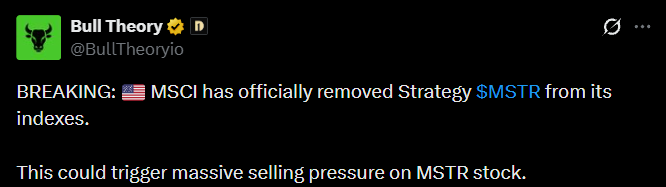
The MSCI Strategy decision is now official. MSCI’s November 2026 Index Review lists Strategy (MSTR) for deletion from the MSCI USA Index. The change takes effect after the market closes on November 30, 2026.
This matters because index funds buy and sell stocks based on index membership. Losing that status can reduce demand for MicroStrategy (MSTR) shares. It also raises questions for other Bitcoin treasury companies. The central question is simple: could index exclusion add selling pressure to MSTR?
At a Glance
MSCI confirmed Strategy’s removal from the MSCI USA Index on November 11, 2026.
The changes take effect at the close of trading on November 30, 2026.
The removal follows MSCI’s new rules for non-operating companies, adopted on October 15.
Strategy previously warned that exclusion could trigger about $2.8 billion in stock sales.
JPMorgan earlier estimated outflows could reach $8.8 billion if other index providers follow.
Metaplanet is also being removed from an MSCI index.
Why Is MSCI Removing Strategy From Its Indexes?
MSCI adopted new eligibility rules on October 15. According to the reports, the rules look at a company’s operating assets and five financial measures. They replace earlier temporary limits on firms that held at least half their assets in crypto. Reuters reports that MSCI decided these companies look more like investment funds than operating businesses.
Strategy and Executive Chairman Michael Saylor opposed the change. In a September letter, the company called the treatment of digital asset treasuries “discriminatory.” It argued that exclusion would not meaningfully affect its business. MSCI’s review documents gave no company-specific explanation for the MSCI Strategy removal.
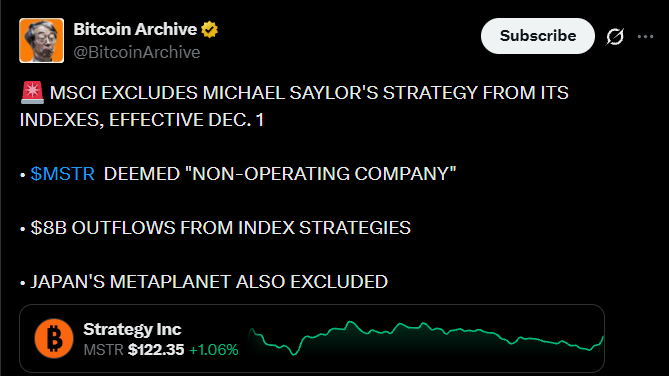
Source: Bitcoin Archive X Post
November 30 Timeline: Key Developments Behind MSCI Strategy Decision
September 2026: Strategy objects to MSCI’s proposed treatment of digital asset treasury companies.
October 15, 2026: MSCI adopts its non-operating company eligibility rules.
November 11, 2026: MSCI’s November review confirms the removal.
November 30, 2026: The index changes take effect after the market closes.
December 1, 2026: The revised index composition becomes effective.
How Much Selling Pressure Could MSCI’s Decision Create for MSTR?
Passive funds copy their index. When a stock leaves, those funds must usually sell it. This is forced rebalancing, which differs from a fund manager choosing to sell. The numbers below are projections, not confirmed sales.
Estimate
What It Means
$2.8 billion
Potential MicroStrategy stock selling tied to MSCI exclusion, as Strategy warned earlier
$8.8 billion
Potential outflows if other indexes providers exclude Strategy, per JPMorgan's earlier estimate
Passive fund rebalancing
Index-tracking funds may need to reduce or sell their MSTR holdings
Bitcoin holdings
Index-related stock sales do not force Strategy to sell its Bitcoin
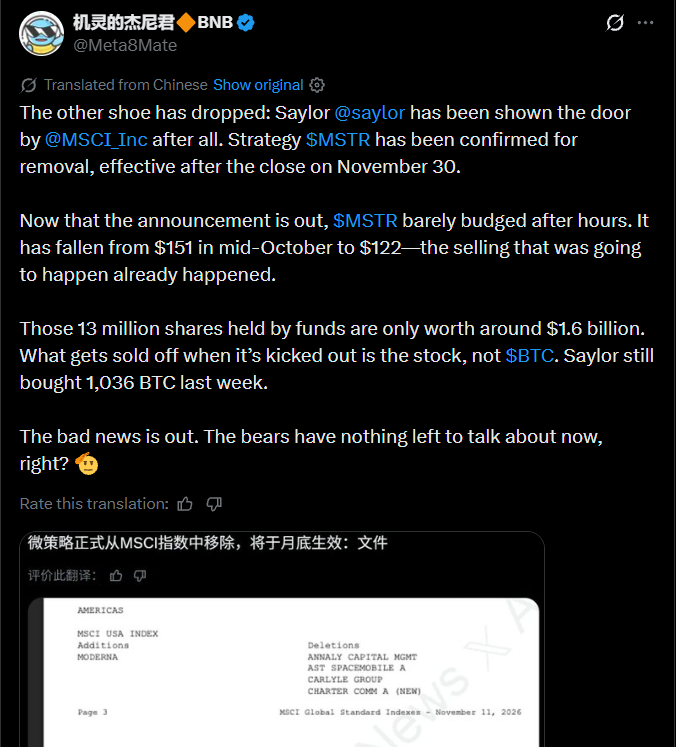
Source: X Post
MSTR Stock Price: How Is Strategy Trading After MSCI’s Announcement?
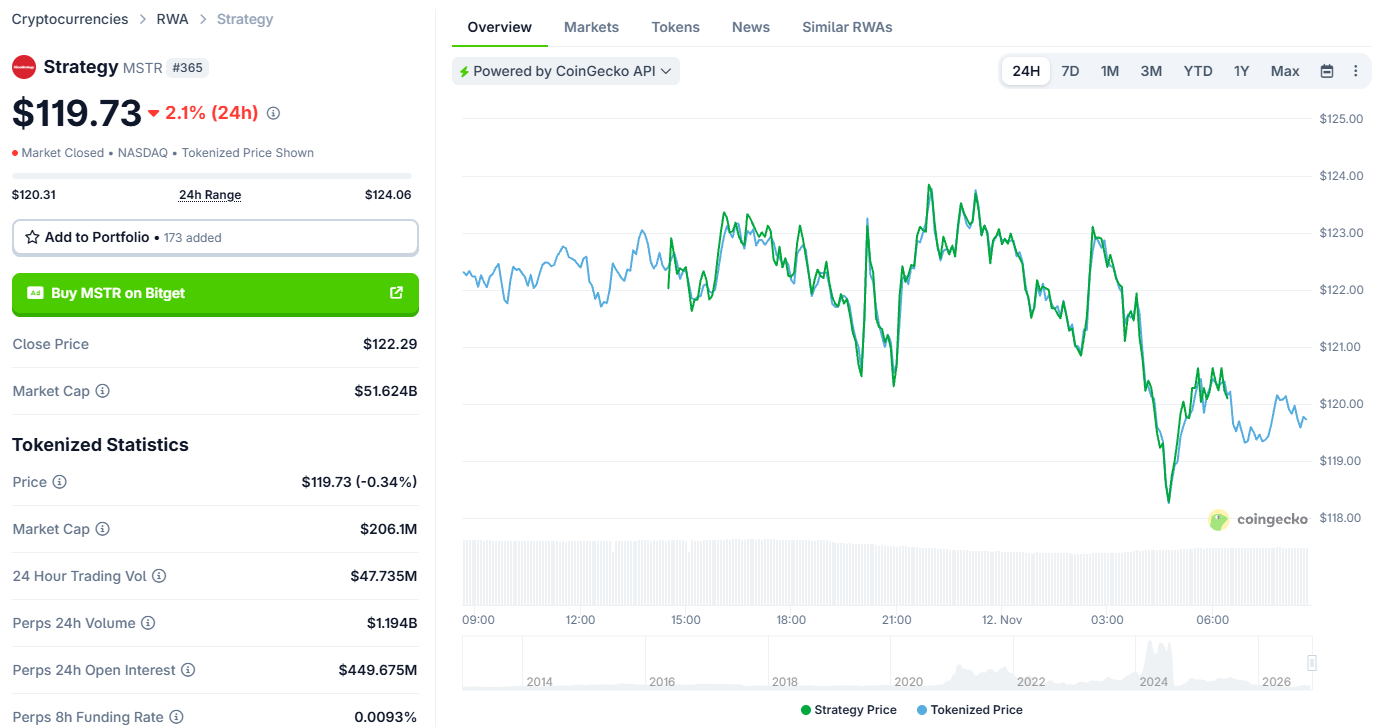
The MSTR fell 2.6% in after-hours trading to $119.06 after the news. The regular NASDAQ close was $122.29, according to the CoinGecko page.
The latest CoinGecko screenshot, taken on the morning of November 12, 2026 (based on its 24-hour chart axis), shows the market closed with a tokenized price shown. Here are the figures:
Tokenized MSTR price: $119.73, down 2.1% over 24 hours.
Tokenized market cap: about $206.1 million.
Tokenized 24-hour volume: $47.735 million.
Underlying stock market cap: $51.624 billion.
Perpetual futures: $1.194 billion in 24-hour volume and $449.675 million in open interest.
A tokenized price tracks the stock on crypto platforms, including when NASDAQ is closed. It is not the same as the official stock quote. The $206.1 million figure covers only the tokenized product, not Strategy’s actual corporate value.
The market may have priced in part of the risk. Strategy had already warned about exclusion in its Q3 SEC filing, and the after-hours drop was modest.
Source: CoinGecko Data
MSCI is removing Japan’s Metaplanet from its Japan Small Cap Index at the same time. Metaplanet shares closed down 2.53% at 231 yen in Tokyo before the announcement. Reuters also named UK uranium investment company Yellow Cake among the removals.
The methodology reaches beyond one company. Any firm whose balance sheet is heavily concentrated in digital assets could face the same screening. Ethereum treasury company SharpLink was placed on MSCI’s watchlist. A watchlist spot is not a confirmed removal, and SharpLink was not on the November deletion list.
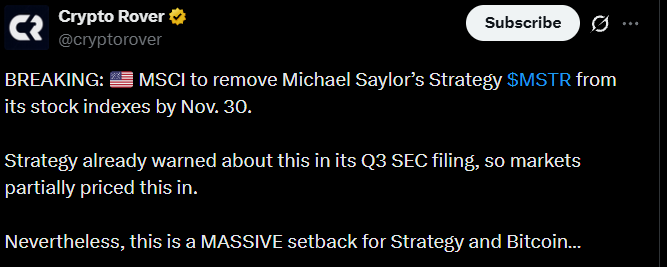
Source: Crypto Rover X Post
What Does MSCI’s Decision Mean for Strategy and Bitcoin?
The MSCI Strategy exclusion could reduce passive demand for MSTR shares. That may make Strategy’s financing harder. The company has relied on selling shares at a premium to buy Bitcoin, and weaker index-driven demand could shrink that premium.
Still, selling MSTR stock does not mean selling Bitcoin. Funds sell shares, not the coins on Strategy’s balance sheet. Reports say Saylor bought another 1,036 BTC last week, which shows buying continued before the removal.
Longer term, the decision may affect sentiment toward Bitcoin treasury companies. How the market reacts is uncertain, and no one can say which way Bitcoin will move.
Source: X
Conclusion
MSCI confirmed the removal, and it takes effect after the close on November 30, 2026. Selling pressure on MSTR is possible, but the $2.8 billion and $8.8 billion figures are estimates. Investors should separate MSTR stock moves from Bitcoin market activity.
Watch three things next: actual index-related flows, MSTR price performance, and any decisions by other index providers on MSCI Strategy-style exclusions.
YMYL Disclaimer: This article is for informational purposes only and is not investment advice. MSTR and Bitcoin-related investments carry market, liquidity, and volatility risks. Cryptocurrency prices are highly volatile, and you can lose some or all of your money. Do your own research and speak with a licensed financial advisor before investing.