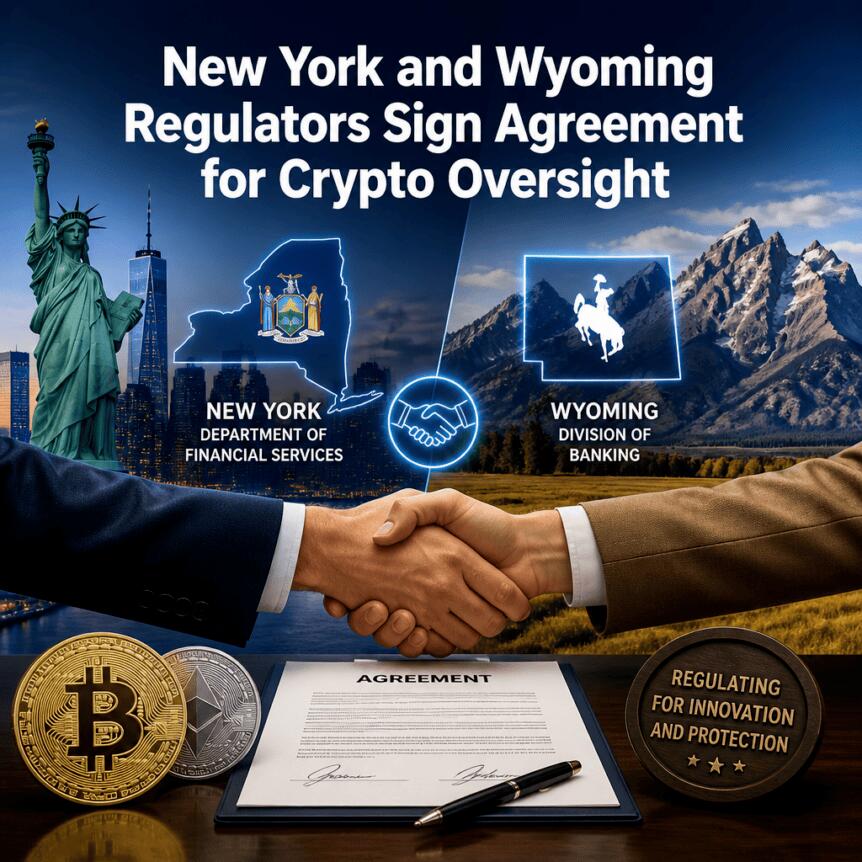
New York and Wyoming have signed a memorandum of understanding (MOU) to coordinate oversight of crypto firms operating in both states. The agreement, announced Thursday by the New York State
New York and Wyoming have signed a memorandum of understanding (MOU) to coordinate oversight of crypto firms operating in both states. The agreement, announced Thursday by the New York State Department of Financial Services (NYDFS), is designed to reduce friction for companies navigating separate licensing and supervision processes while strengthening regulators’ ability to act on compliance and enforcement issues.
The MOU covers licensing, examinations, information sharing, and how regulators may pursue enforcement. It applies not only to firms already regulated in New York or Wyoming, but also to companies seeking approval in both jurisdictions.
Key takeaways
- NYDFS and Wyoming’s Division of Banking will coordinate licensing and supervisory reviews for crypto companies active in both states.
- Regulators plan to share analysis and historical examination data to streamline applications and align examination schedules.
- An expedited review pathway is available for certain firms already licensed or chartered in one state for at least three years, subject to enforcement status.
- The agreement sets protocols for sharing supervisory reports and market trend information, including notifications related to potential enforcement actions.
What the MOU changes for cross-state crypto firms
According to the MOU announcement by NYDFS, the agreement is intended to streamline how both states evaluate and supervise the same firms. For companies that operate under authorization in either jurisdiction—or plan to seek it in both—the coordination could mean less duplication across application materials and fewer surprises during examinations.
Under the agreement, NYDFS and Wyoming’s banking regulator will share relevant analysis and historical examination data. Regulators also plan to coordinate examination timing and work toward joint examinations when companies conduct business across both states.
Faster approvals may be possible under defined conditions
The MOU also creates an expedited pathway for some firms that are already regulated in one state and want approval in the other. NYDFS says the expedited route is limited to companies that have operated under an existing license or charter for at least three years and are not subject to enforcement action.
For such qualifying companies, the second regulator would aim to reach a decision within six months. While the agreement does not state what specific criteria would be used beyond the three-year licensing requirement and the absence of enforcement exposure, the timetable is notable: it suggests the regulators want faster outcomes for established, presumably lower-risk operators while still maintaining oversight standards.
Beyond initial approvals, the MOU sets supervisory protocols for ongoing oversight. The regulators will share supervisory reports, market trend data, and notifications about potential enforcement actions. They also plan to periodically share investigative information and can pursue enforcement jointly, in coordination, or separately depending on the circumstances.
For market participants, these provisions matter because crypto regulation often hinges on how quickly issues are identified and addressed across different regulators. Coordinated notifications and examination data sharing can reduce the chance that the same conduct is reviewed repeatedly, or—conversely—that risks are missed because they fall between jurisdictional lines.
New York’s BitLicense meets Wyoming’s crypto-friendly approach
The MOU connects two states that have taken notably different paths to regulating digital assets. New York has maintained its BitLicense regime since 2015, subjecting crypto firms to what NYDFS describes as rigorous licensing standards. Wyoming, by contrast, has pursued a more crypto-focused regulatory model through specialized laws and banking-oriented structures, including crypto-related chartering through its specialized depository institution framework.
By aligning oversight practices, New York and Wyoming appear to be moving from “different styles of regulation” toward more consistent cross-border supervision—even if the underlying licensing frameworks remain distinct. That could be particularly important for firms that want to serve customers in both states without repeatedly rebuilding compliance programs from scratch for each regulator.
At the same time, the MOU does not suggest that the states will adopt one uniform rulebook. Instead, it emphasizes procedural coordination—sharing information, coordinating exams, and enabling joint or coordinated enforcement—while allowing each regulator to retain its own regulatory authority.
Readers should watch how the expedited pathway is applied in practice, including whether the six-month decision goal becomes a reliable benchmark for eligible firms. It will also be important to see whether joint examinations become common for cross-state operators or remain limited to specific cases where regulators identify overlapping supervisory concerns.
This article was originally published as New York and Wyoming Regulators Sign Agreement for Crypto Oversight on Crypto Breaking News – your trusted source for crypto news, Bitcoin news, and blockchain updates.