Keel Infrastructure sold 2,520 bitcoin for $192 million in the third quarter as the former Bitfarms shifts from cryptocurrency mining to developing AI data centers. The sale brings cash into
Keel Infrastructure sold 2,520 bitcoin for $192 million in the third quarter as the former Bitfarms shifts from cryptocurrency mining to developing AI data centers.
The sale brings cash into a business that expects its first high-performance computing revenue in 2027. Keel is still negotiating leases at three near-term sites, rather than collecting rent from signed AI tenants there.
The company's Nov. 5 earnings release says the bitcoin sold included its entire 2,261-coin treasury position and 259 newly mined coins. Holdings at Sept. 30 were described as nominal, not zero.
Bitcoin produced by the remaining Quebec operation will be sold daily. Keel says that policy effectively removes exposure to price changes on treasury holdings, but it does not eliminate the effect of bitcoin prices on the revenue of its remaining mining business.
A different company for shareholders
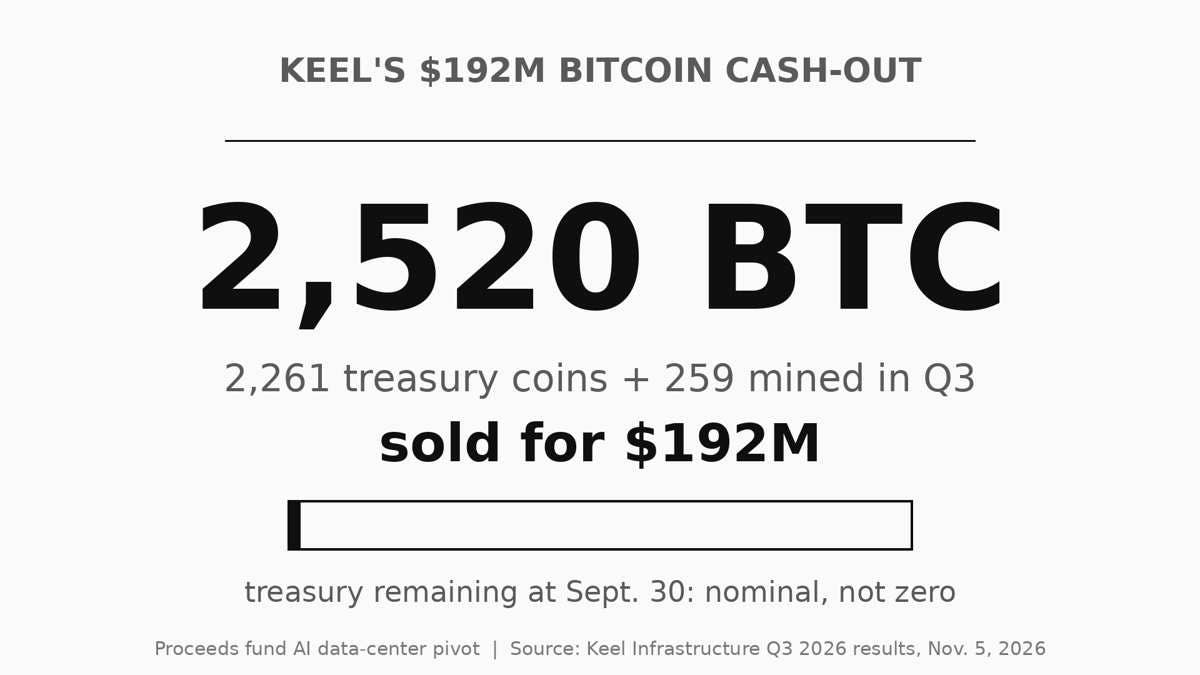 Keel sold its 2,261-coin treasury and 259 newly mined bitcoin for $192 million in Q3 2026, leaving nominal holdings at Sept. 30. Source: Keel Infrastructure Q3 2026 results, Nov. 5, 2026.
The transformation began before this quarter's sale. Bitfarms became Keel in April after moving its parent company from Canada to the United States, with its principal executive office in New York.
Each outstanding Bitfarms common share was exchanged for one Keel share. The change in name accompanied a shift in what management intends the company to own and earn money from.
Instead of retaining mined bitcoin and benefiting if its price rises, Keel plans to develop buildings and energy infrastructure for AI computing customers. Its remaining mining business is shrinking before the new rental business starts producing revenue.
Third-quarter revenue from continuing operations fell 59% to $27.6 million from $68 million a year earlier. The company attributed the decline mainly to shutting its U.S. bitcoin mining operations during the second quarter and a lower average bitcoin price.
The comparison covers its continuing North American portfolio. Argentina and Paraguay operations are classified as discontinued operations following their disposal, so those figures should not be treated as total historical revenue for every business Bitfarms once owned.
Where the AI plans stand
Keel says Moses Lake in Washington received all necessary permits and began construction in September. It expects the site to be its first energized location generating high-performance computing revenue in 2027.
The company is also advancing Sharon and Panther Creek in Pennsylvania. Across those two sites, it reported three permits cleared and four environmental permits outstanding, two of them in draft form.
The broader development pipeline is 2.2 gigawatts. That describes potential development, not completed computing capacity, signed customer demand or revenue already being earned.
A separate secured-capacity figure stands at 478 megawatts. Studies at Panther Creek and Scrubgrass could increase that to as much as 1,928 megawatts, but the studies are not expected to finish until the first quarter of 2027.
The Pennsylvania expansion has a longer history than the rebrand. The March 2025 Stronghold acquisition added power assets and a Pennsylvania growth pipeline, with the company already evaluating sites for possible AI conversion at that time.
That acquisition was a stock-for-stock transaction. It supplied the predecessor business with sites and energy infrastructure, not an automatic conversion of those assets into leased AI data centers.
Why Pennsylvania permits matter
Keel says it revised the Sharon and Panther Creek plans to comply with Pennsylvania's new data-center rules without meaningful changes to tenant costs or schedules.
Gov. Josh Shapiro's Aug. 18 executive order removed AI data-center projects from the state's fast-track permitting program and imposed new requirements for local approvals and public engagement.
The state's GRID requirements call for developers to pay the full cost of electricity infrastructure needed for their projects without shifting it to households and businesses. They also cover community engagement, local workers and environmental protections, including water conservation.
Keel's statement that its designs comply does not mean all remaining environmental permits have been issued. Its own quarter-end update still lists approvals outstanding.
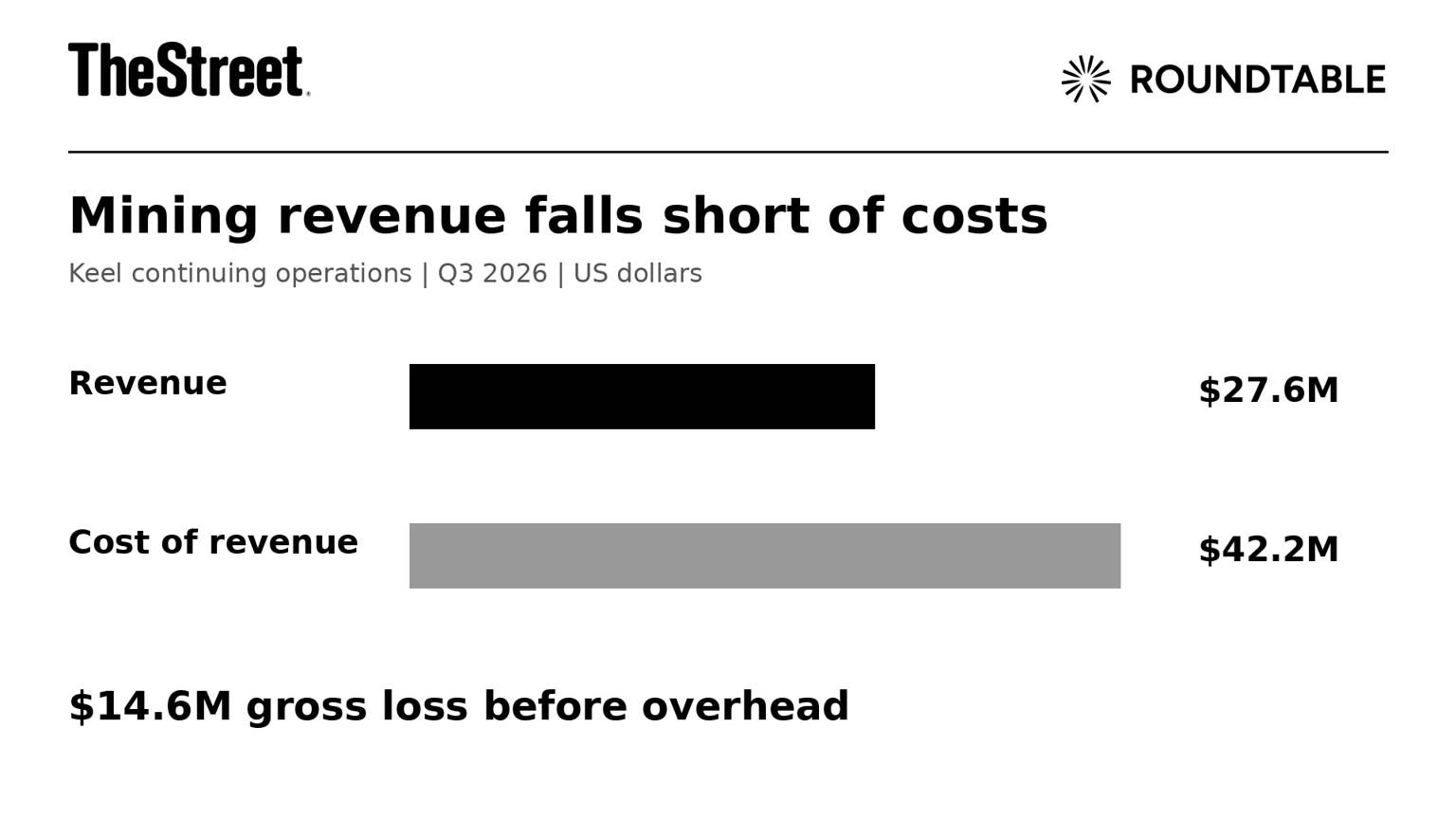
Keel reported $27.6 million of revenue and $42.2 million of cost of revenue from continuing operations in Q3 2026. Source: Keel Infrastructure Q3 2026 results, Nov. 5, 2026.
Keel's reported operating loss narrowed to $7.7 million from $18.5 million. But the operating result included a $73.6 million gain from changes in the value of its digital assets, as well as a $32.2 million realized loss on bitcoin sales.
The bitcoin sale's $192 million of cash proceeds and its $32.2 million accounting loss measure different things. Proceeds show cash received, while the loss compares sales with the coins' carrying value.
The underlying revenue and cost figures remained weak. Cost of revenue was $42.2 million against revenue of $27.6 million, producing a $14.6 million gross loss before general and administrative expenses.
Adjusted EBITDA fell to negative $27.4 million from positive $19.2 million. The company-defined measure removes several accounting items, including bitcoin revaluation and sale gains or losses, and does not replace operating income or cash flow.
General and administrative expenses doubled to $34.3 million. Keel cited senior hires, professional fees and higher stock-based compensation as it moved into project management.
Its loss from continuing operations widened to $62.4 million from $11 million, driven mainly by a $55.3 million noncash loss on capped-call derivatives associated with its 2025 convertible notes. Total net loss, including discontinued operations, was $62.7 million.
Cash now, financing later
Chief financial officer Jonathan Mir said Keel had about $780 million of unrestricted cash on Nov. 4 and "no current need for debt or equity financing before signing a lease."
The last five words limit that claim. Management is not saying the entire development pipeline can be completed without additional financing.
"Capital we deploy ahead of a lease becomes part of our equity contribution to a project's financing," Mir said.
Keel's risk disclosures warn that its AI development strategy may not become profitable, leases may not be signed on acceptable terms and construction could face delays or cost overruns. The company also expects to need substantial additional capital for data-center development.
The next disclosed milestones are lease agreements, remaining Pennsylvania permits and the first-quarter expansion studies. The first AI revenue remains a management expectation for 2027, while the cash-producing legacy business is already smaller.