Key Highlights Newmont delivered Q2 earnings per share of $2.10, surpassing analyst expectations of $1.99, though quarterly revenue of $6.1 billion fell below the $6.4 billion consensus. The
Key Highlights
- Newmont delivered Q2 earnings per share of $2.10, surpassing analyst expectations of $1.99, though quarterly revenue of $6.1 billion fell below the $6.4 billion consensus.
- The company achieved a quarterly record with $2.2 billion in free cash flow, distributing $1.9 billion back to investors.
- Quarterly gold output reached 1.29 million ounces, affected by seismic activity at the Cadia operation in Australia during April.
- The all-in sustaining cost totaled $1,621 per ounce, tracking below the company’s full-year target of $1,680 per ounce.
- Shares declined approximately 1% in extended trading to $93.45, even as operational metrics remained solid.
Newmont (NEM) exceeded Wall Street’s earnings projections for the second quarter of 2026 but came up short on revenue, pressuring shares in after-hours activity. The world’s leading gold producer recorded earnings per share of $2.10 compared to the Street’s $1.99 forecast, yet quarterly sales of $6.1 billion trailed the anticipated $6.4 billion.
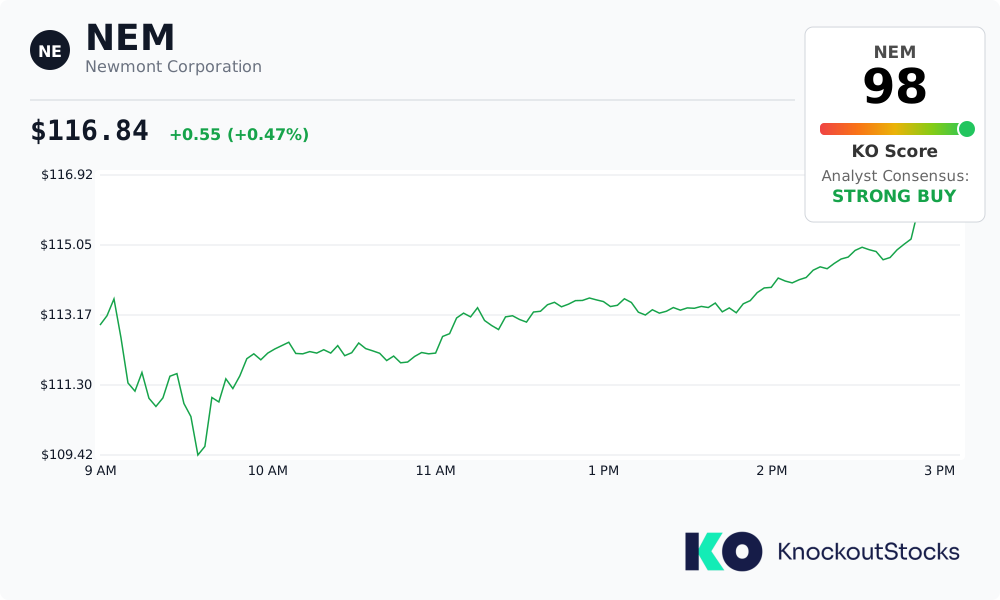
In extended trading, NEM shares changed hands around $93.45 — representing a decline of roughly 1.34% — following a 1.08% drop during regular hours to close at $94.72.
 Newmont Corporation, NEM
While revenue disappointed, Newmont achieved a second-quarter milestone with $2.2 billion in free cash flow generation. Through the first six months of 2026, the miner produced $5.3 billion in free cash flow, marking a significant jump from the $2.9 billion recorded during the comparable 2025 period.
During the quarter, shareholders received $1.9 billion through a combination of dividend payments and stock repurchases. This figure includes $1.7 billion deployed toward buybacks as part of the $6 billion authorization granted in April 2026. The company accelerated repurchases in July, executing over $600 million worth that month.
Over a two-year span since launching its buyback initiative, Newmont has reduced outstanding shares by more than 100 million — representing approximately 9% of the float.
The miner’s average realized gold price for the quarter stood at $4,414 per ounce, climbing from $3,320 during the year-ago quarter but retreating from Q1 2026’s $4,900 level. Year-over-year, realized prices jumped roughly 33%, while direct sales costs increased a modest 4%.
Australian Mine Disruption and Output Levels
Quarterly gold production totaled 1.29 million ounces, slightly below the 1.3 million ounces from the prior quarter and down from 1.48 million ounces in the second quarter of 2025. The April seismic event at the company’s Cadia facility in Australia temporarily disrupted operations, though normal activity has since been restored.
Company executives reaffirmed their full-year production forecast of 5.3 million ounces. Approximately 49% of annual output was achieved in the first two quarters, leaving 51% projected for the latter half — with fourth-quarter production expected to be particularly strong.
The all-in sustaining cost registered at $1,621 per ounce, comfortably beneath the company’s $1,680 full-year projection. Adjusted EBITDA for the period reached $3.8 billion, while operational cash generation totaled $2.9 billion.
Energy Costs and Forward Outlook
A notable challenge emerged from elevated oil prices: crude averaged approximately $100 per barrel during Q2, substantially above the $70 baseline incorporated into Newmont’s annual projections. Energy and fuel expenses represent 15% of direct operating expenditures.
The company’s 2026 guidance framework assumes gold trading at $4,500 per ounce. Each $100 fluctuation in the gold price translates to roughly $505 million in revenue and cost impacts.
Chief Financial Officer Brian Tabolt highlighted “significant operating leverage embedded in the portfolio” and indicated the existing capital allocation strategy could accommodate increasing the quarterly dividend to $0.27 per share — an increase from the current $0.26 — during the next annual assessment.
The Red Chris block cave development in British Columbia achieved important regulatory milestones during the quarter. Management anticipates a board decision on the project’s feasibility analysis near year-end 2026, though they noted capital requirements will likely exceed initial projections due to inflationary pressures.
The quarter concluded with Newmont holding net cash of $3.4 billion — surpassing its $1 billion strategic target — providing ample financial flexibility to maintain share repurchases throughout the remainder of the year.
The post Newmont (NEM) Stock Dips Despite Q2 Earnings Beat and Record Cash Flow appeared first on Blockonomi.

 Revenue: $6.1B (Est. $6.27B)
  ; +15% YoY