According to a recent GSMA report, 57% of all mobile connections globally are expected to run on the 5G network by 2030. But Nigeria may not be among those driving that 57% because it continu
According to a recent GSMA report, 57% of all mobile connections globally are expected to run on the 5G network by 2030. But Nigeria may not be among those driving that 57% because it continues to struggle to expand network coverage as expected.
With an active internet population of nearly 159 million, according to industry data from August 2026, Nigeria has a large connected population. The telecom subscriber base currently stands at 97.4 million, implying that 8 in 10 Nigerians use the internet.
The interesting question is: how many of these eight use the internet on the 5G network?
Telecommunications services generated $6 trillion in economic value in 2025, equivalent to 6.4% of global GDP. With the growing 5G adoption, it is expected to contribute $11.3 trillion by 2030, according to GSMA. This implies that 5G is not just about high-speed connectivity, but about the economic value it creates.
On average, only less than 5% of Nigerians access the internet via 5G. This directly limits the country’s ability to unlock billions of dollars in projected digital economic growth and slows down the pace of industrial technology advancement, smart governance, and digital inclusion.
The World Bank previously estimated that every 10-percentage-point increase in high-speed internet penetration yields a 1.3 percentage-point increase in GDP growth for Nigeria. In fact, a dedicated 5G deployment study by the NCC-Ookla Quality of Experience report projected that robust 5G infrastructure could add 2.08% ($9.3 billion nominal or $24.6 billion real) to Nigeria’s GDP by 2030.
Staying below 5% usage significantly pushes these massive economic returns further down the timeline. Nigeria wants a $1 trillion economy by 2030, but the reality of that ambition rests on the pace of its high-speed internet

Also Read: What 730,000 network tests reveal about MTN, Airtel, Globacom and T2’s performance in Nigeria.
1 in 20 Nigerians use 5G
Industry data as of August 2026 shows that 5G connections still have the least share of the population, sitting at 4.97%. In simple terms, it means that just one in every 20 Nigerians access the internet using a 5G network.
In contrast, the 4G network holds the highest share at 54.77%, followed by 2G with 36.05%, while 3G holds the lowest share at 4.27%.
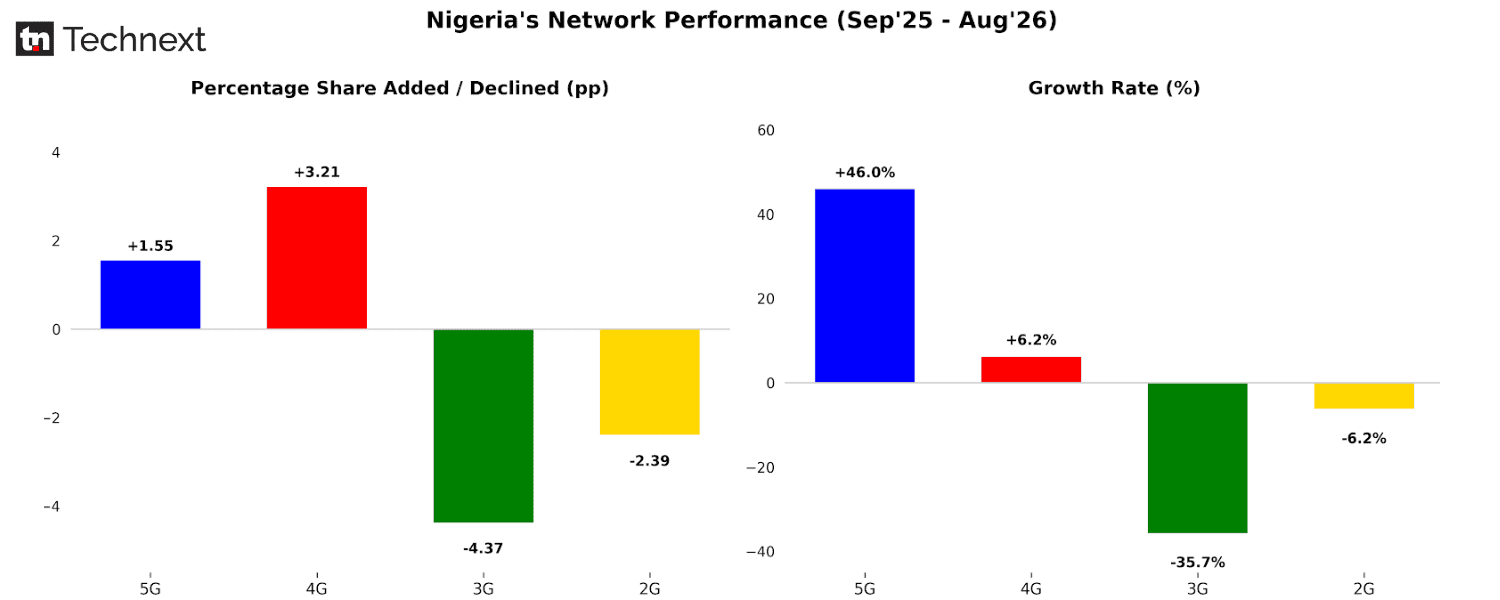
On a closer look, you might want to give 5G some applause. In terms of percentage share added over 12 months (Sep’25 – Aug’26), 4G leads with 3.21, while 5G follows with 1.55. 2G and 3G had a share decline of 2.39 and 4.37, respectively, showing how the networks are gradually phasing out.
In terms of growth over the same period, 5G led with a 46% increase, distantly followed by 4G with 6.2%. As expected, 2G and 3G saw a dip with -6.2% and -35.7%, respectively.
However, the primary concern isn’t that the 5G network isn’t growing, but that the pace of that growth is slow compared to increasing market demands and how increasing needs for the network will fuel economic growth.
 Nigeria’s Network Share Comparison (Sep’25 Aug’26)
Ownership over network availability
While Nigerians continue to bridge the affordability gap by possessing not just smartphones but devices that support high-speed networks, the service quality to enjoy such status is still lagging.
A report in April shows that only about 27% to 31% of capable devices use 5G services in Nigeria, in its biggest cities such as Lagos, FCT Abuja and Port Harcourt. This means that 7 in 10 people who own 5G-enabled smartphones in these cities cannot connect to the network
When the connection stalls, the phone locates the nearest available network (4G or 3G) and stays.
With the big cities struggling to access the network, what becomes of other cities and the rural communities?
In dense city clusters, 5G has a high speed of 181.5 Mbps. While its coverage gap continues to pose serious digital division, 4G LTE remains the nationwide backbone at 15.7 Mbps download speed and remains essential for digital inclusion, according to NCC-Ookla industry data.
Compared to Nigeria, over 60% of the South African population has 5G network coverage, led primarily by major operators MTN and Vodacom. Industry analysts forecast the network’s population coverage in South Africa to reach 73% with roughly 42 million 5G subscribers by 2029.
Challenges with usage gap
While accessing high-speed networks in Nigeria is becoming a matter of survival of the fittest, several users have access to internet service they are not using.
As of 2025, about 140 million Nigerians are unable to utilise telecom infrastructure despite being under coverage. Leading factors are lack of awareness of mobile internet and inability to afford an internet-enabled phone, and a lack of literacy and digital skills.
The trend isn’t a Nigerian issue. It’s global.
While 97% of the global population lives within mobile broadband coverage, 3.4 billion people still do not use mobile internet. Sub-Saharan Africa, the region with the biggest usage gap, has its poorest 20% of people unable to afford a smartphone; equivalent to 44% of their average monthly income.
Also Read: After building the devices behind Nigeria’s big networks, Imose is now coming for the connection itself.
Going forward, telecom operators should increase their spending by upgrading networks and doubling investment in new technologies. Experts report that telecom operators are projected to invest $1.2 trillion in capital expenditure between 2025 and 2030 as they focus on expansion and spreading 5G network coverage. If Nigeria wants to avoid being outside the growth circle, the federal government, in partnership with operators, must at least deploy quality infrastructure that matches subscriber demand.