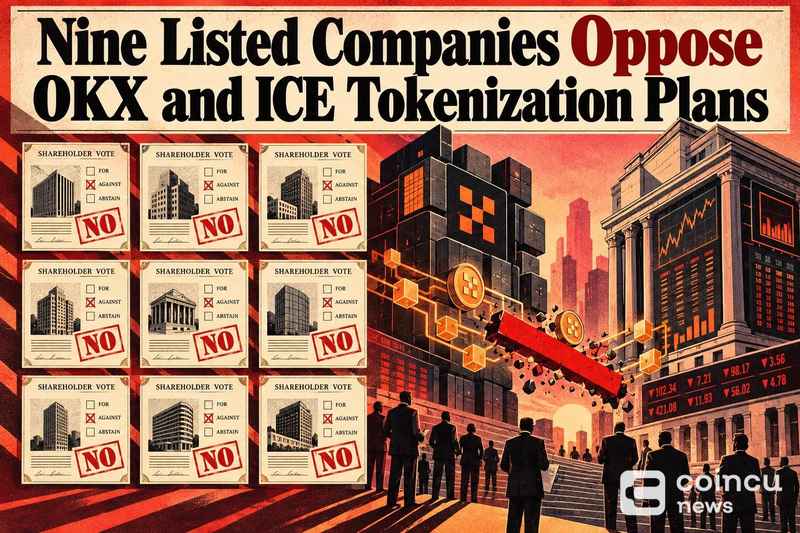
Nine publicly listed companies have formally objected to stock-tokenization plans linked to OKX, one of the world's largest cryptocurrency exchanges, and ICE, the Intercontinental Exchange th
Nine publicly listed companies have formally objected to stock-tokenization plans linked to OKX, one of the world's largest cryptocurrency exchanges, and ICE, the Intercontinental Exchange that operates the New York Stock Exchange, raising issuer-consent questions that could delay or restructure a tokenized-equity push at a moment when traditional finance and crypto infrastructure are converging at unusual speed.
The opposition surfaces as tokenized real-world assets emerge as one of the most contested frontiers in financial markets, with exchanges, custodians, and regulators each staking out incompatible positions on who controls the issuance process, who bears liability for token-holder disputes, and how corporate actions such as dividends, splits, and voting rights translate on-chain. The nine companies have not, according to available reporting as of October 2026, named a single legal filing as their collective instrument; rather, each has communicated objections through notices, counsel letters, or public statements directed at the parties facilitating the tokenization. For related coverage, see BitMine Adds 12,535 ETH, Holdings Reach About 6.04M ETH.
Nine listed companies challenge the OKX and ICE tokenization plans
The companies objecting are understood to be exchange-listed equities whose shares, or instruments referencing those shares, were identified for inclusion in a tokenized-stock product facilitated in part by OKX's exchange infrastructure and ICE's data and market-structure capabilities. The specific identities of all nine have not been uniformly confirmed across primary sources, and this article will not speculate on names where confirmation is absent. For related coverage, see Bitmine Immersion Technologies (BMNR) Announces ETH Holdings Reach 6.04 Million Tokens, and Total Crypto and Total Cash & Marketable Securities Holdings of $15.1 Billion.
What is confirmed at the level of the headline event is that the objections are corporate, not retail, in origin: these are issuers, not individual shareholders, pushing back. That distinction matters structurally because issuers occupy a different legal footing from market participants when challenging the tokenization of instruments that represent, or claim to represent, their equity. An issuer's objection typically centers on consent, trademark and branding control, and the accuracy of token-holder disclosures, while a retail objector would more likely raise investor-protection concerns under securities law.
The plans associated with OKX and ICE reportedly involve creating blockchain-based tokens that track the price or economic exposure of listed equities, potentially allowing crypto-native users to gain equity-like exposure without direct participation in traditional brokerage infrastructure. Such instruments have precedent: similar products appeared on FTX before its collapse, and the DTCC has separately announced a tokenization service targeting a 2027 launch on the Stellar network, signaling that settlement infrastructure for tokenized equities is approaching production readiness regardless of issuer sentiment.
What the disputed stock-tokenization proposals involve
Stock tokenization, in its most common architectural form, involves a custodian or licensed broker holding the underlying shares while a corresponding token is issued on a blockchain. Token holders receive economic exposure to the equity's price movement, and in some designs, dividends, though voting rights are rarely transferred. The token trades on a crypto exchange rather than a regulated securities venue, meaning price discovery, order matching, and settlement occur outside the frameworks that govern traditional equity markets.
ICE's role in this context is significant because the company is not purely a crypto-adjacent operator. ICE owns NYSE, operates global derivatives and fixed-income markets, and provides the data infrastructure that prices equities worldwide. Any tokenization arrangement that draws on ICE's data feeds or market-structure expertise carries an implicit imprimatur that purely crypto-native tokenization products lack, which may be precisely why the nine companies are objecting: the association with ICE lends credibility that could accelerate retail adoption before issuer-consent frameworks are resolved.
OKX, for its part, has been aggressively expanding beyond spot and derivatives trading, building out a wallet ecosystem, an NFT marketplace, and a layer-2 network. Tokenized equities would represent a direct incursion into brokerage territory, potentially allowing OKX to offer U.S. or global equity exposure to its user base without routing through regulated broker-dealers, depending on the jurisdiction and the specific product structure chosen.
Why the companies' objections could matter
The stakes of issuer pushback extend well beyond the nine companies directly involved. If listed corporations can successfully assert that their equity cannot be tokenized without explicit consent, the legal theory would apply broadly across any tokenized-stock product, potentially requiring exchanges and tokenization platforms to renegotiate the terms of every instrument in their catalog. That precedent would significantly raise the compliance cost of bringing tokenized equities to market and could tilt the competitive advantage toward issuers who opt in affirmatively, rather than allowing tokenization as a default condition of being publicly listed.
Investor clarity is a parallel concern. Buyers of tokenized equities do not always understand the gap between token-holder status and registered shareholder status. Without issuer cooperation, the corporate actions pipeline, covering dividend distribution, rights offerings, and proxy voting, cannot function as it does for registered owners. A token backed by shares held in a custodian's name provides economic exposure but strips the holder of the governance rights that securities law attaches to share ownership, a distinction that is material for institutional allocators but frequently invisible in retail-facing marketing.
The objections also arrive at a moment when regulatory scrutiny of tokenized equities is intensifying across multiple jurisdictions. The U.S. government has signaled heightened attention to financial instruments that blend securities exposure with crypto infrastructure, and any product that draws formal corporate opposition is more likely to attract regulatory examination before or during launch. That examination timeline, if triggered, could delay rollout by months or require structural redesign of the tokenization mechanism.
Separately, the broader regulatory environment for crypto-adjacent financial products continues to shift. The U.S. Treasury has been expanding its crypto enforcement perimeter, and issuers may be calculating that formal opposition now creates a cleaner record than acquiescence followed by litigation.
How OKX, ICE, and the companies have responded
OKX has not issued a public statement directly addressing the nine companies' objections, as of the reporting available to this article. The exchange has previously described its tokenized-product ambitions in the context of expanding financial access for users in markets with limited brokerage infrastructure, a framing that positions issuer objections as a structural inefficiency rather than a legitimate consent claim.
ICE has not commented on this specific dispute in a manner that has been confirmed in primary sources available to this article. ICE's posture on blockchain-based market infrastructure has historically been cautious and incremental; the company invested in Bakkt, a regulated crypto platform, but has not publicly committed to a tokenized-equity launch timeline that would require direct engagement with issuer objections at this stage.
The nine companies' objections, communicated through counsel or formal notices, represent a procedural escalation short of litigation. Whether any company converts its objection into a legal filing, a cease-and-desist, or a securities-law complaint will determine how quickly this dispute forces a structural resolution. Absent litigation, the tokenization plans could proceed under a regulatory framework that does not yet require issuer consent, leaving the dispute to play out in the market rather than in court.
The trajectory of the broader pattern of formal opposition to crypto-native financial products suggests that issuer objections rarely halt a product outright; they more commonly reshape the product's structure, delay its launch, or shift its target jurisdiction to one with less issuer-protective regulation.
FAQ: OKX and ICE stock-tokenization plans
Why are the nine listed companies opposed? The companies object primarily on the grounds that their equity is being tokenized without explicit issuer consent, raising questions about branding control, disclosure accuracy, and the proper handling of corporate actions such as dividends and shareholder voting.
What are tokenized stocks? Tokenized stocks are blockchain-based instruments that represent price exposure to, or in some designs fractional ownership of, listed equities. They trade on crypto exchanges and settle on-chain rather than through traditional clearinghouses. The underlying shares are typically held by a custodian, meaning token holders receive economic exposure but may not have the same rights as registered shareholders.
Does the opposition stop the plans? Not automatically. Issuer objections carry legal and reputational weight, but absent a court order or regulatory injunction, tokenization platforms can proceed under frameworks that do not explicitly require issuer consent. The objections are more likely to force structural modifications or jurisdictional adjustments than an outright halt, though that assessment is conditional on no legal filings emerging.
What should investors and market participants watch next? The key catalysts are: whether any of the nine companies escalates to formal litigation or a securities-law complaint; whether U.S. or EU regulators issue guidance on issuer-consent requirements for tokenized equities; and whether OKX or ICE modifies the product structure in response to the objections. A regulatory guidance document from the SEC or ESMA on tokenized equities would immediately reprice the risk of this dispute for all parties. The DTCC's planned 2027 tokenization service launch also provides a reference point for how institutional-grade tokenized equity infrastructure handles issuer relationships, and its framework may influence how OKX and ICE ultimately respond to the corporate pushback they now face.
Additional source references: source document 1.
Disclaimer: This article is for informational purposes only and does not constitute financial or investment advice. Cryptocurrency and digital asset markets carry significant risk. Always do your own research before making decisions.
The post Nine Listed Companies Oppose OKX and ICE Tokenization Plans was initially published on Coincu.