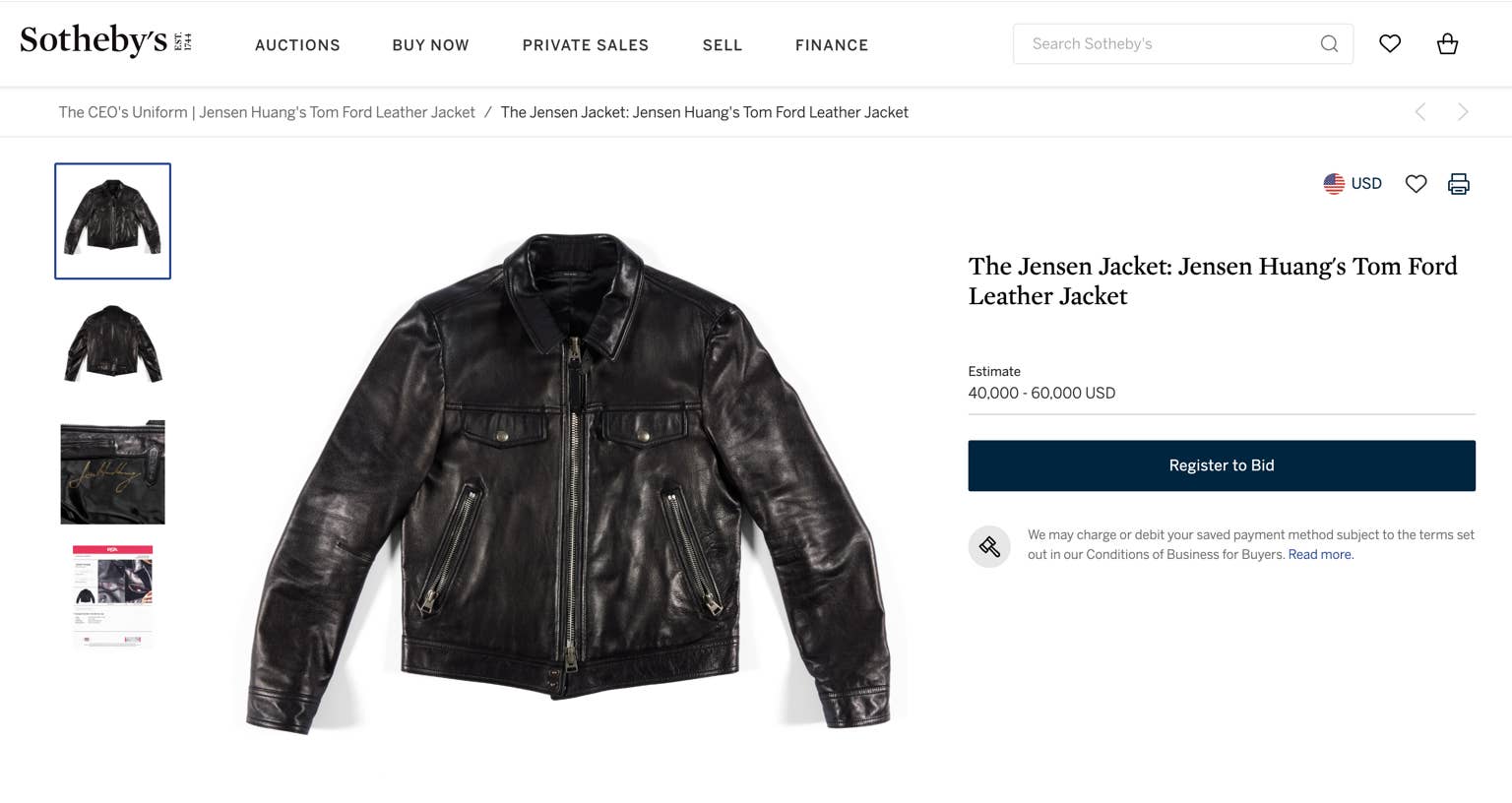
NVIDIA (NASDAQ: NVDA) co-founder and CEO Jensen Huang is putting his trademark black leather jacket up for auction at Sotheby's, with bidding opening July 7. The Tom Ford piece, signed by Hua
NVIDIA (NASDAQ: NVDA) co-founder and CEO Jensen Huang is putting his trademark black leather jacket up for auction at Sotheby's, with bidding opening July 7.
The Tom Ford piece, signed by Huang himself, carries an estimated value of $40,000 to $60,000, according to Sotheby's listing.
Long Journey Ventures organizes the auction, and proceeds will benefit the Edge Institute, a non-profit that runs pop-up residencies for researchers and builders working across technology, science and culture.
Jensen Huang's jacket on Sotheby's website
Sotheby's said the funds will go toward fellowships, grants and residencies for a new generation of innovators.
Related: Nvidia earnings sends mining stock tumbling
A wardrobe staple turned tech symbol
Huang, who immigrated to the U.S. from Taiwan in 1973, has built Nvidia into a chipmaking giant central to both the AI boom and crypto's hardware history.
Huang has worn the jacket for more than a decade, through product launches, developer conferences and major AI announcements, making it, in Sotheby's words, a piece present for "some of the most consequential moments in modern technology."
The garment has become as closely tied to Huang's public image as Steve Jobs' black turtleneck was to his, appearing everywhere from packed keynote stages to a New Delhi street corner in sweltering heat.
The jacket's authenticity has been verified through photo-matching to Huang's appearance at Hon Hai Tech Day in Taipei in October 2023, with the signature confirmed by James Spence Authentication.
Bootleg versions of the look have circulated online for years, with retailers listing jackets under names referencing Huang directly.
Popular on TheStreet Roundtable:
NVIDIA's deeper ties to crypto and Bitcoin mining
Beyond the auction, Nvidia's business has long intersected with the crypto industry.
The company's graphics processing units (GPUs), originally built for gaming and later reengineered for artificial intelligence workloads, were also widely used for years to mine Bitcoin (BTC) and other proof-of-work cryptocurrencies before mining shifted heavily toward specialized ASIC hardware.
NVIDIA released dedicated Cryptocurrency Mining Processors (CMPs) during the 2021 mining boom, while simultaneously limiting the mining performance of its consumer gaming GPUs to deter miners from buying cards intended for gamers.
How Sotheby's became one of crypto's unlikely early adopters
Sotheby's, one of the world's oldest auction houses, announced its entry into the NFT space on March 16, 2021, through a collaboration with anonymous digital artist Pak. The actual sale, titled 'The Fungible', ran from April 12 to 14, 2021, conducted through NFT marketplace Nifty Gateway, and raised $16.8 million across 23 NFTs in three days. That made it Sotheby's first-ever NFT auction and one of the largest digital art sales at a major auction house at the time.
The auction house followed that up in June 2021 with its 'Natively Digital' curated NFT sale, which raised $17.1 million and included the sale of CryptoPunk #7523, known as the 'COVID Alien', for $11.8 million, a world record for a single CryptoPunk at the time.
Sotheby's has since built a dedicated digital art division running live and online auctions, generative art drops, and buy-now offerings, positioning itself as one of the most active traditional auction houses in the NFT and blockchain-based art space.
It also launched its own virtual gallery in Decentraland in June 2021, becoming the first, and at the time only, major auction house to build a dedicated virtual gallery. By the end of 2021, Sotheby's, the almost 300-year-old auction house, had generated nearly $100 million in NFT sales, with 78% of NFT bidders being new to the auction house.
Related: Legendary trader slams billion dollar Nvidia GPU deal for AI push