Nvidia (NASDAQ: NVDA) cofounder and CEO Jensen Huang's sudden resignation has left investors questioning whether the AI giant can maintain its market dominance without its long-time leader. F
Nvidia (NASDAQ: NVDA) cofounder and CEO Jensen Huang's sudden resignation has left investors questioning whether the AI giant can maintain its market dominance without its long-time leader.
Following Huang's ouster, the Roundtable 100 analysts moved Nvidia 49 places lower in the Nov. 13 ranking.
View the original article to see embedded media.
Nvidia's biggest challenge is maintaining its strategy
Published with TheStreet, The Roundtable 100 ranks the top 100 publicly traded technology growth assets. Each is scored from 0 to 100 by the analysts of the Blue Ribbon Committee on five variables, Team, Safety, Value, Innovation, and Market Dominance, with the average forming the asset's Power Ranking. The list refreshes every Friday after the U.S. market close.
The Blue Ribbon Committee's analysts rank a company on the basis of its potential to grow in the future, not its current dominance.
According to HIVE Digital Technologies (NASDAQ: HIVE) co-founder and executive chairman Frank Holmes, who is also a member of the Blue Ribbon Committee, the bigger question is if Nvidia's next CEO will preserve the strategy that made the company an industry leader.
"Stocks can rebound if the vision remains strong," Holmes said in an interview with TheStreet Roundtable's Alp Gasimov.
Huang's departure follows a wave of controversy surrounding his personal conduct and reports involving alleged foreign intelligence activity.
Holmes believes investors should distinguish the personal scandal from the potential consequences for Nvidia's business.
"Well, you need a champion for an industry," Holmes said, emphasizing Huang's importance to the broader AI industry.
The RTB 100 analyst explained that Nvidia's leadership had helped sustain a cycle of investment across chipmakers, data centers and other companies supporting the AI expansion.
That raises a critical question about Nvidia's future leadership.
"Will they change that strategy?" Holmes asked.
He warned that a significant change in direction could disrupt investor confidence and the broader data center expansion.
More on TheStreet Roundtable:
Can AMD challenge Nvidia's dominance?
Despite the leadership uncertainty, Holmes believes Nvidia retains a powerful competitive advantage over rivals such as Advanced Micro Devices, Inc. (NASDAQ: AMD).
He pointed to Nvidia's ability to offer more than individual chips, including servers, cooling systems and the infrastructure needed to support increasingly demanding AI applications. He emphasized that "it's not just the chip, it's the whole architecture."
Holmes described this integrated approach as a competitive moat that would be difficult for rivals to replicate quickly.
While AMD could compete through pricing and improved technology, he suggested that matching Nvidia's complete infrastructure offering would take time.
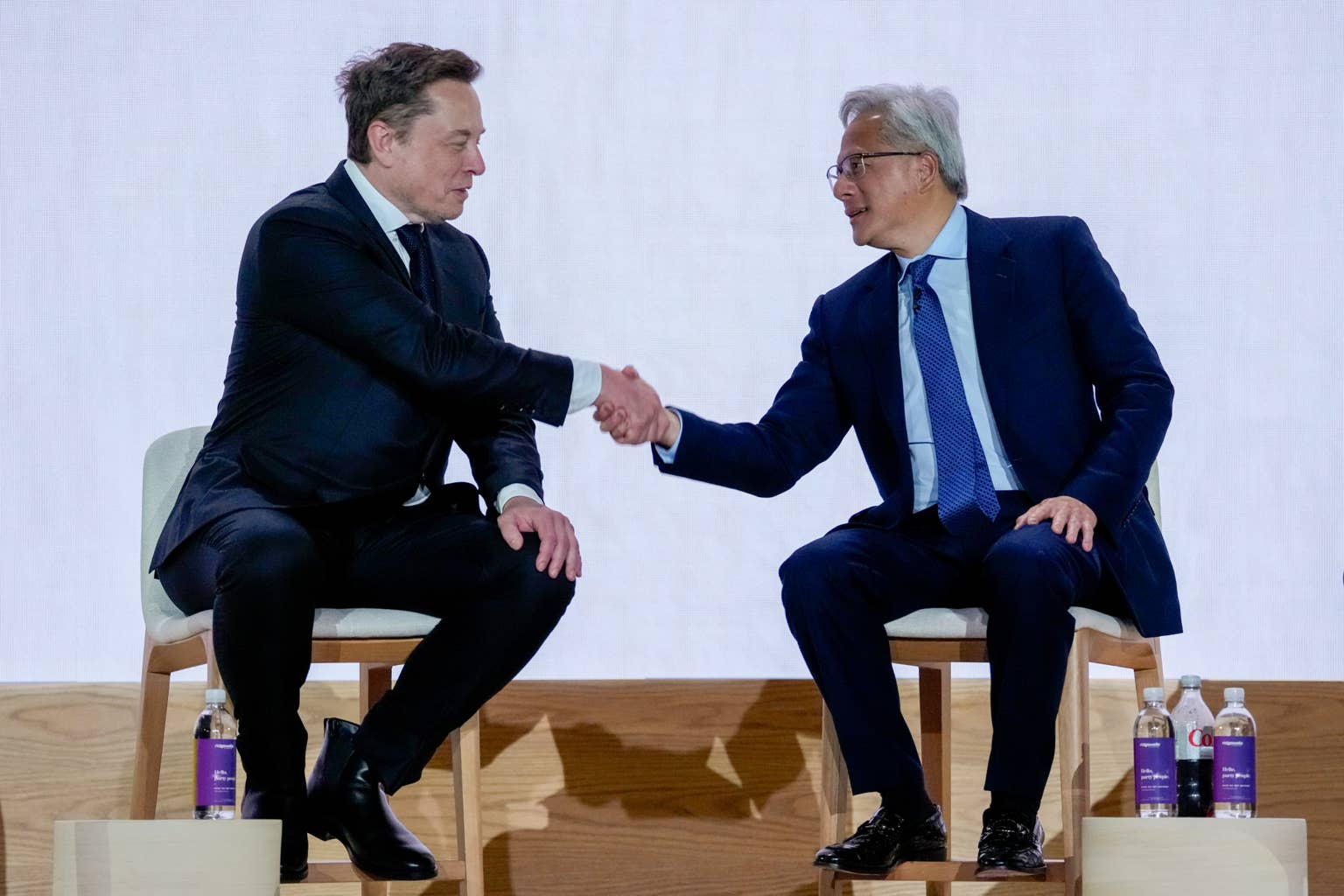
Elon Musk, chief executive officer of Tesla Inc., left, and Jensen Huang, chief executive officer of Nvidia Corp., shake hands during the launch of America.gov in Washington, DC, US, on Tuesday, Sept. 29, 2026.
Elon Musk, chief executive officer of Tesla Inc., left, and Jensen Huang, chief executive officer of Nvidia Corp., shake hands during the launch of America.gov in Washington, DC, US, on Tuesday, Sept. 29, 2026. Source: Getty Images
Why Nvidia's stock matters beyond the chip industry
Holmes also highlighted Nvidia's growing influence over other publicly traded companies, particularly Bitcoin miners expanding into AI infrastructure.
The RTB 100 analyst said an analyst at a recent industry conference described how closely data center construction stocks now move with Nvidia and semiconductor stocks.
For Bitcoin miners transitioning into AI, Holmes estimated the correlation index had reached 75%-80%. He argued that even positive company announcements can struggle to lift shares when Nvidia falls, illustrating how strongly investor sentiment influences the sector.
Holmes also warned that rising financing costs could slow investment in expensive AI chips and data centers.
Follow Nvidia on the Roundtable 100
Nevertheless, he maintained a positive long-term outlook for the industry.
"I remain really positive and bullish about it," Holmes said.
For investors, the central question remains whether Nvidia's next leadership team can preserve its technological advantage and maintain the business strategy that fueled its growth.
As the scandal surrounding Huang unfolded last week, Nvidia fell 49 places to No. 82 in the Roundtable 100.
The Nvidia stock has lost more than 10% of its value in the last week. At press time, it was trading at $159.77.
See the full ranking.
Disclaimer: This article is for informational purposes only and does not constitute financial advice. Investments are subject to market risk. Always conduct your own research before making any investment decisions.
Disclosure: RTB Digital, Inc. (Nasdaq: RTB), publisher of the Roundtable 100, is itself a ranked constituent of the index. The Roundtable 100 is published for informational purposes only and is not investment advice, an offer, or a recommendation to buy or sell any security, commodity or digital asset. Rankings reflect the views of Roundtable analysts as of the ranking date. Investing involves risk, including loss of principal.
Related: 390-year-old Ivy League university quietly hoards Bitcoin and gold