Nvidia Hits $4T: Crypto Market & Macro US Session Roundup This is the Crypto Market & Macro US Session Roundup for November 23, 2026, covering 12:00 UTC to 23:59 UTC. The session produced ten
Nvidia Hits $4T: Crypto Market & Macro US Session Roundup
This is the Crypto Market & Macro US Session Roundup for November 23, 2026, covering 12:00 UTC to 23:59 UTC. The session produced ten stories: Nvidia's market capitalization briefly touched $4 trillion after Jensen Huang returned as chief executive, even as the crypto Fear & Greed Index sat at 11 (Extreme Fear) and the Sky Protocol co-founder acknowledged a $77 million borrowing position had locked up the stUSDS lending pool.
Key Takeaways
- Nvidia's market cap briefly hit $4 trillion as NVDA surged 31.6% to $165/share, inflicting $12 billion in short-seller losses.
- Treasury Secretary Bessent publicly urged the Fed not to adopt a 50-basis-point hike at the December 8-9 meeting, countering Fed minutes that showed broad support for further tightening.
- Citadel Securities warned of market parallels to 2018-era tightening amid slowing growth and Fed hawkishness, with Bitcoin near $61,525 and Ethereum near $1,742 at the time of reporting.
- S&P Global analyst Lisa Schroeer introduced the VRA framework for DeFi lending vaults, noting vault deposits grew from roughly $1.5 billion two years prior to roughly $10 billion by September 2026.
- DeFi Development Corp extended its Solana buying streak to 11 consecutive weeks, accumulating a total treasury of 2,624,491 SOL.
- Spark Liquidity Layer executed an automated $408 million recall across 316 transactions on November 18-19, as USDS outflows reached roughly $1.9 billion.
- Ethereum recovered from a weekend low of roughly $1,539 to a Monday intraday high of $1,845.07, while spot ETFs recorded $305.8 million in net outflows for the week of November 16-20.
- Sky Protocol co-founder Rune Christensen acknowledged his borrowing drove the stUSDS pool to near-100% utilization; roughly $77 million remains outstanding after a $3 million partial repayment.
- Christensen's $3 million repayment was entirely withdrawn in 24 seconds; stUSDS traded at roughly $0.88 versus its $1.00 peg and SKY fell 58% from its prior-month peak to roughly $0.041.
- USDC Treasury minted 250 million USDC on the Solana network on November 23, the third such mint in eleven days, with no recipient or intended use disclosed.
Nvidia's Market Cap Hits $4 Trillion as Jensen Huang Returns as CEO
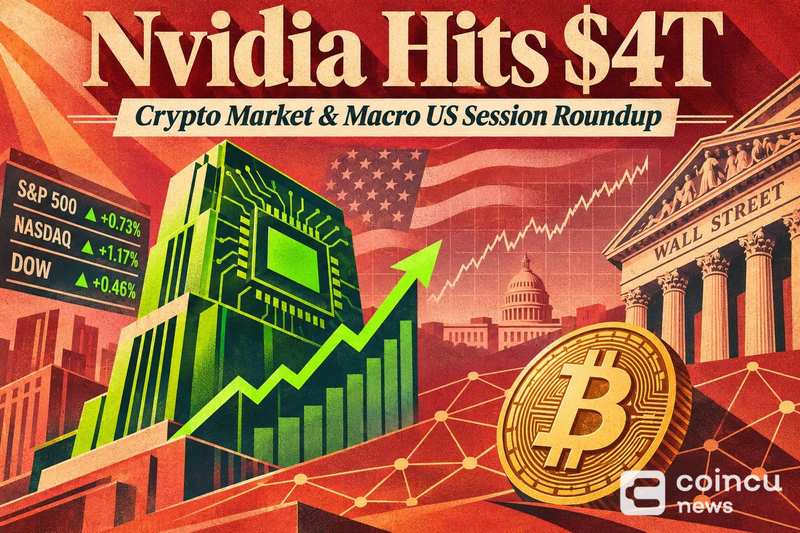
Nvidia's market capitalization briefly touched $4 trillion on November 23, 2026, after Jensen Huang returned as chief executive, according to Crypto Briefing. NVDA stock surged approximately 31.6% to $165 per share during the session, restoring Nvidia's position as the world's second-most-valuable company. Short sellers bore the immediate cost: estimated losses reached $12 billion, per the same report, while European short exchange-traded products on Nvidia were halted entirely due to the size of the move. For related coverage, see Coinbase and Nvidia Drive U.S. Market Gains to New Heights.
Cathie Wood's ARK Investment Management sold roughly $17 million in NVDA shares amid the rally, Crypto Briefing reported. The crypto market did not mirror the equity surge: the total crypto market capitalization stood at $2.11 trillion, Bitcoin traded near $61,525, and Ethereum near $1,742 around the same period, underscoring a stark divergence between AI-driven TradFi enthusiasm and digital-asset sentiment. The Fear & Greed Index registered 11, labeled Extreme Fear, at the time of session reporting. Context on this theme: Silver Overtakes Global Giants: Market Cap Hits $4.485 Trillion.
Nvidia's $4 trillion milestone matters for crypto market watchers because prior episodes of broad equity risk-on have occasionally preceded capital rotation into digital assets, though the session data showed no confirmed spillover. Coincu previously covered Nvidia stock volatility and its relationship to tech market sentiment, providing useful context for assessing the durability of Monday's move. More on this in Alphabet Surpasses $4 Trillion in Market Cap Milestone.
Treasury Secretary Bessent Urges Fed Against Half-Point Rate Hike at December Meeting
Treasury Secretary Scott Bessent told CNBC on November 20, 2026 that he would encourage the Federal Reserve not to embrace a half-point rate increase at the December 8-9 meeting, according to Forbes. Bessent cited an energy supply shock and a drop in crude prices as conditions the Fed should weigh before tightening further. He characterized one Fed governor's support for a 50-basis-point hike as "somewhat peripatetic," given that the same official had backed a comparable cut within the prior year. Background reading: Alphabet Surpasses $4 Trillion Market Cap Amid AI Collaboration.
Bessent's public pushback creates a rare executive-branch counter-signal to the Fed at a moment when Fed minutes, also released around November 23, showed broad official support for additional rate hikes, with some members explicitly favoring the larger half-point move, per Crypto Briefing's reporting on the Citadel story. Bitcoin added roughly 10% from its prior-week low as of the Forbes article's publication, though the report did not attribute that move solely to Bessent's comments.
The binary uncertainty ahead of December 8-9 is directly relevant to crypto risk appetite: a 25-basis-point outcome aligns with market pricing and would reduce near-term tightening pressure, while a 50-basis-point move would reprice risk assets across equity and digital-asset markets simultaneously.
Citadel Warns of Market Challenges as Fed Signals Potential Rate Hikes
Citadel Securities warned that markets may face further challenges amid slowing economic growth and Federal Reserve hawkishness, drawing an explicit parallel to 2018, when tightening financial conditions triggered declines in both equities and crypto, according to Crypto Briefing. The firm's warning coincided with the release of Fed minutes showing broad support for further rate increases, while market pricing as of the session favored a quarter-point hike as the most likely December outcome.
At the time of Crypto Briefing's publication, Bitcoin was trading near $61,525 and Ethereum near $1,742, levels that sit well below the year-to-date highs for both assets. Citadel's reference to 2018 is relevant: that year's tightening cycle saw Bitcoin fall from roughly $20,000 in January to below $4,000 by December, suggesting the firm views the current macro configuration as a comparable stress scenario rather than an isolated equity concern.
The $60,000 level in Bitcoin has been flagged by multiple analysts as a critical support threshold; Citadel's warning, paired with Bessent's counter-signal, leaves the December 8-9 meeting as the clearest near-term resolution point for this macro uncertainty. Coincu's earlier coverage of U.S. market gains driven by Coinbase and Nvidia provides context for how equity-side AI momentum has periodically intersected with crypto market sentiment.
S&P Global Analyst Says DeFi Lending Vault Investors Should Look Past the Yield
S&P Global Ratings analyst Lisa Schroeer said DeFi lending vault investors should evaluate vaults on liquidity, concentration risk, and stress performance rather than yield alone, according to Crypto Briefing. Schroeer introduced the VRA (Vulnerability Risk Assessment) framework around October 5-6, 2026, as DeFi vault deposits grew from roughly $1.5 billion two years prior to roughly $10 billion by September 2026, an increase of roughly 567% over that period.
Annual DeFi hacking losses represent between 0.07% and 0.30% of on-chain assets, per S&P's analysis. A Term Finance governance exploit in August 2026 caused an $8.5 million loss, illustrating the category of risk the VRA framework is designed to surface. Kraken now offers vault products, signaling that institutional participation in the sector has reached a scale where formal risk assessment frameworks from ratings agencies carry practical relevance.
The timing of S&P's framework is notable given the same-day Sky/stUSDS liquidity crisis, which saw a lending pool reach near-100% utilization due to concentrated borrower exposure: precisely the concentration risk Schroeer's framework flags as a primary vulnerability metric.
DeFi Development Corp Extends Solana Buying Streak to 11 Straight Weeks
DeFi Development Corp (Nasdaq: DFDV) extended its Solana treasury buying streak to 11 consecutive weeks since September 14, 2026, bringing its total SOL holdings to 2,624,491 SOL, according to The Block. The firm added approximately 5,180 SOL in the latest week, down from 9,482 SOL the prior week. DFDV stock rose 12% on Monday's session but remains down 54% year-to-date; SOL itself is down 40% in 2026, per The Block's reporting.
DFDV's preferred share class, CHAD, carries a 14% annualized dividend rate paid daily, and the company's NAV per share more than quadrupled in the third quarter. The largest public SOL treasury competitor, Forward Industries, holds 7.55 million SOL, giving context to DFDV's current 2.62 million SOL position. Separately, Solana officially retired its "mainnet beta" label during the same period, adopting Protocol Version 1.0.
DFDV's accumulation through a 40% drawdown mirrors Strategy's approach to Bitcoin treasury construction, and its persistence through the Extreme Fear environment suggests at least one institutional player has not changed its long-term Solana thesis despite the year's price underperformance.
Spark Liquidity Layer Recalls $408M in 24 Hours Amid Stablecoin Outflows
Spark Liquidity Layer executed an automated recall of $408 million in deployed capital across the Ethereum and Base networks via 316 transactions on November 18-19, 2026, according to Crypto Briefing. The recall proceeded in two phases: roughly $67.2 million was recalled on November 18 beginning around 21:00 UTC, followed by $339.2 million on November 19, with a peak rate of $114 million in a single 30-minute window. Triggers included approximately $1.9 billion in USDS outflows and a partial loan recall from Sky to replenish the Peg Stability Module.
After the recall, Spark retained $2.4 billion in stablecoin capital, and the Spark Liquidity Layer's total value locked stood at approximately $1.824 billion, down roughly 33% over the prior month from a peak in the range of $2.9 billion to $3.9 billion, per Crypto Briefing. Recent 30-day fee generation reached roughly $12 million. The SLL launched in November 2024 with no reported operational faults prior to this event.
The automated execution of a $408 million recall across 316 transactions without governance intervention demonstrates that programmatic DeFi risk management can operate at institutional scale; however, the underlying $1.9 billion in USDS outflows that triggered it reflects the genuine stress in the Sky ecosystem driven by Christensen's borrowing position.
Ethereum Reclaims $1,700 After Weekend Rebound as ETF Outflows Weigh on Recovery
Ethereum recovered from a weekend low of roughly $1,539 to a Monday intraday high of $1,845.07, closing around $1,783.80, a gain of roughly 3.45% on the session, according to Bitcoinist. The 14-day RSI recovered to 35.37 from a Friday low of 22.63, the latter reading below the 30 threshold conventionally associated with oversold conditions. Liquidation clusters concentrated between $1,825 and $1,850, overlapping the $1,826 resistance level Bitcoinist identified as critical for a sustained breakout.
The technical rebound occurred against a persistent institutional outflow backdrop: Ethereum spot ETFs recorded $305.8 million in net outflows for the week of November 16-20, per Bitcoinist. BlackRock's iShares Ethereum Trust accounted for $124.2 million in outflows on Thursday alone, representing roughly 95% of that day's total industry outflows, and an additional $60.8 million on Friday. As of the session's close, CoinGecko data showed Ethereum at $1,706.76, down 0.89% over 24 hours.
The divergence between ETH's oversold technical rebound and $305.8 million in weekly ETF outflows illustrates the competing forces on Ethereum's price: spot-market dip-buying from retail or algorithmic participants clashes with sustained institutional redemption pressure from the largest ETF vehicle in the category.
Sky Founder Considers Institutional Token Sale to Repay $77M Amid stUSDS Liquidity Crisis
Sky Protocol co-founder Rune Christensen publicly acknowledged that his borrowing drove the stUSDS lending pool to near-100% utilization, creating a liquidity crisis for depositors, according to Crypto Briefing. A wallet linked to Christensen held approximately 48% of the pool's outstanding borrowings as of November 19. He repaid $3 million in USDS as of the report's publication, with roughly $77 million remaining outstanding. Christensen said he is exploring selling SKY tokens directly to institutional investors to cover the balance and pledged updates every 48 hours.
"This is on me. I got overconfident in Sky's strength," Christensen said, per Crypto Briefing's reporting. The USDS stablecoin maintained its dollar peg throughout the event; the liquidity issue was reported as isolated to stUSDS, the staked and lending derivative of USDS, not the base stablecoin itself. Korean exchanges Upbit, Bithumb, and Coinone issued trading warnings or halted SKY token deposits, per Protos's reporting on related events.
Repaying the $77 million requires selling approximately 2 billion SKY tokens, per Protos data, against a token price that had fallen 58% from its prior-month peak to roughly $0.041 as of the session. The scale of the institutional SKY sale needed to resolve the position relative to the token's current market depth represents the central execution risk in Christensen's proposed resolution path.
USDS Stakers Drain Sky Liquidity Pool in 24 Seconds After Christensen's $3M Repayment
The entire $3 million USDS repayment Rune Christensen made to the stUSDS pool was withdrawn in 24 seconds, returning available liquidity to zero, according to Protos. One user withdrew approximately $1.58 million; arbitrage bots swept the remainder, with roughly $910,000 routed through Curve Finance. The pool holds approximately $158.7 million in total assets, and interest rates hit the 50% annualized ceiling to attract new deposits, with no effect on restoring available liquidity.
stUSDS traded at approximately $0.88 versus its $1.00 peg as of Protos's reporting. SKY fell 58% from its prior-month peak to roughly $0.041. Chinese trader Du Jun publicly offered to buy Christensen's entire SKY position, Protos reported, though no transaction had been confirmed at the time of publication. Korean exchanges Upbit, Bithumb, and Coinone issued trading warnings or halted deposits for SKY tokens.
The 24-second drainage of a $3 million repayment against $77 million in outstanding debt illustrates that piecemeal remediation is not viable at the current scale of the liquidity deficit; the crisis will require either a single large institutional purchase of Christensen's SKY position or a governance-level intervention to restructure the pool's terms.
USDC Treasury Mints 250M USDC on Solana, Boosting Liquidity Potential
The USDC Treasury minted 250 million USDC on the Solana network on November 23, 2026, as reported by on-chain monitoring service Whale Alert, according to Crypto Briefing. Similar mints were reported four days and eleven days prior, suggesting a recurring cadence. No recipient or intended use was disclosed, and it remained unclear at the time of publication whether the newly minted tokens would enter circulation immediately or be held in reserve.
SOL was trading at roughly $73, up approximately 3.1%, at the time of Crypto Briefing's publication. As of the session's close, CoinGecko data showed Solana at $71.88, up 1.76% over 24 hours, with a market capitalization of $42.56 billion. The Fear & Greed Index stood at 11 (Extreme Fear) at the time of publication.
Three 250-million-USDC mints on Solana within eleven days expands the stablecoin supply available for DeFi and trading on the network, though the absence of disclosure on recipients or circulation timing limits any firm conclusion about whether the mints reflect anticipated demand or routine treasury operations.
Session Outlook: What These Stories Add Up To
Outlook as of 23:59 UTC on November 23, 2026, based on reports published from 12:00 UTC on November 23, 2026 to 23:59 UTC on November 23, 2026.
Overall read: Mixed. Nvidia's $4 trillion milestone and Bessent's pushback against a 50-basis-point hike represent the session's clearest bullish macro catalysts for risk assets, while the Sky/stUSDS liquidity crisis, $305.8 million in Ethereum ETF outflows, and an Extreme Fear reading of 11 reflect persistent crypto-specific headwinds that prevented TradFi's enthusiasm from translating into digital-asset gains during the window.
- Nvidia Hits $4T (Nov 23, 21:09 UTC): Positive for Crypto Market & Macro, because a $4 trillion AI-sector milestone and $12 billion in short-seller losses signal strong equity risk appetite that could eventually spill into digital assets.
- Bessent Urges Fed Against 50bps Hike (Nov 23, 13:35 UTC): Positive for Crypto Market & Macro, because a 25-basis-point outcome at the December 8-9 meeting would reduce tightening pressure on risk assets including crypto.
- Citadel Warns of Market Challenges (Nov 23, 19:08 UTC): Negative for Crypto Market & Macro, because Citadel's 2018 parallel and Fed minutes showing broad support for further hikes represent a concrete downside scenario for both equity and crypto markets.
- S&P Global VRA Framework for DeFi Vaults (Nov 23, 12:21 UTC): Neutral for Crypto Market & Macro, because the framework highlights structural vault risks without altering current market conditions, though its timing alongside the Sky crisis adds immediate context.
- DeFi Development Corp 11-Week SOL Streak (Nov 23, 15:34 UTC): Positive for Crypto Market & Macro, because sustained institutional accumulation of 2.62 million SOL through a 40% drawdown signals long-term conviction in the network.
- Spark Liquidity Layer $408M Recall (Nov 23, 16:05 UTC): Negative for Crypto Market & Macro, because while the automated mechanism functioned, the $1.9 billion in underlying USDS outflows reflects systemic stress in the Sky ecosystem.
- Ethereum Reclaims $1,700 Amid ETF Outflows (Nov 23, 16:03 UTC): Neutral for Crypto Market & Macro, because the technical recovery from oversold conditions is offset by $305.8 million in weekly ETF outflows and a failed breakout above $1,826 resistance.
- Sky Founder Seeks Institutional SKY Sale to Repay $77M (Nov 23, 17:35 UTC): Negative for Crypto Market & Macro, because a protocol co-founder holding 48% of pool borrowings and seeking to sell roughly 2 billion tokens to cover the debt introduces governance concentration risk and potential token supply pressure.
- stUSDS Pool Drained in 24 Seconds (Nov 23, 19:57 UTC): Negative for Crypto Market & Macro, because maximum interest rates failed to attract deposits and Korean exchanges halted SKY trading, indicating the liquidity crisis is deepening rather than stabilizing.
- USDC Treasury Mints 250M USDC on Solana (Nov 23, 19:16 UTC): Positive for Crypto Market & Macro, because a third consecutive large USDC mint on Solana within eleven days expands the network's stablecoin liquidity base, supportive for DeFi activity even if the immediate price impact is neutral.
Of the ten kept stories, four are positive, four are negative, and two are neutral for Crypto Market & Macro.
Connecting the dots: The session suggests a macro environment defined by contradictory signals pulling risk appetite in opposite directions. Nvidia's $4 trillion milestone and Bessent's public resistance to aggressive Fed tightening point toward a scenario where AI-driven equity enthusiasm could eventually extend to digital assets, yet the Sky/stUSDS contagion dynamics, persistent Ethereum ETF outflows, and an Extreme Fear reading of 11 indicate that crypto-specific headwinds are substantial enough to prevent direct translation of TradFi risk-on sentiment. The simultaneous $408 million Spark recall and 24-second drainage of Christensen's $3 million repayment together point to a DeFi liquidity stress event of a scale that automated mechanisms alone may not fully absorb.
What could happen next: If the Federal Reserve limits itself to a 25-basis-point hike at the December 8-9 meeting, as Bessent publicly encouraged, the reduction in tightening pressure could allow the Nvidia-driven equity momentum to reach crypto markets in the sessions that follow. If Rune Christensen completes an institutional SKY token sale sufficient to cover a meaningful portion of his $77 million outstanding debt before his next 48-hour update, that could reduce the pool utilization overhang and stabilize stUSDS closer to its peg. If neither condition is met before the December 8-9 meeting, the combination of Fed hawkishness and unresolved Sky ecosystem stress could reinforce the Extreme Fear reading over the coming weeks.
This outlook is editorial analysis based on the reports above and is not financial advice.
What to Watch Next
- Federal Reserve December 8-9 meeting: The FOMC meeting is the clearest near-term macro catalyst; the Fed minutes released around November 23 showed broad support for further rate hikes, while Bessent publicly discouraged a 50-basis-point move, leaving the outcome unresolved as of session close.
- Rune Christensen 48-hour update: Christensen pledged updates every 48 hours on his institutional SKY token sale plan to cover approximately $77 million in outstanding stUSDS borrowings; the first scheduled update falls within the next two days of this roundup's publication.
This roundup summarizes reporting published from 12:00 UTC on November 23, 2026 to 23:59 UTC on November 23, 2026. Each item links to its original source.
Editorial credits
LZ
Liam Zhang
Writer · Coincu
HN
Haruto Nakamura
Editor · Coincu
Monitors published articles around the clock and can correct or withdraw them.
Checked by Coincu QC Team before publishing on November 24, 2026 for headline accuracy, original value, metadata, commercial disclosure, authorship claims and risk disclosure: our AI review system checks every article before it goes live, and our editor monitors it after publication. Report an error.
Coincu uses AI for research, drafting and review. Our editorial team is responsible for every article and corrects or withdraws articles when needed. How we review.
Disclaimer: This article is for informational purposes only and does not constitute financial or investment advice. Cryptocurrency and digital asset markets carry significant risk. Always do your own research before making decisions.
The post Nvidia Hits $4T: Crypto Market & Macro US Session Roundup was initially published on Coincu.