Key Highlights NVDA shares climbed over 10% during the week, finishing Friday’s session at $223.96 SpaceX revealed plans to deploy Nvidia chips exclusively across both terrestrial and space-b
Key Highlights
- NVDA shares climbed over 10% during the week, finishing Friday’s session at $223.96
- SpaceX revealed plans to deploy Nvidia chips exclusively across both terrestrial and space-based data center infrastructure
- Reports indicate Nvidia may scale back HBM memory specifications for its next-generation Rubin Ultra processor amid supply constraints
- AMD shares initially fell approximately 8% following earnings before recovering to close the week nearly 2% higher
- Wall Street maintains a consensus “Buy” recommendation on NVDA with a mean price objective of $304.26
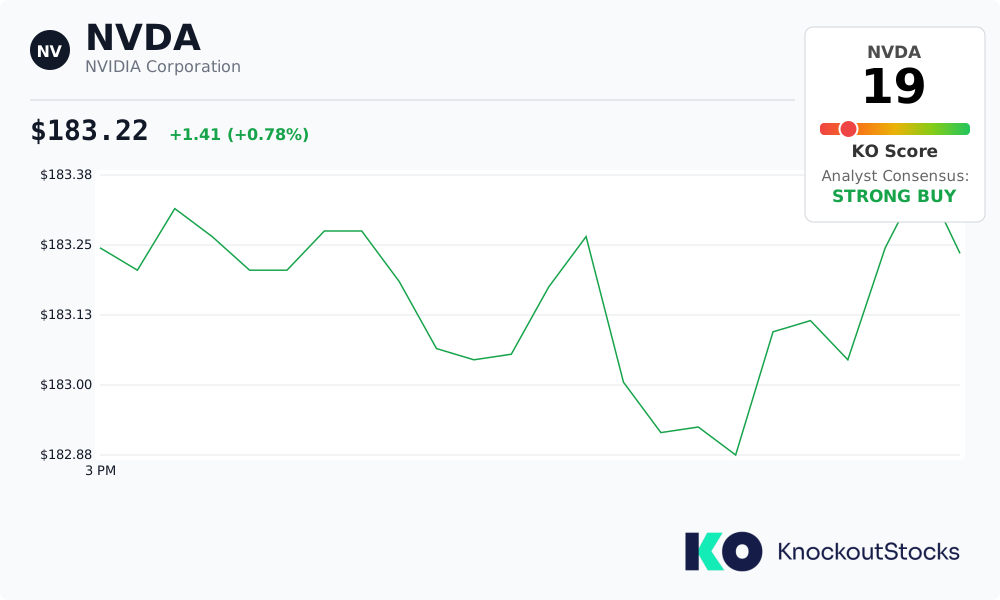
Nvidia shares concluded Friday’s trading at $223.96, marking a weekly advance exceeding 10%. The broader Philadelphia Semiconductor Index demonstrated similar strength, climbing more than 8% throughout the five-day period.
 NVIDIA Corporation, NVDA
This recovery comes after semiconductor stocks endured a challenging period marked by investor anxiety regarding artificial intelligence valuations and whether underlying business performance could justify premium multiples. Market sentiment improved notably this week as these concerns subsided.
The primary driver emerged from SpaceX. During the aerospace company’s inaugural earnings conference call on Tuesday, CEO Elon Musk revealed plans to construct data centers utilizing Nvidia’s technology exclusively, with deployments planned for both Earth-based facilities and orbital installations.
Musk specified that SpaceX intends to deploy Nvidia’s Vera Rubin-powered NVL72 rackscale systems for terrestrial operations, while customized variants would be launched into space-based environments.
Memory Configuration Adjustments for Rubin Ultra
However, the week wasn’t entirely without challenges. According to a Thursday report from The Information, Nvidia is evaluating reduced high-bandwidth memory configurations for its forthcoming Rubin Ultra processor.
Initial specifications called for Rubin Ultra to incorporate 1TB of HBM. The publication indicates Nvidia is currently evaluating alternatives featuring 192GB and 256GB capacities, representing a decrease from the 288GB configuration deployed in the existing flagship Rubin processor. Supply chain constraints affecting global memory availability were identified as the driving factor.
Notwithstanding this development, NVDA shares maintained their upward trajectory throughout the remainder of the week.
From an institutional investment perspective, Steelhead Wealth Management acquired 3,856 shares during the first quarter, representing approximately $672,000 in value. Institutional stakeholders collectively control 65.27% of outstanding shares.
Nvidia’s most recent quarterly report, published May 20, delivered earnings per share of $1.87, surpassing analyst expectations of $1.76. Revenue totaled $81.61 billion, exceeding the $78.42 billion consensus forecast and representing year-over-year growth of 85.2%.
Management also authorized an $80 billion stock repurchase program and increased the quarterly dividend to $0.25 per share from the previous $0.01.
AMD Experiences Volatility
AMD navigated a more turbulent week in comparison. Despite surpassing second-quarter projections and providing encouraging third-quarter guidance, investor reaction proved disappointing, with shares declining approximately 8% following the earnings announcement.
AMD managed to recoup most losses, finishing the week modestly higher by just under 2%.
From a longer-term perspective, AMD has delivered exceptional returns of 180% over the trailing twelve months, significantly outperforming Nvidia’s 28% appreciation during the same timeframe. AMD’s central processing unit division and its forthcoming Helios rackscale platform, designed to compete directly with Nvidia’s NVL72 solution, have fueled this performance.
AMD also expanded its AI inference capabilities through the acquisition of startup Taalas. Industry analysts observed that while strategic, the transaction doesn’t immediately narrow the competitive gap with Nvidia.
Regarding analyst coverage, Wedbush Securities elevated its NVDA price target from $300 to $330 while maintaining an outperform rating. Wells Fargo reaffirmed its overweight stance with a $315 target. The consensus street target stands at $304.26, supported by 48 buy recommendations, 3 strong buy ratings, and 2 hold ratings.
Corporate insider transactions skewed toward dispositions, with 45 sales and zero purchases documented over the previous six months. Board member Mark A. Stevens divested 885,000 shares at an average price of $210.17 in June.
NVDA’s 52-week trading range extends from a low of $164.07 to a peak of $236.54.
The post Nvidia (NVDA) Stock Surges 10% Following SpaceX Partnership Announcement appeared first on Blockonomi.