Key Takeaways NVDA has climbed 11% in 2026 but significantly underperforms the PHLX Semiconductor Index’s 88% surge Major clients including Microsoft and Meta are developing proprietary chips
Key Takeaways
- NVDA has climbed 11% in 2026 but significantly underperforms the PHLX Semiconductor Index’s 88% surge
- Major clients including Microsoft and Meta are developing proprietary chips to reduce AI infrastructure expenses
- First-quarter revenue reached $81.62B, representing an 85.2% year-over-year increase and exceeding analyst projections
- NVDA’s forward P/E ratio sits at 20.2x, notably below the semiconductor sector’s 26.8x average
- Analyst consensus remains bullish with a “Buy” rating and mean price target of $305.67
Nvidia shares started Wednesday’s session at $207.41 following a 2.4% decline the previous day. Though the stock has posted an 11% advance in 2026, this performance pales in comparison to the PHLX Semiconductor Index’s impressive 88% rally during the identical timeframe.
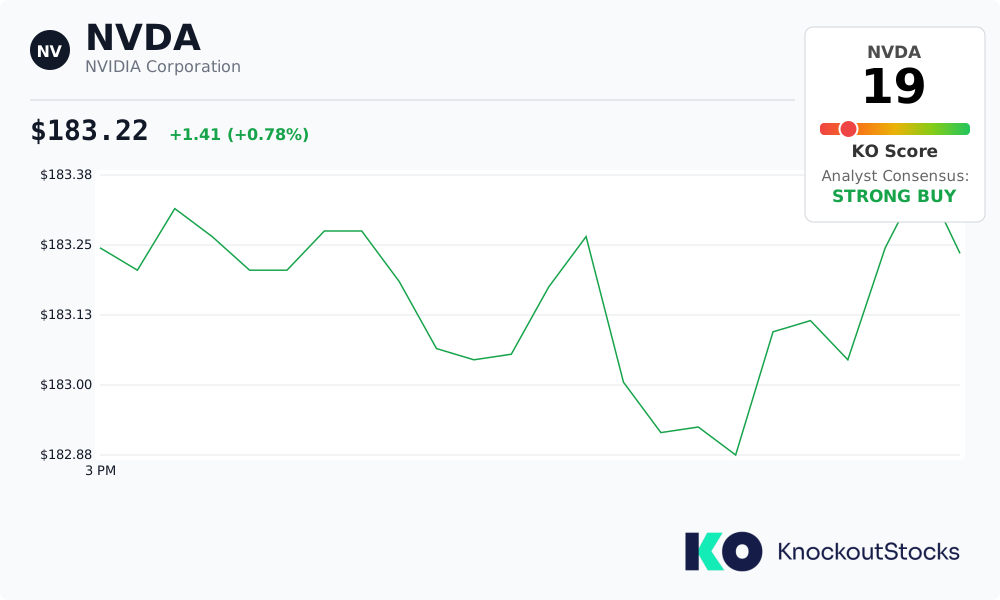 NVIDIA Corporation, NVDA
This performance disparity hasn’t gone unnoticed by market observers. NVDA currently commands a forward P/E multiple of 20.2x, sitting well below the semiconductor sector’s 26.8x average — a valuation discount that suggests mounting skepticism about Nvidia’s ability to maintain its stranglehold on artificial intelligence chip expenditures.
The underlying challenge is clear-cut: the enormous wave of AI hardware capital allocation is becoming increasingly fragmented. Specialized chip architects and processor manufacturers are capturing larger portions of budgets that previously flowed almost exclusively toward Nvidia’s offerings.
Microsoft and Meta — representing two of Nvidia’s most significant revenue sources — are actively engineering proprietary semiconductor solutions to diminish dependence on external chip suppliers. This strategic shift aims to compress infrastructure expenses as datacenter investments consume substantial operating cash flow.
Cloud Giants Face Capital Expenditure Crunch
Epoch AI analyst Isabel Juniewicz highlighted in a recent Tuesday analysis that combined capital expenditures across major cloud service providers are projected to surpass their collective operating cash flow around the third quarter of 2026. This approaching inflection point creates urgency for Nvidia to expand its revenue streams before these technology giants potentially curtail spending.
Nvidia is positioning itself to capture emerging demand from robotics applications, space-based data infrastructure, and government-sponsored artificial intelligence initiatives to compensate for any prospective shortfall.
Regarding institutional positioning, Talos Eurisko Asset Management expanded its NVDA holdings by 21.1% during the fourth quarter, acquiring 38,149 additional shares to establish a total position of 218,900 units, representing approximately $40.8 million in value. Institutional ownership now comprises 65.27% of outstanding shares.
Insider transactions paint a contrasting picture. Chief Financial Officer Colette Kress divested shares valued at $7.46 million during March, while Board Director Mark A. Stevens liquidated $109.9 million in holdings in early June. Corporate insiders have collectively sold $277.4 million worth of stock throughout the most recent quarter.
Notwithstanding the stock’s relative weakness, Nvidia’s operational metrics remain robust. The company delivered Q1 earnings per share of $1.87, surpassing the consensus projection of $1.76, alongside revenue totaling $81.62 billion — eclipsing the $78.42 billion estimate and marking an 85.2% year-over-year expansion.
Nvidia additionally unveiled an $80 billion stock repurchase authorization and elevated its quarterly dividend from $0.01 to $0.25 per share, with distribution scheduled for June 26.
Wall Street sentiment continues positive. JPMorgan elevated its valuation target to $280, Bank of America established a $350 objective, and Mizuho maintains a $300 forecast. The aggregated price target across 54 covering analysts reaches $305.67, encompassing 48 Buy recommendations and three Hold ratings.
Nvidia also secured approximately $20 billion through its inaugural bond offering since the artificial intelligence surge commenced, demonstrating management’s conviction in sustained infrastructure investment opportunities.
The stock oscillates within a 52-week band of $142.03 to $236.54 and carries a market capitalization of $5.02 trillion.
The post Nvidia (NVDA) Stock: Why the AI Chip Giant Is Underperforming in 2026 appeared first on Blockonomi.