OCBC and StraitsX launched a cross-border B2B stablecoin payments pilot on November 23, 2026, marking a significant step toward integrating digital-asset settlement rails with established cor
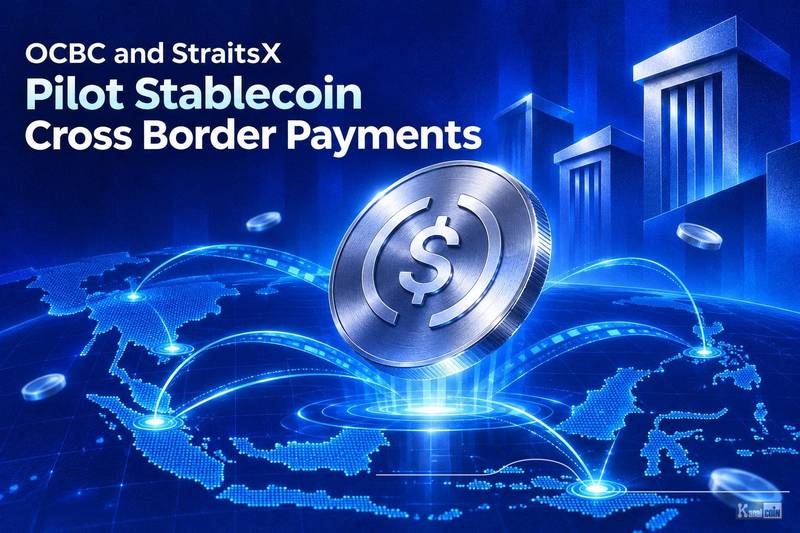
OCBC and StraitsX launched a cross-border B2B stablecoin payments pilot on November 23, 2026, marking a significant step toward integrating digital-asset settlement rails with established corporate banking infrastructure in Southeast Asia. The initiative allows its identified pilot participant to receive stablecoin payments directly into an existing OCBC bank account, without managing digital assets itself.
What the OCBC and StraitsX stablecoin payments pilot involves
The pilot pairs StraitsX's blockchain payment infrastructure with OCBC, to create a stablecoin-linked payment corridor for business clients. Receiving companies do not need to hold or manage stablecoins at any point in the transaction flow. For related coverage, see Solana ETF Inflows: Ethereum Asia Session Roundup.
StraitsX's Dedicated Wallet Address (DWA) infrastructure handles the stablecoin side of each transaction: collection, payment identification, on-chain compliance checks, reconciliation, and settlement. OCBC then provides the fiat off-ramp and maintains the recipient banking relationship, depositing settled funds into the business's existing OCBC account. Context on this theme: Bitcoin Briefly Falls to $17,000 on Kraken; Exchange Says No Hack.
NTT DOCOMO Asia is the first company to participate in the pilot. According to Fintech News Singapore, the first live payment originated in Japan and settled into an OCBC account the same day, completing after the conventional Japanese yen currency cut-off time had already passed. More on this in Ethereum Classic (ETC) Rises 4.17% in 24 Hours: What the Data Shows.
StraitsX holds a Major Payment Institution license from the Monetary Authority of Singapore (MAS) and issues two regulated stablecoins: XSGD, pegged to the Singapore dollar, and XUSD, pegged to the US dollar. Both are issued under Singapore's Stablecoin Issuance Framework, giving the pilot a defined regulatory foundation that many comparable cross-border experiments lack.
"Stablecoins can move value efficiently across borders, but businesses still need a straightforward way to receive and manage those payments within their existing financial operations."
Tianwei Liu, CEO and Co-Founder, StraitsX — Fintech News Singapore
Carmen Chan, Deputy Head of Global Transaction Banking at OCBC, framed the bank's participation as an exploration of how stablecoin payments can be layered onto existing services rather than replace them, stating the collaboration with StraitsX allows the bank to explore how stablecoin-based payments can be integrated with established banking services, according to The Block.
Why stablecoins are being tested for cross-border settlement
Traditional correspondent banking routes for B2B cross-border payments carry currency cut-off windows, and reconciliation overhead. Stablecoin networks operate continuously, which is why the NTT DOCOMO Asia payment completing after the JPY cut-off time is highlighted as a proof point in this pilot, not a minor technical footnote.
The design of this pilot is notably conservative. By routing settlement back into standard OCBC accounts, StraitsX and OCBC are targeting corporate finance teams that have no appetite for managing crypto wallets, private keys, or stablecoin liquidity. The DWA model abstracts the blockchain layer entirely from the corporate recipient. Singapore's approach to blockchain adoption in enterprise settings has increasingly focused on this kind of invisible infrastructure, a trend also visible in the country's broader regional push to integrate blockchain into existing business workflows.
Both StraitsX and OCBC participate in MAS's BLOOM initiative, launched in October 2025 to develop use cases for tokenized bank deposits and stablecoin networks, according to Ledger Insights. On November 19, 2026, just four days before this pilot announcement, StraitsX, OCBC, and Standard Chartered separately completed a tokenized deposit interoperability proof-of-concept under Project BLOOM.
MAS's BLOOM initiative provides the regulatory framing that matters for institutional adoption. Without a licensed stablecoin issuer operating under a defined framework, most corporate treasury teams and their legal departments would not engage with a pilot of this kind. StraitsX's MPI license from MAS and its status as an early issuer under the Stablecoin Issuance Framework directly address that barrier, as Ledger Insights noted in its analysis of the DWA model.
What to watch as the pilot develops
The current pilot is narrow by design: one participant, one payment corridor, one bank as the off-ramp. The critical disclosures that will determine the initiative's broader significance include which additional payment corridors are supported beyond Japan-Singapore, whether XUSD (the dollar-pegged stablecoin) is activated alongside XSGD for USD-denominated B2B flows, and what the reconciliation failure rate looks like at scale.
The Japan corridor matters beyond NTT DOCOMO Asia as a single client. A working JPY-originating stablecoin corridor that settles into a Singapore bank account without manual forex intervention would be a commercially meaningful product for Japanese companies with ASEAN subsidiaries.
For Southeast Asian markets, the model's significance is partly structural: it uses a Singapore-regulated stablecoin issuer and a Singapore bank as anchor institutions, which fits the MAS-led approach of building regional payment infrastructure through licensed intermediaries rather than decentralized protocols. If this pilot moves to a broader rollout, the questions for regional exchanges and financial institutions will center on which banks in Indonesia, the Philippines, Thailand, and Malaysia could serve the same off-ramp function that OCBC plays here, and whether local regulators in those jurisdictions would recognize MAS-licensed stablecoins as a compliant settlement instrument.
No timeline for a wider deployment has been announced. The pilot's scope, compliance requirements, and operational parameters will all need to be assessed before any commercial rollout, and both companies have framed the current phase as exploratory.
TLDR Key Points
- Pilot partners: StraitsX (MAS-licensed stablecoin issuer, XSGD/XUSD) and OCBC launched a cross-border B2B stablecoin payments pilot on November 23, 2026.
- How it works: StraitsX's DWA infrastructure handles stablecoin collection and compliance; OCBC provides the fiat off-ramp so corporate recipients receive funds in existing bank accounts without touching digital assets directly.
- What's still needed: The pilot is in an early, single-participant stage with NTT DOCOMO Asia; supported corridors, settlement design at scale, participant scope, and a commercial rollout decision all remain to be established.
Editorial credits
EP
Ethan Parker
Writer · Kanalcoin
AK
Aisha Khan
Editor · Kanalcoin
Monitors published articles around the clock and can correct or withdraw them.
Checked by Kanalcoin QC Team before publishing on November 24, 2026 for headline accuracy, original value, factual consistency and authorship claims: our AI review system checks every article before it goes live, and our editor monitors it after publication. Report an error.
Kanalcoin uses AI for research, drafting and review. Our editorial team is responsible for every article and corrects or withdraws articles when needed. How we review.
Disclaimer: This article is for informational purposes only and does not constitute financial or investment advice. Cryptocurrency and digital asset markets carry significant risk. Always do your own research before making decisions.
Read original article on kanalcoin.com