Crypto fortunes have often been measured in balance sheets, not shopping carts. But over the years, a handful of prominent figures have converted digital wealth into eye-catching, sometimes s
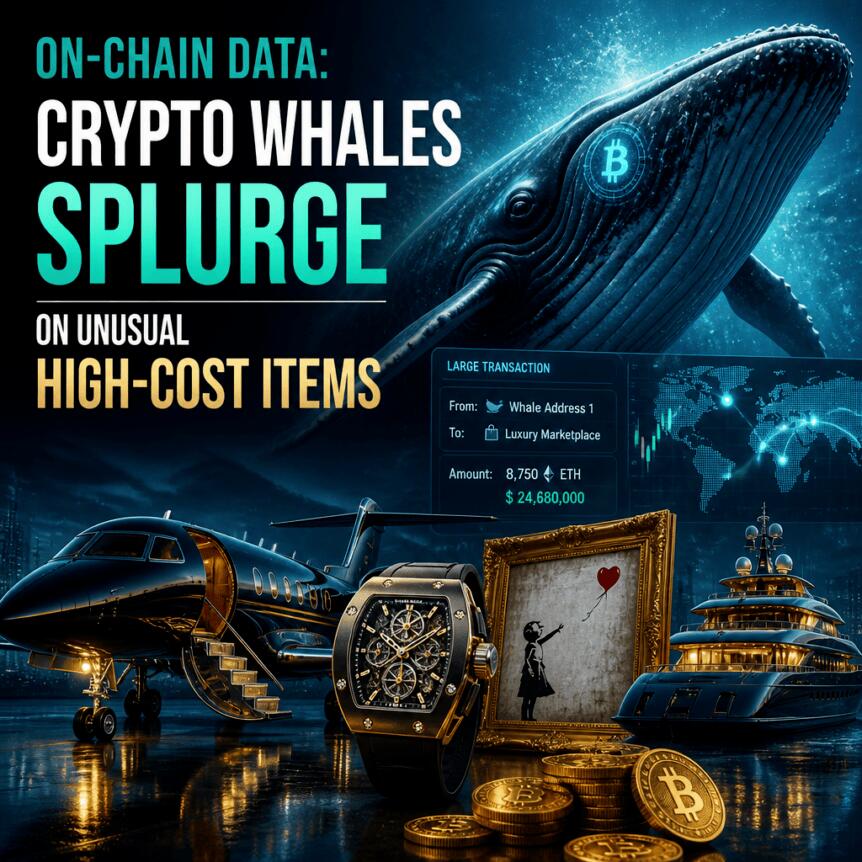
Crypto fortunes have often been measured in balance sheets, not shopping carts. But over the years, a handful of prominent figures have converted digital wealth into eye-catching, sometimes surreal real-world purchases—ranging from sky-high space access to high-end art with billion-dollar punchlines.
Below are seven of the strangest examples where early adopters and major crypto personalities reportedly spent millions (or more) in ways that show how differently “luxury” can look when it’s funded by crypto.
Key takeaways
- Virgin Galactic’s early promise to accept Bitcoin led to high-profile purchases that were ultimately tied up for years amid delays and fleet retirement.
- Justin Sun’s $6.24 million “banana” purchase illustrates how crypto wealth can be directed toward celebrity-grade, attention-driven collectibles.
- For some pioneers, the most unusual “investment” has been cryonics—raising questions about how crypto communities fund long-horizon personal bets.
- Crypto money has also reached into traditional luxury markets, including rare fossils and historic memorabilia, with Bitcoin-era narratives shaping the purchases.
- Even flagship NFT milestones—like MetaKovan’s Beeple sale—show that the biggest crypto art trades can be as symbolic as they are financial.
Bitcoin’s longest detour: space tickets that never took off
In November 2013, British entrepreneur Richard Branson—founder of Virgin Group—publicly announced that Virgin Galactic would accept Bitcoin for spaceflight tickets, according to coverage in The Guardian. At the time, a ticket was priced at $250,000, a figure that drew curiosity among early Bitcoin holders.
In March 2014, the Gemini founders Cameron and Tyler Winklevoss each purchased a ticket using Bitcoin, with their purchase tied to the plan to fund the flights via BTC, as described by Winklevoss Capital. The tickets did not lead to an actual trip: the flights were repeatedly delayed, and Virgin Galactic’s VSS Unity was officially retired from spaceflight in June 2024.
The episode highlights how early crypto “utility” narratives sometimes collided with real-world execution risk. Even when the payment method is credible, delivery timelines can be dominated by engineering and operational constraints.
Other crypto-connected space moves followed later. The article notes that Tron founder Justin Sun flew briefly on Blue Origin in 2025 for $28 million, and that f2pool co-founder Chun Wang flew on SpaceX’s Fram2 mission. It also cites estimates—sourced to Sky News—that the Fram2 mission could cost around $220 million, though the exact payment for Wang is not specified.
A banana for $6.24 million: collectibles, celebrity, and crypto-funded spectacle
Not all crypto spending is aimed at permanence. In November 2024, Tron founder Justin Sun reportedly paid $6.24 million for Maurizio Cattelan’s Comedian, according to the auction report by Sotheby’s. The artwork consists of a banana duct-taped to a wall.
Sun later carried out the purchase in public by eating the banana at a press conference in Hong Kong, tying the performance to the piece’s concept and to the spectacle that often surrounds high-profile crypto figures. The article emphasizes that the central value of what he bought was not the banana itself, but the authenticity documentation and instructions for installing the work.
For investors and traders watching crypto’s cultural footprint, purchases like this are a reminder that attention can be part of the product. When crypto wealth enters mainstream luxury auctions, it can turn “collecting” into media events—and that can influence market perception as much as ownership does.
Cryonics: when the bet is on future technology, not today’s returns
While most extravagant crypto spending aims at immediate status, some early Bitcoin participants directed money toward longer-term personal hopes. The article points to Hal Finney, an early Bitcoin contributor and recipient of the first Bitcoin transaction from Satoshi Nakamoto, who was cryopreserved after his death in August 2014.
Finney was reportedly a member of the Alcor Life Extension Foundation for more than two decades. His cryopreservation was said to have been paid for through a mix of life insurance and Bitcoin donated by fans, referenced via Cryonics Archive.
The same piece notes that investor Peter Thiel and “Bitcoin Jesus” Roger Ver were also set to undergo cryonics. It further cites earlier comments from Ver in a 2021 interview where he discussed seriously considering suicide and cryopreservation to avoid being sent to jail, as covered by Cointelegraph in its magazine.
For readers, the key uncertainty is the same across all cryonics stories: the feasibility of revival is unknown. Yet the willingness of crypto insiders to fund such plans illustrates how digital wealth can support radically different time horizons than the usual “bull market to profit” cycle.
From dinosaurs to diamonds: crypto’s reach into rare-asset markets
Some of the strangest spending isn’t even about “crypto,” but about how crypto fortunes buy into categories that feel far removed from blockchain trading.
In 2025, the article says a group of investors—including Yoann Turpin, co-founder of cryptocurrency market maker Wintermute—spent $5 million on a Triceratops skeleton. Bloomberg is cited as the source for that figure in the original reporting, and the piece adds that the fossil was shipped from Wyoming to a storage facility in Singapore. It also notes Turpin’s reported comparison of the fossil’s scarcity to Bitcoin’s limited supply, citing Bloomberg Law.
Another example of crypto-adjacent luxury is the purchase of a major black diamond by HEX founder Richard Heart. In February 2022, Heart reportedly acquired The Enigma, a 555.55-carat black diamond, for approximately $4.3 million, with the acquisition tied to auction reporting by Rapaport. The diamond—also known as a carbonado—was described as among the largest faceted diamonds ever offered at auction.
The article also states that Heart later renamed it the HEX.com diamond, connecting the purchase to his cryptocurrency project. It cites a U.S. Securities and Exchange Commission civil case filed in 2023 in which the regulator alleged misappropriation of investor assets, including funds used to purchase the diamond, referencing the SEC complaint PDF via SEC.gov. It further notes that Heart was arrested in Turkey earlier that year due to an Interpol Red Notice connected to separate Finnish tax fraud charges, though those details are presented without additional sourced context in the article beyond the mention itself.
These examples underscore a pattern: once crypto money enters tangible markets, it can pull regulatory and reputational risks along with it—especially when purchases are framed as part of a token-linked brand narrative.
NFT history at full volume: a $69 million Beeple sale
Crypto’s weirdest spending has also occurred in the most famous digital collectible category. In March 2021, cryptocurrency investor MetaKovan reportedly paid $69.3 million for Beeple’s EVERYDAYS: THE FIRST 5000 DAYS, with the sale described by Cointelegraph in its report. The article notes that the sale was priced at 42,329.453 Ether.
At the time, the purchase made the NFT the most expensive ever sold and one of the highest-priced artworks by a living artist, based on the figures and framing contained in the original report. It also adds that the owner had no intention of selling, though the piece suggests the current price likelihood of a similar trade is uncertain.
Unlike many of the other entries on this list, this purchase wasn’t about a one-off physical indulgence. It was about anchoring a new kind of cultural prestige inside blockchain-native markets—one that, even now, continues to shape how people evaluate art, scarcity, and ownership online.
Watching the next “weird spend” wave
As crypto matures, these stories are likely to shift from novelty to strategy—less about first-generation experiments like paying for space with Bitcoin, and more about how wealthy holders translate on-chain value into cultural capital, long-horizon bets, or mainstream luxury venues. The next headline will probably reveal whether that translation becomes more disciplined—or stays delightfully irrational.
This article was originally published as On-chain data: Crypto whales splurge on unusual high-cost items on Crypto Breaking News – your trusted source for crypto news, Bitcoin news, and blockchain updates.