Understanding Opal Chain Tokenomics and Token Economy It is a blockchain ecosystem tailored to lightning-quick transactions. Institutional-level security and unparalleled transparency. Anyone
Understanding Opal Chain Tokenomics and Token Economy
It is a blockchain ecosystem tailored to lightning-quick transactions. Institutional-level security and unparalleled transparency. Anyone can mine OPAL coins using their phones and join the unique Burn to Earn system, whereby coins are burned every 10 days to earn USDT.
Tokenomics of Opal Chain are designed for scarcity and steady growth. The ecosystem caters to regular mobile phone users, providing them with e-commerce payments, freelance payment solutions, merchant solutions, and marketplace services on a low-cost blockchain platform.
Addressing Market Challenges
Problems and Solutions
The Problems
• Delayed transaction times for real-time transactions.
• High cost of energy/hardware.
• Lack of mobile ecosystem.
• Transparency in token circulation is weak.
• No motivation for the community.
The Solutions
• Near-instantaneous, mobile-friendly transactions.
• Low-energy mining using a smartphone.
• Deflationary (tokens burnt every 10 days increase the price floor by $0.0015).
• Uses real-world utility such as e-commerce, freelancing, and merchants.
• On-chain transparency
Token Distribution and Allocation of Opal Chain
It uses a fixed number of coins to make things predictable and support long-term growth. Having a number of tokens helps stop too much inflation and creates a strong foundation for a healthy blockchain economy.
The controlled token release model is meant to promote token distribution and make the entire ecosystem more valuable. It helps achieve this by managing how many tokens are released. This approach supports the Opal ecosystem and its token.
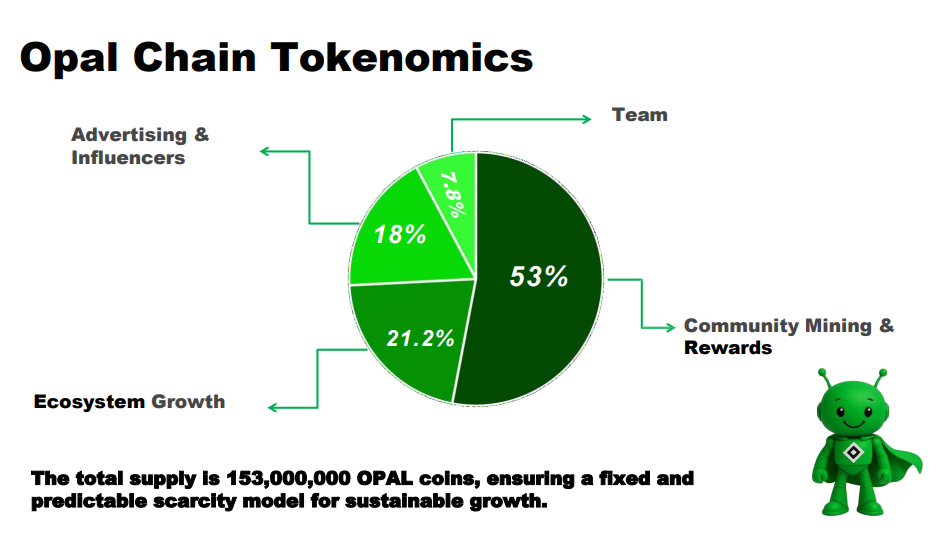
Rewarding mobile miners and early users in order to promote our decentralized platform.
For important partnerships, effective marketing campaigns, and improving the liquidity of our tokens.
For promoting campaigns and rewarding important influencers to make our token known across the globe.
For our main project team
Burning To Earn Model
It will employ a novel burning to earn model to reduce the circulating supply of coins and consequently make the tokens more scarce and valuable to the token holders.
The token burning will start again after the DEX listing. This means that every single community member will have the chance to take part in the burning process. The community members will be able to participate in the burn process of the burning.
Frequency of burning:15% of all tokenomics mined will be burnt after every 10 days, making the tokens out of circulation.
Burns Monthly:This means that every month, about 45% of all the coins mined will be burnt.
Effect on the Price: Each burn will raise the minimum price by $0.0015 starting from the current price of $0.05.
Ecosystem Utilities
E-commerce Transactions: Instant, borderless payments for online retailers.
Freelance Work Payments: Global payouts without high banking fees
Merchant Payment Gateways:Mobile-based POS solutions for small businesses.
Subscription Billing: Crypto-based recurring payments for digital services.
Peer-to-Peer Transfers:Fast, low-cost personal transactions
Opal pad
Multi-Chain Support: Build and launch Web3 projects seamlessly across a diverse array of blockchain networks, maximizing reach and interoperability.
User-Friendly Interface
This feature made it easy to get started with an onboarding process. The design is also very intuitive.
Tools ensure an accessible experience for both seasoned developers and emerging startups.
Fundraising & Distribution:
Robust tools for secure token sales, efficient distribution, and comprehensive financial management. Integration projects can leverage OPAL tokens, benefit from mobile minting, and integrate with Burn-to-Earn. It incentivizes helping to make things more sustainable. The goal is to help developers and entrepreneurs around the world.
The OpalPad is to be a place where they can launch all their Web3 projects in one go.
Technology and ArchitectureCategoryDetails
Consensus MechanismPoS + Byzantine Fault Tolerance
Blockchain LayersLayer 1 Core and Modular Rollups
Security ProtocolsCryptographic Audits and Multi-Sig
Scalability FeaturesSharding and Parallel ExecutionRevenue Model & Incentives
Transaction fees: It provides the minimal cost for each transaction.
Rewards: The steady coins flow to the user.
Burn-To-Earn: It offers regular USDT payouts for token burns.
Merchant Payment Fees: Business integration revenue.
Developer Integration: SDK/API usage fees.
Conclusion
MineOpals' system for tokens is not like the way of giving rewards. It does things like make sure everyone can use it reduce the number of coins over time and make it useful in the world. All of these things work together in one system. It does things like let people mine tokens on their phones have events where they burn tokens to earn more and use the blockchain in ways. The goal is to make an economy that is fair for people who just started and for people who have been around for a long time.
Disclaimer: Blockchain development outcomes vary based on effort and practice.. Conduct your own research before making any investment decision. We do not endorse any specific exchange or platform.