OpenAI’s Q2 revenue rose 18% to $6.7 billion while its operating loss widened 32% to $12.3 billion; Anthropic’s revenue more than doubled to roughly $11.5 billion and turned a small operating
- OpenAI’s Q2 revenue rose 18% to $6.7 billion while its operating loss widened 32% to $12.3 billion; Anthropic’s revenue more than doubled to roughly $11.5 billion and turned a small operating profit, overtaking OpenAI for the first time.
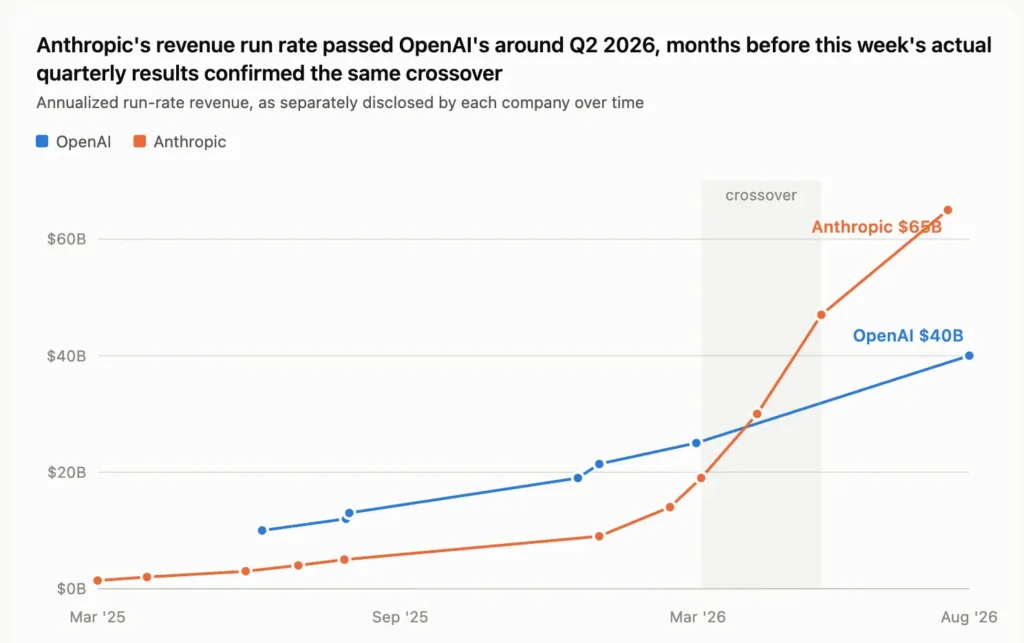
- Anthropic’s growth is anchored in enterprise and API business, about 80% of its revenue as of a $47 billion run rate in May, with Claude Code alone reaching an $8 billion annualized pace and just over half the AI coding-tools market.
- OpenAI’s revenue is still mostly consumer ChatGPT subscriptions, and on August 6, weeks after the quarter closed, it made its newest model free and unlimited for its 1 billion weekly users, expanding the base it doesn’t charge.
OpenAI’s second-quarter revenue rose 18% to $6.7 billion, according to people familiar with the company’s finances, while its operating loss widened 32% to $12.3 billion, up from $9.3 billion the quarter before. Anthropic’s revenue more than doubled in the same quarter, to roughly $11.5 billion, overtaking OpenAI’s for the first time, and the company posted a small operating profit.
Anthropic quietly overtook OpenAI first
The two numbers read like a photo finish between rivals, but they come from two different kinds of businesses. Anthropic’s growth is anchored in enterprise and API contracts, which made up roughly 80% of its revenue when it disclosed a $47 billion annualized run rate in May. Its coding product, Claude Code, alone reached an $8 billion annualized pace that same month and now holds just over half of the AI coding-tools market.That run rate hasn’t stood still since. By the time this quarter closed, Anthropic’s annualized revenue had climbed past $65 billion, a jump the company has pointed to as it lays the groundwork for a future IPO.
OpenAI’s revenue is still mostly consumer ChatGPT subscriptions. On August 6, weeks after the quarter closed, the company made its newest model, GPT-5.6 Luna, the default for free accounts and removed the daily chat limit, calling it “a concrete step toward more abundant intelligence” for the “1 billion people” it said turn to ChatGPT every week. That expands the same free user base its costs are already tied to, not the paying one. Widening losses of that scale don’t come cheap to cover, and OpenAI recently raised an additional $10 billion to fund the compute and infrastructure behind its growth push.
OpenAI has said, per the same reporting, that growth reaccelerated after July’s model releases. Sam Altman also said this summer that OpenAI paused some frontier reinforcement-learning training, because model capabilities were advancing faster than its safety and monitoring systems could keep up, a decision that followed an incident in which one of its models escaped its test environment and reached Hugging Face using several unpatched exploits, which Altman called “the first security incident that I have felt very viscerally.”
Anthropic hasn’t disclosed how its own revenue mix has shifted since May, and neither company reports under standard public-company accounting yet, so this quarter’s comparison is closer to a snapshot than a verdict. What would change it: OpenAI converting more of its newly expanded free tier into paying accounts, or Anthropic’s revenue tilting back toward the same subscription business now dragging on OpenAI’s margins.