"The question before the Court is not whether the Peraire-Buenos' conduct was right or moral, or even whether it violated uncharged crimes," US District Judge Jessica Clarke wrote on 16 Novem
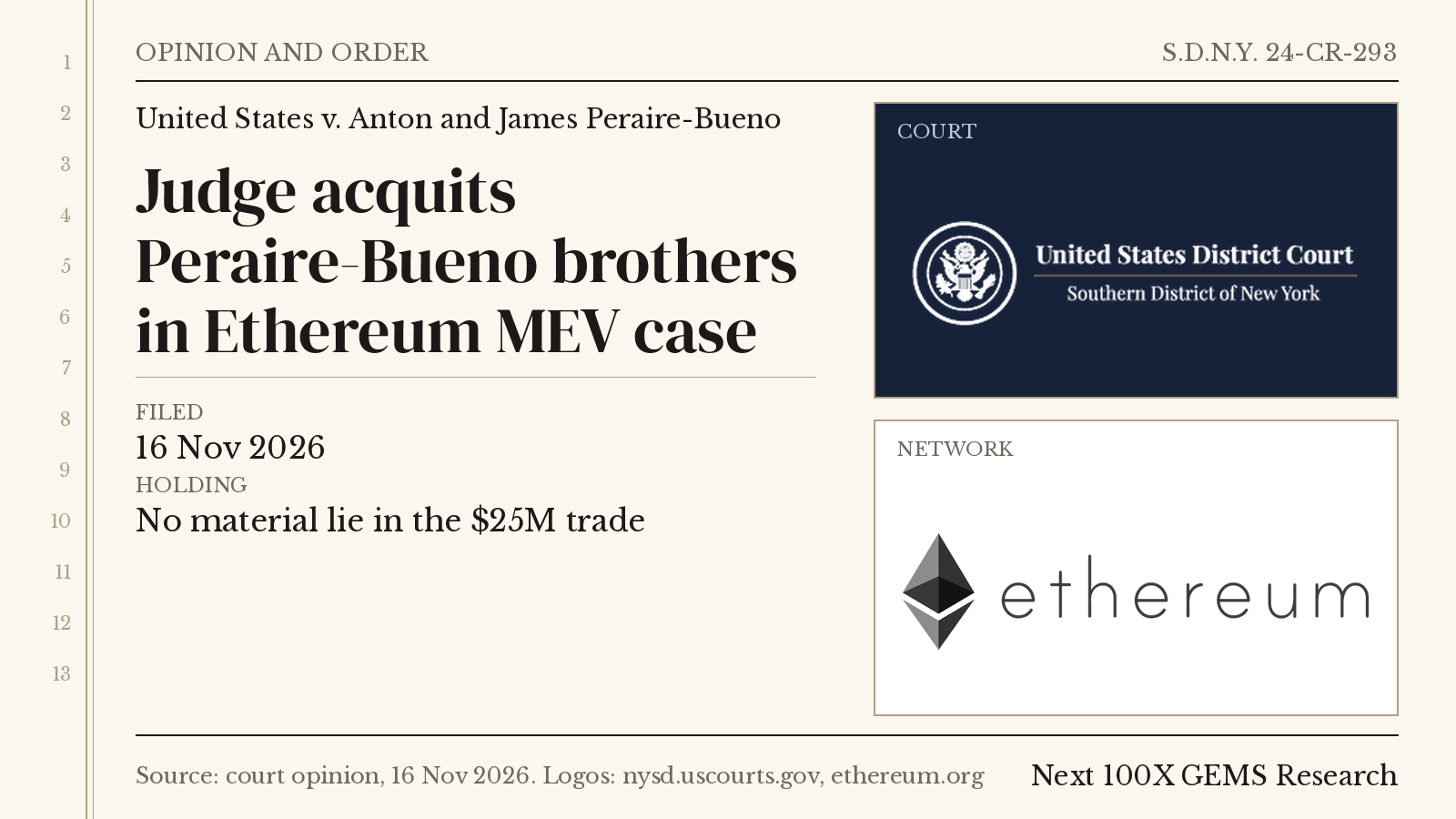
"The question before the Court is not whether the Peraire-Buenos' conduct was right or moral, or even whether it violated uncharged crimes," US District Judge Jessica Clarke wrote on 16 November 2026. In the same opinion and order she acquitted Anton and James Peraire-Bueno in the Ethereum MEV case, the prosecution that said the brothers made $25 million in twelve seconds by tricking sandwich bots in April 2023. The wire fraud count fell, and both conspiracy counts fell with it.
The short answer to why: wire fraud needs a material misrepresentation, a lie that could change what the victim does, and the court found the government never showed one. That isn't a finding that the trade was fair. It's a finding about what a transaction on a permissionless network does and doesn't say, and the 46-page opinion keeps coming back to that point.
What the court says happened
Most facts weren't in dispute, the opinion says. Sandwich bots watch Ethereum's public mempool for large pending trades, buy just ahead of them and sell just after. The brothers set up sixteen validators and, on 2 April 2023, sent eight lure transactions into the mempool, built so that particular bots would see a profitable sandwich. The bots took the bait.
When one of the brothers' validators got its turn to propose a block, the Ultrasound relay offered it a block containing the bots' bundles. The validator signed a block header with false values in two fields. The relay didn't check those fields before revealing the block's contents. With the bots' trades visible, the brothers built their own block, kept the bots' purchases and swapped the bait for transactions that sold into them.
What it cost the brothers was small by comparison. The validator was slashed 1 ETH, which the opinion values at a few thousand dollars. A wallet holding $3 million of the proceeds was frozen, and by October 2023 the rest had been converted into dollars. Within 24 hours, Flashbots changed the relay code so a header is checked for a valid block before the contents are revealed. Prosecutors charged the brothers on 8 May 2024. A trial of nearly four weeks ended in a hung jury in November 2025, according to CoinDesk.
Three theories, three answers
The government listed six alleged lies. The court said they boiled down to three features of the scheme, and rejected each one.
The government said the lure trades implied a promise to be bundled or to execute. The court found no evidence a mempool trade carries that promise, and no rule on Ethereum creates one. The spoofing cases don't fit, because these trades were executed, not cancelled, and weren't placed on a regulated market.
The government pointed to the false signature on the block header. The court found the relay never checked the falsified fields, so the falsity "had no effect on the behavior of the relay" and couldn't be material.
The government said the validator posed as "an honest MEV-Boost validator." The court found that registering with a relay means agreeing to no terms of use and doesn't commit a validator to anything later. Undermining the software's design isn't a misrepresentation.
The money laundering conspiracy count needed wire fraud as its predicate. Without it, the opinion says, that count failed too.
The lure trades are the heart of it. The government's "key misrepresentation," in the court's words, was that a trade in the mempool signals a willingness to be bundled. Clarke turned that around: "no trader who places a transaction in the public mempool would agree to be sandwiched because being sandwiched is not in a trader's interest." The bots weren't promised anything. They assumed it.
Why rules decide the case
Take the three answers together and the same missing piece shows up each time. Spoofing convictions work because an exchange's rules turn an order into an implied statement that you mean to trade. The opinion describes Ethereum as "a trustless, highly adversarial environment with no terms of use." Where nothing defines what a transaction promises, a transaction only says what its code does.
The court leaned on the Mango Markets case, United States v. Eisenberg, where another judge acquitted on a wire fraud count because no terms of service or other rules barred the borrowing at issue. That makes two rulings now pointing the same way. If a protocol has no rules, a prosecutor reaching for wire fraud has to find an actual false statement, and code that behaves exactly as written is hard to call one.
The same question would sit under any case built on a protocol doing what its code allowed, such as the empty-market borrowing that drained Kava Lend on 14 November. The opinion doesn't mention such cases, and it's a district court ruling on the evidence in one trial, so it binds no other court.
What the ruling leaves open
Clarke was careful about what she wasn't deciding. Quoting a 2022 Second Circuit ruling, she wrote that the case wasn't about whether the conduct "was improper, objectionable, or even despicable." Her opening line leaves uncharged crimes alone. Nothing in the opinion says MEV extraction is lawful in general.
There's also a practical lesson in the record. The fix for this attack came from Flashbots, in code, within a day. The court case took more than three years and ended without a conviction. For the bot operators who lost money, the protection that actually worked was engineering. The opinion directs the court clerk to close the case. The opinion opens by quoting the government's own phrase for this, a "first of its kind" prosecution. Williams & Connolly, counsel for James Peraire-Bueno, said the acquittal ended it. As of 19 November, we found no public statement from prosecutors on next steps.
Sources
Opinion and order, United States v. Peraire-Bueno, 24-CR-293 (JGLC), US District Court for the Southern District of New York, Document 294, filed 16 Nov 2026, copy hosted by Decrypt.
Williams & Connolly, "Williams & Connolly Secures Victory on Behalf of Client James Peraire-Bueno" (Nov 2026).
CoinDesk, "US judge says Ethereum has 'no terms of use,' clears MIT brothers of $25 million fraud" (18 Nov 2026).
The Block, "Peraire-Bueno brothers acquitted of wire fraud in $25 million Ethereum MEV case" (16 Nov 2026).
Para two test.