Pi Network deploys four updates to facilitate the creation, launch and monitoring of applications before its first Ecosystem Summit. These tools reduce several technical obstacles, but only o
Pi Network deploys four updates to facilitate the creation, launch and monitoring of applications before its first Ecosystem Summit. These tools reduce several technical obstacles, but only one new feature directly creates measurable demand for the PI token.
In brief
- Pi Network deploys four updates to facilitate the development and launch of applications.
- SoloHost integrates artificial intelligence to simplify software deployment.
- PiVerify allows companies to verify identities and pay for this service in PI tokens.
- Other tools improve the ecosystem without guaranteeing an increase in PI demand.
- The Pi Ecosystem Summit, scheduled from November 17 to 19, 2026, must demonstrate the real usefulness of these new features.
The first change concerns the Developer Portal. Its new interface gathers domains, API keys, application wallets and privacy information in a single section. Developers also more easily access Pi Sign-In, PiNet, the advertising network and the app referral system.
Start your crypto adventure safely with OKXThis link uses an affiliate program.
This centralization aims to shorten the journey between setting up a project and its publication. Pi Network is therefore no longer just seeking to attract developers. The network is trying to build a complete chain that covers user identification, payments, distribution and, eventually, monetization.
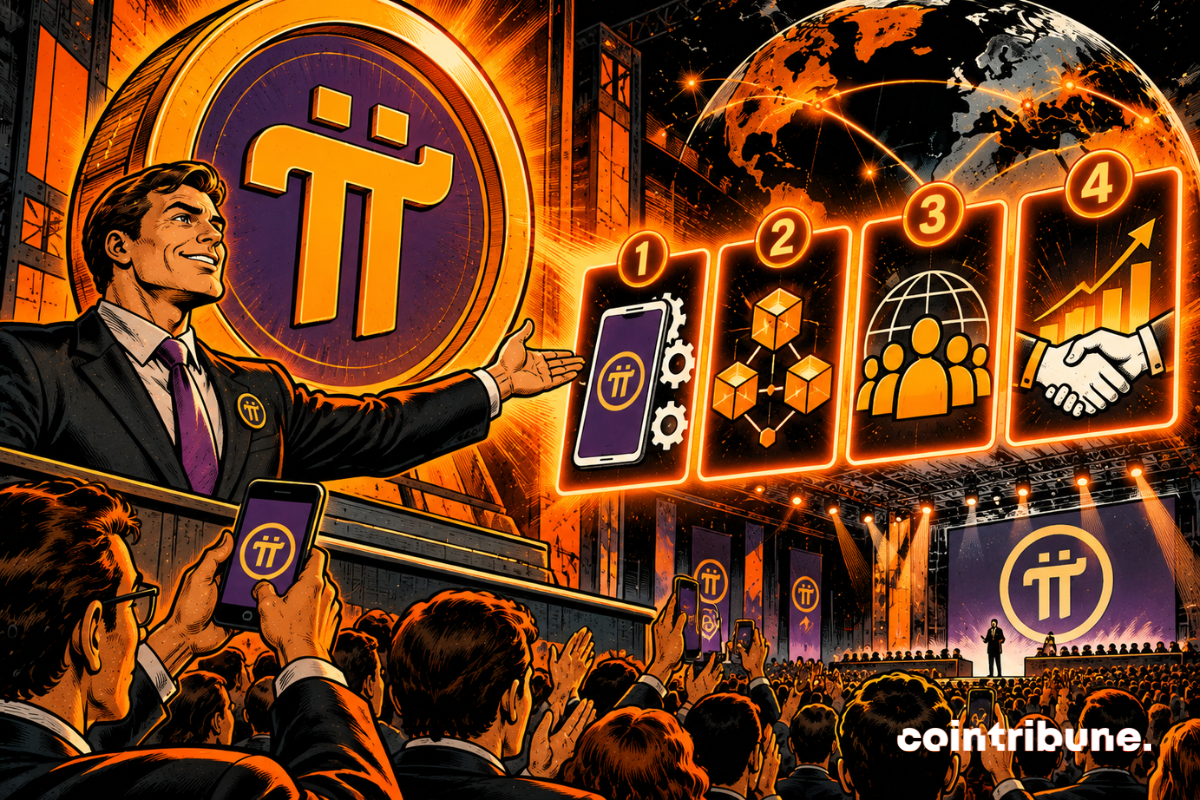
The four updates take place at different stages of this process :
- The Developer Portal simplifies app configuration and management ;
- Pi BlockExplorer shows the price history of tokens from the Launchpad Testnet ;
- SoloHost allows AI assistants to prepare the files needed for deployment ;
- PiVerify adds detection of duplicate identities and several liveness checks.
The evolution of SoloHost is the one most directly linked to artificial intelligence. From a public Docker image of an application, Claude Code, Cursor or Codex can now generate and verify docker-compose.yml and config_options.yml files. The developer can then use them to offer their software on Pi Desktop.
This automation does not create an application from scratch. It mainly avoids a technical configuration phase that could slow down the publication of an already functional software. Projects distributed by SoloHost can theoretically reach a network of more than 420,000 nodes.
The four announcements do not have the same economic effect. The portal improvement, token tracking and deployment assistance reduce development costs. However, they do not guarantee new users nor an increase in PI transactions.
PiVerify has a more direct link to the network’s economy. This service allows external companies to use the identification technology developed for Pi Network’s KYC. Clients can verify that a face is not already associated with multiple accounts and request new liveness tests after initial validation.
These functions address a growing difficulty: distinguishing a real person from an automated account or a duplicated identity. Financial platforms, social networks, rewards services and certain AI applications could use this type of control against fraud.
Most importantly, client companies must pay for the service in PI. PiVerify can thus generate demand linked to professional use, unlike simple speculative activity. The real scope of this outlet will depend on the number of clients, the price of verifications and the volume of checks performed. Pi Network does not yet publish these on-chain data.
The service also raises sensitive questions about biometric data protection. The project will have to specify how faces are processed, where information is stored, how long it remains accessible and what guarantees are offered to companies subject to regulations like GDPR.
The new Pi BlockExplorer function illustrates the gap that remains between infrastructure and real economic activity. The explorer now displays historical token variations like SLICE against Test-Pi. This information is publicly accessible, without a Pi account or Pi Browser.
The tokens concerned remain limited to the Testnet. Pi Network specifies that they will never migrate to the Mainnet. Price tracking is therefore used to test the Launchpad’s operation and familiarize users with liquidity pools, not to measure the value of tradable assets.
The first Pi Ecosystem Summit, held online from November 17 to 19, 2026, must show whether these technical components really attract creators. The program includes demonstrations, app presentations, new features and the announcement of a hackathon.
Pi Network claims more than 60 million engaged members, 18.1 million fully verified users and over 300 Mainnet applications. These figures offer developers a potentially large distribution, but do not inform about daily active users, app revenues or payment volumes in PI.
The success of the four updates will therefore not be measured by the number of announced tools. It will depend on the apps actually published, their regular usage and the payments they generate. The summit will need to demonstrate that the Pi Network can convert its vast community into a true digital marketplace.