How Adoption and Token Supply Influence Pi Network Price Factors Pi Network Price Factors are drawing fresh attention because PI trades near $0.082 on October 12, 2026, roughly 97% below the
How Adoption and Token Supply Influence Pi Network Price Factors
Pi Network Price Factors are drawing fresh attention because PI trades near $0.082 on October 12, 2026, roughly 97% below the high it reached soon after the public mainnet opened.
That gap leaves newcomers with a simple question: what actually sets the value of a coin that millions of people first earned through a mobile app?
The answer sits in token supply, migration speed, real-world use, liquidity, and market mood. This article walks through each driver using the project's published tokenomics and current market data, while keeping confirmed facts separate from claims that still need proof.
What Is PI, and Which Pi Network Price Factors Set Its Value?
Pi Network began as a mobile mining app and opened its public mainnet in February 2025. From that point, PI-became tradeable, so a market price now exists next to the balances users built up over the years.
According to theproject's whitepaper, the network uses a consensus model based on the Stellar protocol and aims to support apps and payments inside its own ecosystem.
How Does Token Supply Shape Pi Network Price Factors?
Supply is usually the first of the Pi-Network price factors that analysts examine, because PI-has a fixed maximum of 100 billion tokens, while only a small share trades today.
The officialtokenomics and migration roadmap divide that maximum supply as shown below.
Allocation
Share
Tokens
Stated purpose
Community mining rewards
65%
65 billion
Rewards earned by community members
Core Team
20%
20 billion
Team allocation
Foundation reserve
10%
10 billion
Ecosystem and community work
Liquidity
5%
5 billion
Market liquidity
The project adds an unusual rule here. Every allocation tracks migrated community rewards, and the Effective Total Supply is calculated by dividing those migrated rewards by 65%, so team and foundation shares can only grow as community balances move onto the mainnet.
These Pi-Network Price Factors show up clearly in market data, which currently lists about 11.24 billion-PI in circulation and roughly 17.3 billion in total supply. Circulating supply means the tokens that are freely available to trade, which is why it matters more for daily price action than the 100 billion cap.
Market cap and fully diluted valuation (FDV) then tell very different stories. At around $0.082, the circulating market cap sits near $920 million, while an FDV based on the full 100 billion cap would be close to $8.2 billion.
Measured against the 17.3 billion total supply, the figure is nearer $1.4 billion. A low token price does not automatically mean a low project valuation.
How Do Migrations and KYC Affect Circulating Supply?
Migration is the process of moving mining balances from the app onto the mainnet blockchain. The project says migrations happen in batches and depend on identity checks, known as KYC, which confirm that a real person owns each account.
Each batch can raise the number of tokens that exist on-chain. For that reason, Pi-Network price factors always include the pace of migration, since more circulating PI can add selling pressure when demand stays flat.
Does Real Utility Support PI Demand?
Demand is the other half of Pi-Network Price Factors, alongside supply. Utility means a practical reason to hold or spend a token, such as paying for goods inside apps, running network services, or interacting with smart contracts.
The project says its ecosystem is built around apps and merchants, yet published payment volume remains limited. Without that data, it is hard to judge how much genuine spending exists, and that uncertainty is one of the Pi-Network Price Factors that keeps valuations cautious.
Technical progress adds another layer. In the Pi Core Team's announcement, Protocol 28 is scheduled for the mainnet on October 16, 2026, after node operators finish upgrading by October 13.
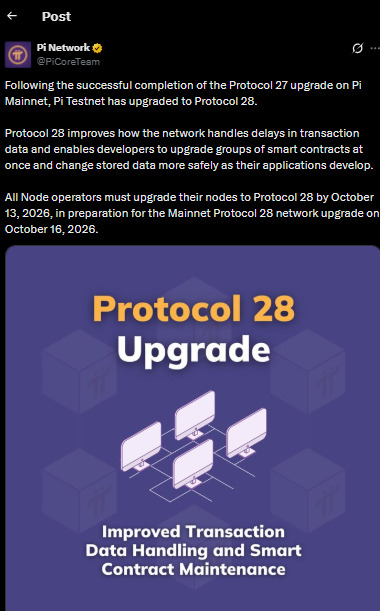
The update improves how the network handles delays in transaction data and lets developers upgrade groups of smart contracts at once.
Upgrades strengthen infrastructure but do not guarantee demand, as theProtocol 28 mainnet date coverage notes while the price slipped.
The Protocol 28 Testnet rollout arrived while the price was drifting lower, which shows that technical milestones and market value do not always move together.
What Role Do Liquidity and Trading Volume Play?
Liquidity describes how easily a token can be bought or sold without moving its price. PI's daily trading volume has stayed in the single-digit millions of dollars at most, which is small next to a market cap near $920 million.
Thin volume makes the price sensitive to a few large orders. A modest sell order can push the price down quickly, while a burst of buying can lift it just as fast, which helps explain sudden swings in PI.
The project reserves 5% of maximum supply for liquidity purposes, but that allocation also becomes available only in proportion to the migrated community rewards. Liquidity therefore grows slowly, and Pi-Network price factors tied to market depth are unlikely to change overnight.
How Do Sentiment and Technical Levels Move PI?
Among all Pi-Network price factors, sentiment is the hardest to measure, since crypto prices follow mood as much as fundamentals. When bitcoin and large altcoins rise, smaller tokens often follow, and when risk appetite falls, coins with limited volume tend to drop harder.
Recent trading has stayed in a narrow band between roughly $0.08 and $0.09, and the available data suggests that $0.10 has acted as a psychological ceiling. A Pi Network price prediction built on those levels remains a scenario rather than a forecast, since one large order can break any range.
Which Pi Network Price Factors Matter Most Right Now?
Only about 11% of the 100 billion maximum supply circulates today. That makes the central question simple: can demand grow as fast as migrations add new tokens?
In practical terms, supply and utility carry the most weight among Pi-Network Price Factors. Liquidity and sentiment decide how violently the price reacts, while upgrades like Protocol 28 shape long-term confidence rather than next week's chart.
This reading is an interpretation, not a confirmed outcome, and Pi-Network Price Factors can shift quickly. If verified payment volume rises faster than circulating supply, the balance could shift, and if migrations outpace real use, pressure could build.
What Are the Main Risks to Consider?
Several risks sit behind the Pi-Network price factors discussed above:
Supply expansion: each migration batch can add tokens that reach the market.
Insider share: the Core Team and foundation together account for 30% of the maximum supply under the published model.
Verification delays slow KYC progress can stall both circulation and adoption.
Thin liquidity: low volume amplifies price swings in both directions.
Unverified adoption: merchant and app usage claims need independent data.
Execution risk: network upgrades can face delays or technical problems.
What Do Pi Network Price Factors Add Up To?
Pi Network is a community-built blockchain whose price depends on a few clear forces: a large maximum supply, rolling migrations, uncertain real-world demand, and shallow liquidity.
What stands out is the design that ties team and foundation allocations to community migration. What remains uncertain is how quickly genuine utility can develop compared with new supply.
The next checkpoints are the outcome of the Protocol 28 mainnet upgrade, the pace of future migrations, and any published data on in-app payments. Together, those updates will show whether Pi-Network price factors are improving or simply repeating.
Pi-Network Price Factors data was reviewed on October 12, 2026. Figures change quickly and may differ across sources.
Disclaimer:
This article is for information only and is not financial advice. Crypto assets are highly volatile and can lose value quickly, so independent research is essential before any decision involving- PI or any other token.