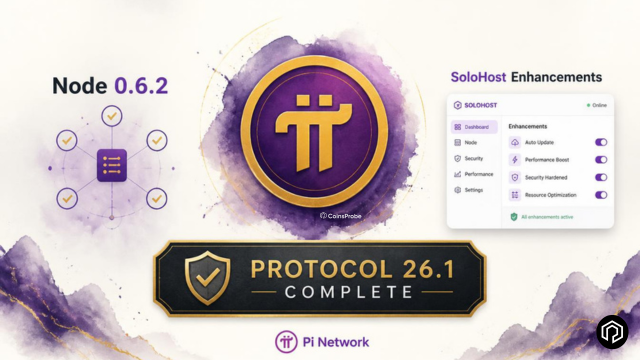
Key Highlights Pi Node version 0.6.2 launched on August 14, 2026 — introducing automatic port configuration via UPnP, unlisted SoloHost app support, and improved app status management. Pi com
Key Highlights
- Pi Node version 0.6.2 launched on August 14, 2026 — introducing automatic port configuration via UPnP, unlisted SoloHost app support, and improved app status management.
- Pi completed its first successful distributed computing test using a SoloHost app across five volunteer Node runners — a meaningful step toward monetized decentralized compute for the 420,000+ Node network.
- Protocol 26.1 was successfully completed on August 11, 2026 — leaving Protocol 27.1 as the sole remaining upgrade on Pi's mandatory sequential path.
Pi Network delivered two meaningful infrastructure milestones in mid-August 2026 — advancing both the Node software experience for everyday Pioneers and the long-running protocol upgrade sequence that has been defining the network’s technical roadmap through 2026. Neither update is a headline-grabbing announcement, but together they represent exactly the kind of steady, infrastructure-focused progress that separates a maturing network from one that is still finding its footing.
As covered in our Pi Network Protocol 26.1 activation and sequential upgrade path analysis and Pi2Day 2026 recap including SoloHost and new utility releases, these updates continue a consistent pattern of incremental but compounding infrastructure build-out that has characterized Pi’s development cadence throughout the year.
Pi Node Version 0.6.2 — What Changed and Why It Matters
On August 14, 2026, the Pi Core Team officially released Pi Node version 0.6.2 — an update focused on two parallel goals: making Nodes easier to run for non-technical Pioneers, and making them more useful beyond their baseline function of supporting blockchain validation.
 Pi Node 0.6.2 Released/Source: @PiCoreTeam (X)
Automatic Port Configuration With UPnP
The most practically impactful change for the average Node runner is automatic port configuration via UPnP (Universal Plug and Play). Previously, running a Pi Node effectively often required manually configuring router port forwarding — a technical step that created friction for less experienced operators and limited the effective size of Pi’s active Node network.
With 0.6.2, Nodes can now automatically open required ports on supported routers without manual intervention. This lowers the barrier to entry for Node operators meaningfully — and for a network that depends on 420,000+ active Nodes for both blockchain validation and, increasingly, distributed computing, expanding the accessible operator pool has direct network-level value.
New Port Checker
The update includes a new Port Checker tool that assists with local connectivity between mobile devices and applications running on the Node. This is a diagnostic and troubleshooting improvement that reduces the friction of identifying and resolving connectivity issues without requiring external tools or technical support.
SoloHost — Unlisted App Support and Better Status Management
Two SoloHost-specific improvements in 0.6.2 advance Pi’s developer ecosystem in a targeted way:
Support for Unlisted SoloHost Apps allows developers to run and test applications privately on their Node before making them publicly listed in the SoloHost directory. This is a standard software development workflow feature — the equivalent of a staging environment — that has been absent until now. Its addition signals that Pi is building SoloHost into a more mature app development and deployment platform rather than a simple listing directory.
Better SoloHost App Status Management introduces a clearer three-state management framework: draft, unlisted, and listed — giving developers full lifecycle control over their SoloHost deployments from initial development through public launch.
Additional Featured SoloHost Apps
Version 0.6.2 also adds new featured SoloHost apps to the ecosystem, including mcp-atlassian (a project management integration tool) and OpenClaw — continuing the expansion of the SoloHost directory that has been building since the framework’s launch at Pi2Day 2026.
UI and Navigation Improvements
Supporting quality-of-life improvements include better app status tracking and automatic switching to the App tab once a SoloHost installation is complete — reducing the friction of the installation workflow and improving the overall Node management experience.
Pi’s First Distributed Computing Test — A Network-Level Milestone
Alongside the 0.6.2 software release, Pi completed what the Core Team describes as its first distributed computing test using a SoloHost application — and the results are worth examining carefully for what they signal about Pi’s longer-term infrastructure ambitions.
What the Test Involved
Five volunteer Node runners participated in a structured test in which each Node:
- Connected to a Pi coordinator — establishing the network communication layer
- Processed assigned jobs — executing computational tasks distributed by the coordinator
- Reported results back — returning outputs to the coordinator for verification
The test was small by design — five Nodes, controlled conditions, specific job types — but its significance is structural rather than scale-dependent. It demonstrated that Pi’s Node network can function as a coordinated distributed computing layer, not just as a blockchain validation network.
Why This Matters for Pi’s Roadmap
Pi’s Node network consists of more than 420,000 active operators — a figure that represents one of the largest existing distributed computing infrastructure pools in the crypto ecosystem, currently underutilized beyond its blockchain validation function.
The distributed computing test represents the first practical demonstration that this infrastructure can be repurposed for compute-intensive tasks — with AI workloads and other high-demand computational tasks explicitly identified as future use cases. The longer-term vision embedded in this test is one where Node operators can earn Pi for contributing computational resources to the network beyond validation — a potential economic model that would meaningfully change the incentive structure for running a Pi Node.
The gap between a five-Node test and a 420,000-Node production deployment is significant. But the test establishes the technical proof-of-concept — and in Pi’s infrastructure build-out pattern, proof-of-concept tests have consistently preceded broader rollouts.
Protocol Upgrade Progress — 26.1 Complete, 27.1 Remains
Pi Network’s protocol upgrade path operates on a mandatory sequential model — each upgrade must be completed network-wide before the next can begin. The full upgrade sequence is:
19.1 → 19.6 → 19.9 → 20.2 → 21.2 → 22.1 → 23.0 → 24.1 → 25.2 → 26.1 → 27.1
Protocol 26.1 was successfully completed on August 11, 2026 — a relatively quick upgrade characterized by internal data migrations that completed in under five minutes, with the Core Team advising operators to divert traffic during the process.
The completion of 26.1 leaves Protocol 27.1 as the sole remaining planned upgrade on the current sequence. As of the time of writing, 27.1 has not yet started — its status is listed as Do Not Start / TBD — meaning the Core Team has not yet signaled readiness to begin the final upgrade in the current path.
 Pi Node Upgrade Path/Source: Minepi
What Node Operators Need to Know
- Update to Pi Node version 0.6.2 through the official Pi app immediately
- Follow only the official sequential upgrade path — no skipping versions
- Do not initiate Protocol 27.1 until an official network-wide completion signal is issued
- Monitor Pi’s official channels for the eventual 27.1 rollout announcement
Bottom Line
Pi Network’s mid-August 2026 update package is a clean example of the infrastructure-focused development cadence the Core Team has maintained throughout the year. Node 0.6.2 lowers the barrier to running an effective Node (UPnP auto-configuration), expands the developer toolkit (unlisted SoloHost apps, three-state status management), and adds new featured applications to the SoloHost directory. The first distributed computing test — five Nodes successfully processing and returning assigned jobs — establishes the technical proof-of-concept for the most significant long-term expansion of Pi’s Node utility: a monetized decentralized compute layer for AI and compute-intensive workloads. And Protocol 26.1’s completion advances the mandatory upgrade sequence to its final planned step, with 27.1 now the sole remaining upgrade before the current path is complete.
For Pioneers running Nodes, the immediate action is straightforward: update to 0.6.2 through the official Pi app and await the official signal for Protocol 27.1. For those watching Pi’s infrastructure trajectory, the distributed computing test is the development most worth tracking — it is the earliest visible step toward a Node utility model that could materially change the economics of running Pi infrastructure.
Disclaimer: The views and analysis presented in this article are for informational purposes only and reflect the author’s perspective, not financial advice. Technical patterns and indicators discussed are subject to market volatility and may or may not yield the anticipated results. Investors are advised to exercise caution, conduct independent research, and make decisions aligned with their individual risk tolerance.