Pieverse vs Venice: How Do Their AI Use Cases Compare Today? People who follow trending AI crypto projects have started searching for "Pieverse vs Venice" more often, as both names keep comin
Pieverse vs Venice: How Do Their AI Use Cases Compare Today?
People who follow trending AI crypto projects have started searching for "Pieverse vs Venice" more often, as both names keep coming up in AI token discussions. Both tokens sit where AI meets blockchain, yet each one solves a different problem.
Pieverse builds wallets and payment tools for AI agents. Venice runs a private AI app and ties its VVV token to access, credits, and burns. Their token designs differ just as much as their products.
What Is Pieverse, and How Does It Work?
Pieverse is a Web3 platform for AI agents. Its main product, Purr-Fect Claw, lets a user launch an agent with its own wallet. The personal version, called Pip, is shown on the official Pieverse website.
What Are the Core Features of Pieverse?
Pieverse builds its tools around a single idea: an AI agent that can hold money and act on its own. The features below make up the core of that setup.
Personal agent (Pip): A chat-based agent built on Purr-Fect Claw. It checks balances, studies markets, and runs on-chain actions from messaging apps.
Keyless agent wallet: Keys stay inside a Trusted Execution Environment, a locked area of a chip, as the Pieverse developer documentation explains. Users never see seed phrases.
Agent payments:Agents find, hire, and pay each other over x402b, which the project calls gasless rails. Each job leaves an on-chain invoice and receipt.
The homepage shares no usage numbers, so each feature remains a project claim.
What Is Venice, and How Does It Work?
Venice is a private AI platform that says it keeps user prompts away from third parties.
The official VVV page says Venice has over 4 million users. That is a company claim, but it points to a working product behind the token.
What Are the Core Features of Venice?
Venice packs its AI tools and token links into one platform, which shapes the Pieverse vs Venice contrast. These are its main features.
Private AI access:Privacy options run from hiding user details to fully encrypted prompts, and they cover text, image, video, and audio tools.
Pro plan and API:The plan costs $18 a month. It includes unlimited text prompts, up to 1,000 images a day, and API access for building agent tools.
VVV and DIEM link:Staking VVV unlocks the Pro plan and lets holders mint DIEM, which provides $1 of AI credit each day.
How Do the Pieverse vs Venice Token Utility Compare?
What Does the PIEVERSE Token Do?
PIEVERSE has a fixed supply of 1 billion tokens. The project's published tokenomics call it a utility and governance token. Holders can vote, stake for rewards, and may get lower fees.
It lives on BNB Chain and Ethereum. The whitepaper and tokenomics release is where token details can be checked directly.
What Does the Venice VVV Token Do?
VVV is an ERC-20 token on the Base blockchain. It launched on January 27, 2025 with 100 million tokens, according to Venice.
Staking 100 VVV unlocks Venice Pro. Staked VVV can also mint DIEM, a second token. One DIEM gives $1 of Venice AI credit each day.
Venice says revenue buys VVV from the market, and those tokens are burned every month. Published token disclosures say VVV carries no governance rights.
A quick Pieverse vs Venice token utility comparison shows where the two designs differ.
Factor
Pieverse (PIEVERSE)
Venice (VVV)
Core product
AI agent wallets and payments
Private AI app and API
Blockchain
BNB Chain, Ethereum
Base
Supply
1 billion, fixed
100 million at launch, then emissions and burns
Token roles
Governance, staking, fee discounts
Staking, Pro access, DIEM minting
Governance rights
Yes, per the published tokenomics.
No, per token disclosures
Revenue link
Not shown on the homepage
Monthly buy-and-burn
Stage
Early agent tools
Live paid product
The Piveway vs Venice table shows two bets. PIEVERSE links to a wider agent economy. VVV links to one paid product, which is easier to measure.
How Do Supply and Vesting Differ in Pieverse vs Venice?
PIEVERSE splits its 1 billion supply across five groups, based on its published tokenomics.
Allocation
Share
Community growth and rewards
27.6%
Ecosystem development and marketing
27.4%
Team and advisors
20%
Investor allocation
15%
Foundation reserve
10%
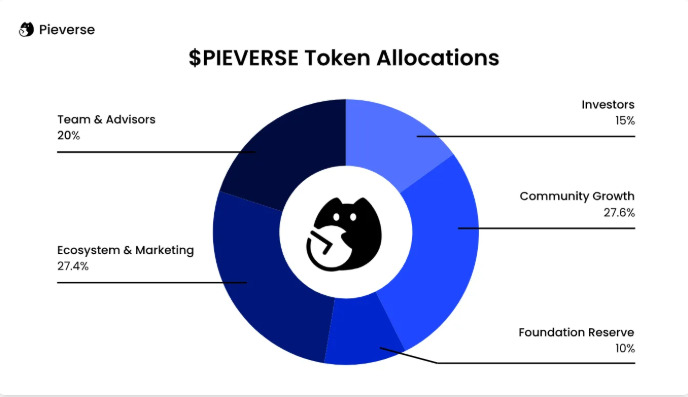
Team, advisors, and investors hold 35% together. Vesting is the schedule that controls when tokens unlock and applies to them. The published timeline runs to November 2028, so new supplies keep arriving for years.
Venice works differently. New VVV comes only from staking rewards. Venice announced cuts from 14 million a year at launch to 2 million by October 2026. Monthly burns remove tokens too.
Market cap counts only circulating tokens. Fully diluted valuation, or FDV, assumes all tokens exist. A big locked supply makes that gap matter.
Pieverse vs Venice: Which Project Shows Stronger Real Use?
Expert Analysis: Proven Use vs Future Potential
Venice has a clearer link between token and product. A user pays for AI, revenue funds burn, and staking leads to Pro access or API credit.
Pieverse aims at a wider idea, where agents earn, spend, and prove their work. If agent trade grows, wallet safety and payment rails could matter. Token demand is hard to judge without public usage figures.
In this Pieverse vs Venice comparison, the available data suggests that Venice has stronger proven utility today, while Pieverse leans more on future growth. Neither point is enough on its own to settle the value of either token.
What Are the Main Risks in Pieverse vs Venice AI Tokens?
Tokens that enter through AI crypto presales or fast listings often carry added risk. These points apply to both sides of the Pieverse vs. Venice debate.
Locked supply:Much of PIEVERSE stays under vesting, and later unlocks could add selling pressure when demand is thin.
Early claims:Several "first of its kind" statements come from Pieverse itself and come without usage data on its homepage.
Shrinking rewards:VVV staking yield is paid from emissions, so every cut in emissions lowers the yield unless revenue and burns keep growing alongside it.
Company control: VVV holders have no governance rights, which leaves Venice in charge of emission schedules and treasury decisions.
Price swings:Even top AI crypto coins can move hard with the AI story.
Conclusion: What Does Pieverse vs Venice Show About AI Crypto?
Pieverse vs Venice is less a race than a comparison of two layers. Pieverse targets agent wallets and payments. Venice sells private AI access and links VVV to that revenue.
Venice shows a more measurable token loop today. Pieverse still needs agent commerce to grow, and public usage data remains limited. VVV yield also depends on revenue outpacing the steady fall in emissions.
For anyone comparing Pieverse vs Venice AI tokens, white papers, official docs, and on-chain supply data remain the most dependable checks. Across AI crypto tokens, big stories often run ahead of measurable use.
Disclaimer:
This article is for information only and is not financial advice. Crypto assets are volatile and high risk, and past results do not guarantee future returns. Investors should research independently before any decision.