Play to earn refers to video games in which you receive cryptocurrencies and NFTs for time played, wins or completed tasks, which you can then exchange for euros or dollars on an exchange. Th
Play to earn refers to video games in which you receive cryptocurrencies and NFTs for time played, wins or completed tasks, which you can then exchange for euros or dollars on an exchange. The model boomed from 2020 to the end of 2021 and has since almost completely collapsed: according to CoinGecko, eight of the best-known gaming tokens were trading between 98.8 and 99.9 percent below their all-time highs on November 11, 2026.
This explainer shows how the rewards are created technically, why the economic model runs up against its limits and which rules apply under EU regulation. If you want to make money from games, you will find the figures here that let you assess an offer in advance.
What is play to earn? Games that hand out tokens and NFTs as rewards
In a conventional game, you own nothing you collect. Swords, skins or in-game money sit on the publisher's servers, and reselling them outside the game is usually prohibited. Play-to-earn games turn this around: characters, land and equipment are NFTs, unique tokens on a blockchain that sit in your own wallet. On top of that there is at least one fungible token, an interchangeable in-game currency that the game pays out as a reward and that trades on crypto exchanges.
Many games use two tokens. The first is a governance token with a fixed maximum supply that lets holders vote on development; at Axie Infinity, that is AXS (see the Axie Infinity price prediction). The second is the actual reward currency with no fixed cap; at Axie, that was Smooth Love Potion (SLP). Alongside them are virtual worlds such as The Sandbox or Decentraland, where users buy and rent out digital land. The NFTs are traded on the games' own marketplaces or on general platforms, which we compare in our NFT marketplace comparison.
Play to earn, play and earn and GameFi
GameFi is the umbrella term for combining games with decentralised finance applications, such as staking, lending or liquidity pools within a game. Since the collapse of reward currencies, many studios prefer to call their games "play and earn": the fun of playing is meant to come first, with tokens as a side feature. For you as a player, the label changes little. What matters is still where the money for payouts comes from.
Token emission in game economies: where the money for rewards comes from
Token emission is the ongoing issuance of new tokens by a protocol. That is exactly how rewards are created in play-to-earn games: the game mints new units of its currency with every win or daily task. These units only have a price if someone else buys them. The buyers are usually new players who need tokens to breed characters, upgrade equipment or join at all.
This produces a simple mechanism. As long as more newcomers arrive than players cash out, the price of the reward currency rises. As soon as the inflow slows, existing players' sales push the price down, the reward in euros shrinks, even more players quit, and the downward spiral accelerates. Economists describe such models as dependent on new inflows.
Sinks: how games take tokens back out
To counter inflation, developers use so-called sinks. A sink is any game feature that permanently destroys tokens, such as fees for breeding, repairs or tournaments. A game is only stable if, over time, the sinks burn at least as many tokens as the rewards create. In practice, hardly any title managed this, because every higher fee takes away the return players came for.
Axie Infinity in 2021: the scholarship model in the Philippines
The best-known example is Axie Infinity from the Vietnamese studio Sky Mavis. Players needed three Axies, small fighting monsters in the form of NFTs, whose prices rose sharply during the 2021 boom. Anyone who could not afford them became a scholar: a manager or a guild such as Yield Guild Games provided the characters, and in return the player handed over part of their SLP rewards.
In the Philippines in particular, the game became a source of income during the pandemic. A report by the analytics firm Naavik, covered by the trade outlet Forkast in November 2021, counted 55 percent of players in the Philippines and up to 1.95 million daily active users in October 2021. At the same time, the report noted that a typical player's daily earnings had been below the Philippine minimum wage of $7.03 since August 2021, with the exception of the top-ranked players.
The reason was the price of the reward currency. SLP hit its peak in 2021, at $0.40 to $0.42 depending on the data source, and stood at only $0.066 in November 2021. On November 11, 2026, one SLP costs $0.00047 according to CoinGecko. Anyone who earned and held $100 in rewards back then now owns tokens worth around 12 cents.
The Ronin hack in 2022: around $620 million from the game's bridge
In March 2022 came a second blow. Axie Infinity ran on Ronin, Sky Mavis's own blockchain, which was connected to Ethereum via a bridge. A bridge is a program that locks tokens on one blockchain and issues a counterpart on another. On March 23, 2022, attackers used the keys of five of the nine validators to sign withdrawals from this bridge. The theft was only discovered and reported on March 29.
The FBI put the damage at around $620 million in ether and stablecoins and attributed the attack to North Korea's Lazarus Group in April 2022. Depending on the ether price on the reference date, reports cite figures between $540 million and $625 million. For players, the case showed that a game carries not only an economic but also a technical risk: anyone holding assets on a game's own blockchain depends on its security model.
Gaming tokens in 2026: eight sit almost 99 percent below their all-time high
Our analysis sums up the state of play on November 11, 2026. We looked up the current prices and all-time highs of eight gaming and metaverse tokens on CoinGecko. Seven of the eight hit their peak between July and November 2021; only Ronin (RON) did so in March 2024. The smallest gap is 98.8 percent (Decentraland and Immutable), the largest 99.9 percent (SLP).
- Axie Infinity (AXS): peak of $164.90 in November 2021, now $0.80
- The Sandbox (SAND): peak of $8.40, now $0.043
- Gala (GALA): peak of $0.82, now $0.0015; see the Gala price prediction
- Yield Guild Games (YGG), the guild behind many scholarships: peak of $11.17, now $0.021
- Ronin (RON): peak of $4.45 in March 2024, now $0.045
At around $141 million, Axie Infinity's market capitalisation is still just ahead of Decentraland and The Sandbox. For comparison: the hackers alone stole more than four times that amount from the Ronin bridge in 2022. One point matters for context: a 99 percent loss means a token would have to rise a hundredfold from its low to get back to its old peak.
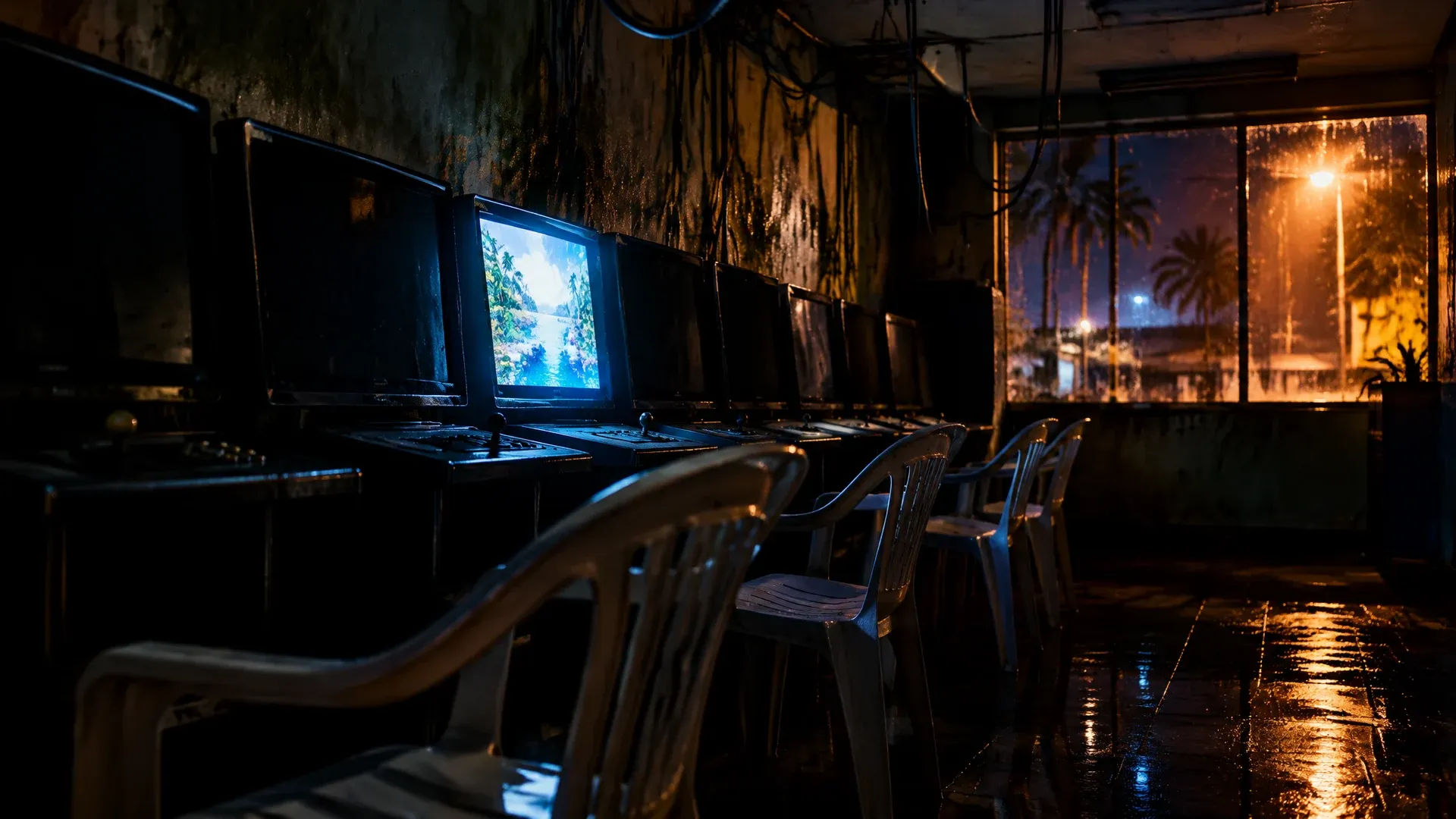
When no new players arrive, the rewards have no buyers and the game worlds empty out.
Ember Sword and Nyan Heroes: studios close for lack of funding
As prices collapsed, funding for many studios dried up too. In May 2025, the Ethereum role-playing game Ember Sword shut down, as the trade outlet Decrypt reported. The studio, Bright Star Studios, had collected pledges of $203 million from almost 35,000 players for virtual land sold as NFTs and cited a lack of money to keep running as the reason for the closure. At that point, the EMBER token was more than 99 percent below its peak. In the same month, the Solana shooter Nyan Heroes closed for the same reason.
The analytics platform DappRadar counted around 300 blockchain games in the second quarter of 2025 that had still been active in the previous quarter and recorded not a single transaction afterwards. For the third quarter of 2025, DappRadar reported an average of 4.66 million daily active wallets in blockchain games, 4.4 percent fewer than in the previous quarter. According to CoinDesk, a report by the investor Caladan concluded in April 2026 that more than 90 percent of the Web3 games launched since 2020 have failed, after around $15 billion flowed into the sector.
What a shutdown means for NFTs and tokens
If a game closes, your NFTs do stay in your wallet. Without servers, a game world and a marketplace, however, they lose all function and usually every buyer. The token often continues to trade but loses its demand from the game. The terms of use of such projects generally do not provide for refunds of land or character purchases.
Token distribution and revenue source: how to spot a viable crypto game
There is no guarantee, but some metrics can be checked before your first purchase. Most projects publish them in their white paper or documentation:
- Token distribution: What share belongs to the team, investors and foundation? Large shares with short lock-up periods mean selling pressure.
- Unlocks: When are locked tokens released? Projects usually publish major dates themselves, and unlock calendars bundle them.
- Rewards versus sinks: Does the project state how many tokens it issues and how many it burns each day?
- Revenue source: Does the studio earn money from the game itself, for example through sales to players who are not after a return, or only from token and NFT sales?
- Entry costs: Do you have to buy NFTs before you receive your first reward? Then you carry the price risk from day one.
A game that is no fun without tokens will, over time, have no buyers for its rewards. That was the central lesson of Axie Infinity, and it applies to every new project.
NFTs and wallet approvals: the security risks of crypto gaming
Crypto games require a wallet, and that is precisely where fraudsters strike. Common schemes include fake sites for supposedly free NFTs or token distributions, as well as approvals that give a smart contract unlimited access to your tokens. A wallet approval is a permission you grant with your signature, and it remains in place until you revoke it.
Three habits significantly reduce the risk. Use a separate wallet with a small balance for games and keep larger holdings elsewhere. Read which rights a site requests before every signature. Regularly check via a blockchain explorer which approvals are still open, and revoke old ones. Many forget the Ronin case: a game's infrastructure can also be attacked without you making any mistake.
MiCA and gaming tokens: which rules apply to in-game currencies
The EU Markets in Crypto-Assets Regulation, MiCA for short, has applied in full since December 30, 2024. It covers fungible gaming tokens such as AXS or SAND as crypto-assets: anyone offering them to the public or seeking admission to a trading platform generally needs a white paper, and exchanges that trade them in the EU need authorisation. Unique, non-fungible crypto-assets, meaning typical NFTs of individual game characters, are exempt. MiCA also provides exemptions for tokens that can only be redeemed within a limited network.
For you, this means: if you buy gaming tokens on an exchange with MiCA authorisation, rules on custody and the segregation of client funds apply there. That protection does not exist for the game itself, its rewards or its NFTs. Our comparison below shows which exchanges are already authorised.
Play to earn: rewards only hold up while new players pay in
Play to earn has shown that blockchain games make genuine ownership of digital items possible. As a source of income, the model has not held up: eight large gaming tokens sit almost 99 percent below their peak, and most of the games from the boom have closed. If you still want to get involved, three steps help:
- Buy tokens only from authorised providers: Compare the regulated crypto exchanges with MiCA authorisation before you acquire gaming tokens.
- Set up a separate wallet for games: A dedicated software wallet with a small balance limits the damage from a wrong approval. You will find suitable apps in the software wallet comparison.
- Document every reward: A crypto tax tool automatically records inflows and sales with date and value, which makes your tax return easier.
With every game, expect that tokens and NFTs can lose their entire value. Only play with money you can afford to lose.
(As of November 11, 2026. This article is not investment advice. Prices and fee structures change; check the terms with the provider before you buy.)