Now, with one integration, Solana businesses can take a bank deposit, hold it in stablecoins and pay it out to a US bank account. With licenses in 48 US states behind the dollar leg, Polygon
Now, with one integration, Solana businesses can take a bank deposit, hold it in stablecoins and pay it out to a US bank account.
With licenses in 48 US states behind the dollar leg, Polygon Labs on Thursday added Solana to its Open Money Stack.
USDC, USDT and PYUSD route across TRON and EVM chains
The stack converts fiat into stablecoins on Solana, retains funds in embedded or custodial wallets, and pays out to bank accounts, cards, cash or wallets. Every client is given a virtual account so that incoming bank transfers have an address to go to.
In a blog post released by Polygon, the stack is said to move USDC, USDT, PYUSD, SOL and wrapped SOL across Solana, TRON and EVM chains in one transaction.
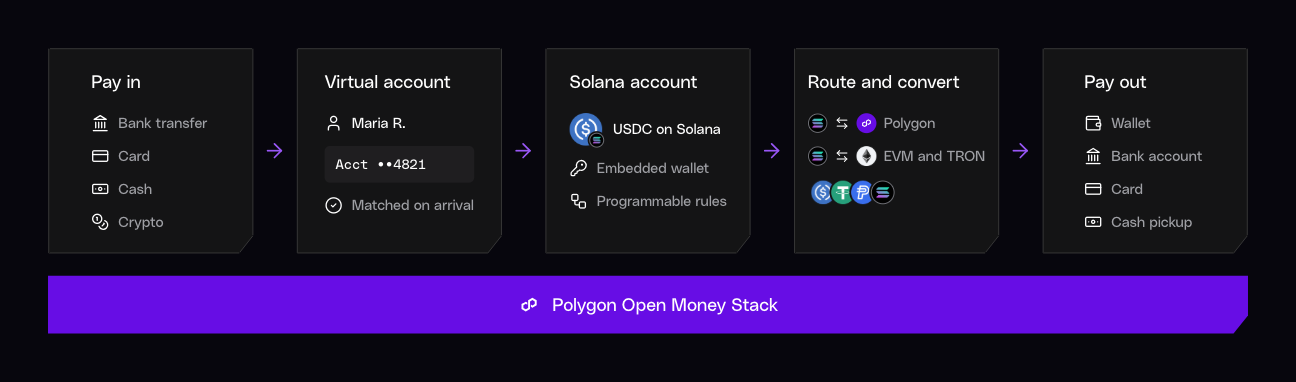
How a payment moves through Polygon’s Open Money Stack on Solana, from bank pay-in to payout, shown in its
blog post of October 29, 2026.
The app can take USDC from an Ethereum wallet and settle it in SOL to a Solana user. TRON entered the stack earlier in October. Licenses are from the Coinme buy.
The closed deal gave Polygon 37 state money-transmitter licenses and 11 exemptions in a total of 48 US states, Cryptopolitan reported on October 14. It also brought Polygon a money services business registration with the Financial Crimes Enforcement Network.
Kira is among the first firms to plug in
Kira is among the first companies to use the Solana integration. The company moves clients between dollars and stablecoins, transmits payments via banking rails and pays suppliers overseas.
“We already use Solana to move stablecoins, and working with Polygon helps us turn those transfers into dollars in our clients’ bank accounts when they need to pay suppliers,” said Kira CEO Edrizio De La Cruz.
In 2026, the network processed over $5.5 trillion of stablecoin volume, said Vibhu Norby, chief product officer at the Solana Foundation. Polygon’s stack is another path for businesses, along with payment tools already on Solana, he said.
Per Polygon, Solana processes over $2 trillion in stablecoin volume every quarter.
The launch came about a week after Solana switched on its Alpenglow consensus upgrade. Finality went from around 12.8 seconds to 150 milliseconds.
Solana is Polygon’s newest move in a pivot that played out across 2026. In January, a spokesperson said, “Polygon Labs is no longer a scaling company, but a blockchain-based payments company.”
Polymarket, which accounted for more than half of Polygon’s transactions in March 2026, has been developing its own layer-2 network.
Polygon said in January it would buy smart-wallet provider Sequence and Coinme in deals worth more than $250 million combined. Together, the two constitute the Open Money Stack, which aggregates on- and off-ramps, wallets, cross-chain routing and settlement under a single API.
Co-founder Sandeep Nailwal branded the strategy a “reverse Stripe.”
Stablecoins now total about $300 billion in supply. Tether’s USDT leads the pack, with more than $180 billion, while Circle’s USDC sits at almost $72 billion.
Don’t just read crypto news. Understand it. Subscribe to our newsletter. It's free.