
Markets2 min read
WEEKLY MARKET REPORT
Key Events This Week: ├📁May ISM Manufacturing PMI data - Monday ├📁April JOLTS Job Openings data - Tuesday ├📁May ISM Non-Manufacturing PMI data - Wednesday ├📁Initial Jobless Claims data -
Prediction markets received a significant institutional endorsement this week after Wintermute announced plans to provide liquidity across event contracts, highlighting growing confidence in

Prediction markets received a significant institutional endorsement this week after Wintermute announced plans to provide liquidity across event contracts, highlighting growing confidence in one of crypto’s fastest-expanding sectors. As trading activity rises and participation broadens, the move signals that prediction markets are beginning to attract the same infrastructure that supports more mature financial markets.
According to the source, Wintermute is extending its institutional trading operations into prediction markets and will provide “two-sided markets across event contracts on leading venues.” While the company did not disclose which venues it is currently supporting, the announcement arrives as demand for event-based trading continues to accelerate across the digital asset industry.
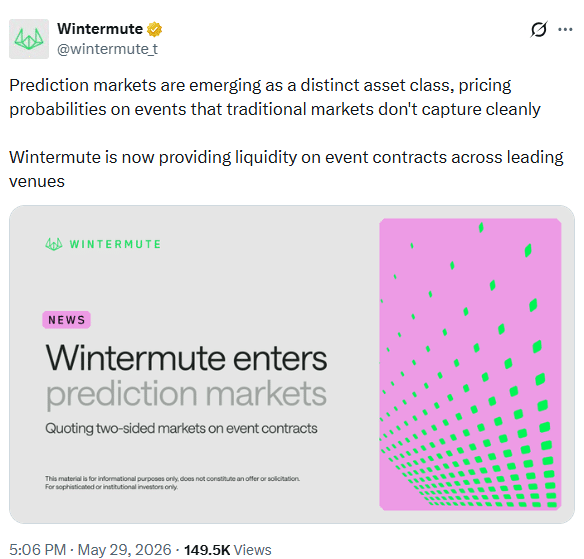 Source: X
The importance of this development becomes clearer when considering the scale of Wintermute. The crypto trading firm reportedly processes around $3.5 trillion in annual trading volume, making it one of the largest liquidity providers in the industry.
Its decision to enter prediction markets suggests that institutional firms increasingly view the sector as more than a speculative niche. Over the years, Wintermute has built infrastructure across spot trading, derivatives, decentralized finance, and over-the-counter markets. The company noted that prediction markets complement these existing operations, creating a natural extension of its liquidity business and allowing it to leverage expertise already developed across multiple crypto sectors.
Jake Ostrovskis, Head of OTC Trading at Wintermute, emphasized the importance of liquidity in market development. He said, “For these markets to become a reliable real-time source of probability estimates, they need sustained two-sided liquidity.”
At the center of the announcement is Wintermute’s commitment to provide two-sided liquidity across event contracts. In simple terms, this means continuously offering both buy and sell prices to traders.
The company said it will post continuous bid and offer prices across contracts on leading venues. This process can narrow spreads, support larger trades, and improve overall market efficiency.
Ostrovskis added that greater liquidity helps strengthen the signal embedded in market prices. As a result, prediction markets can become more reliable tools for assessing future outcomes and measuring sentiment.
Market-implied probabilities are especially important because they function as collective forecasts. By combining the opinions, information, and capital of thousands of participants, these markets often provide real-time insight into how likely an event is to occur.
For many years, prediction markets were primarily associated with election forecasts and sports betting. Today, the sector is steadily evolving into a broader venue for trading event risk.
According to Wintermute, prediction markets are moving beyond simple forecasting and becoming marketplaces where participants can express views on political developments, economic outcomes, corporate events, and other real-world scenarios.
This shift reflects a growing recognition that market-based forecasting can serve practical financial purposes. Rather than simply predicting outcomes, traders increasingly use prediction markets to manage uncertainty and assess risk.
The trend also creates new opportunities for decentralized finance. Because Wintermute already operates across several crypto sectors, its entry could accelerate integration between prediction markets and DeFi applications through collateral reuse, yield strategies on locked capital, and oracle feeds derived from prediction market prices.
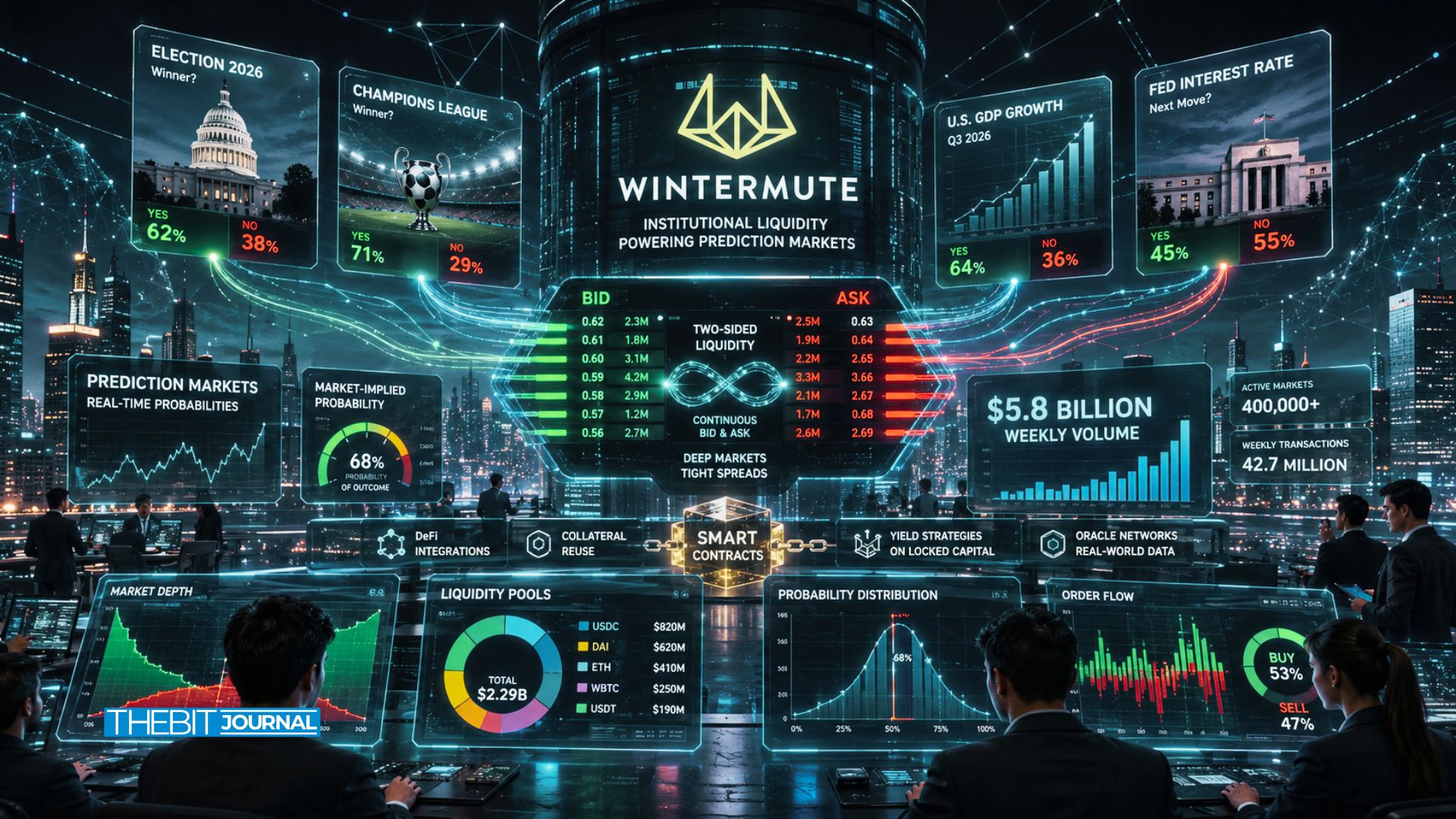
The growth of prediction markets is already evident in industry data. According to DeFiRate, Kalshi and Polymarket currently generate approximately $5.8 billion in weekly notional trading volume.
Together, the two platforms support nearly 400,000 active markets and around 42.7 million weekly transactions. Politics and sports continue to dominate activity across both venues, accounting for much of the sector’s demand.
Kalshi currently controls roughly 70% of market volume and operates under the oversight of the Commodity Futures Trading Commission. That regulatory status gives the platform a notable advantage as institutional participation increases. Meanwhile, Polymarket remains the leading crypto-native competitor and continues to attract substantial trading activity.
The arrival of Wintermute marks an important milestone for prediction markets as they continue their transition toward mainstream financial relevance. With a firm handling $3.5 trillion in annual trading volume now providing liquidity, the sector gains stronger infrastructure, deeper market depth, and greater institutional credibility.
As prediction markets evolve from niche forecasting tools into platforms for trading event risk, they could play an increasingly important role in helping investors, analysts, and businesses understand uncertainty through market-driven insights. The next phase of growth may depend not only on participation, but also on how effectively these markets transform information into actionable signals.
Prediction Markets: Markets where participants trade contracts based on future event outcomes.
Liquidity: The ability to buy or sell assets quickly without major price changes.
Market-Implied Probability: The likelihood of an event occurring based on market pricing.
Event Contracts: Tradable contracts linked to specific future outcomes.
DeFi: Decentralized financial services built on blockchain networks.
They are trading platforms where users speculate on the outcomes of future events.
The company aims to improve liquidity and support the sector’s growing institutional demand.
It means continuously offering both buy and sell prices to improve trading efficiency.
They provide real-time forecasts that reflect collective market sentiment and expectations.
Read More:Prediction Markets Outlook Strengthens as Wintermute Adds Liquidity Support">Prediction Markets Outlook Strengthens as Wintermute Adds Liquidity Support