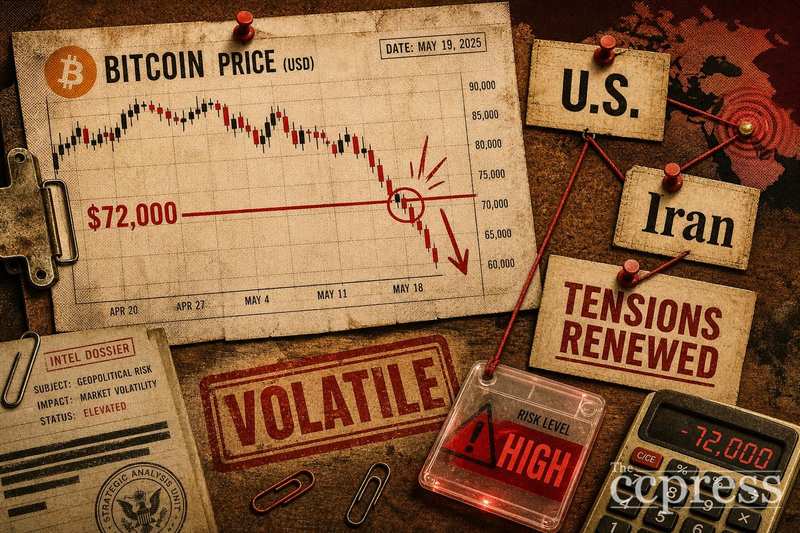
Bitcoin fell below $72,000 as renewed U.S.-Iran tensions triggered a broad risk-off move across crypto markets, pushing the leading cryptocurrency to its lowest level in weeks and dragging ma
Bitcoin fell below $72,000 as renewed U.S.-Iran tensions triggered a broad risk-off move across crypto markets, pushing the leading cryptocurrency to its lowest level in weeks and dragging market sentiment firmly into fear territory.
Bitcoin Drops Below $72,000 as Risk Sentiment Weakens
Bitcoin traded at $70,994 at press time, well below the $72,000 threshold that had served as a key psychological level for traders. The breakdown marked a 3.27% decline over 24 hours, with Bitcoin’s market cap slipping to roughly $1.42 trillion.
Bitcoin Price $70,994 CoinGecko-backed research data showed Bitcoin trading below the $72,000 mark as geopolitical risk sentiment hit crypto markets.
CryptoSlate reported an intraday low of $72,792 earlier in the session before selling pressure intensified further. The broader crypto market saw approximately $930 million in liquidations as leveraged positions were unwound.
24h Change -3.27% The 24-hour decline adds numeric context to the headline move and helps frame the selloff as more than a brief intraday dip.
The Fear & Greed Index printed 29, firmly in “Fear” territory. Bitcoin dominance held at 56.7%, suggesting altcoins were hit at least as hard as BTC itself during the selloff.
U.S. spot Bitcoin ETFs compounded the pressure, recording $733.4 million in net outflows as institutional investors pulled capital from crypto exposure. The ETF outflows represent a meaningful shift in institutional positioning, particularly at a time when exchanges like Binance are expanding into traditional asset classes for non-U.S. users.
How Renewed U.S.-Iran Tensions Pressured Crypto Markets
The selloff was catalyzed by a sharp escalation in U.S.-Iran tensions. Reuters reported that U.S. military forces shot down an Iranian drone that approached the USS Abraham Lincoln in the Arabian Sea, fueling a broader risk-off reaction across global markets.
Gold surged 2.4% to $5,057.50 an ounce in its biggest daily gain in 17 years, underscoring how traditional safe-haven assets absorbed capital fleeing risk markets. Bitcoin, often debated as a digital safe haven, moved in the opposite direction.
The geopolitical situation worsened after U.S. and Iranian negotiators failed to reach a resolution to extend a ceasefire, according to CoinDesk. Bitcoin traded around $71,600 in the immediate aftermath of that breakdown in talks.
The pattern is consistent with previous geopolitical flare-ups where crypto markets initially traded as risk assets rather than hedges. Institutional flows through ETFs acted as the transmission channel, converting macro uncertainty into direct selling pressure on Bitcoin, even as crypto platforms continue expanding into new markets like India.
What Bitcoin Traders Will Watch After the $72,000 Breakdown
With Bitcoin now trading below $71,000, traders are watching whether the selloff stabilizes or deepens. The $70,000 round number is the next widely watched level, and a sustained break below it could trigger another wave of liquidations.
Despite the price drop, Bitcoin’s network remained active. Blockchain data showed 545,734 daily transactions with an estimated hashrate near 898 EH/s, indicating that on-chain fundamentals have not deteriorated alongside price.
Near-term direction likely depends on whether U.S.-Iran tensions escalate further or diplomatic channels reopen. Traders are also monitoring ETF flow data for signs of stabilization. The institutional outflow of $733.4 million in a single session suggests that further geopolitical deterioration could accelerate redemptions.
Meanwhile, activity across the broader crypto ecosystem continues. Large institutional players have been accumulating Ethereum even as Bitcoin faces short-term headwinds, suggesting that some market participants view the pullback as sector-specific rather than systemic.
24-hour trading volume reached $42.2 billion, well above recent averages, confirming that the move was driven by active repositioning rather than thin liquidity.
Disclaimer: This article is for informational purposes only and does not constitute financial or investment advice. Cryptocurrency and digital asset markets carry significant risk. Always do your own research before making decisions.
The article Bitcoin Falls Below $72,000 Amid Renewed U.S.-Iran Tensions first featured on theccpress.com.