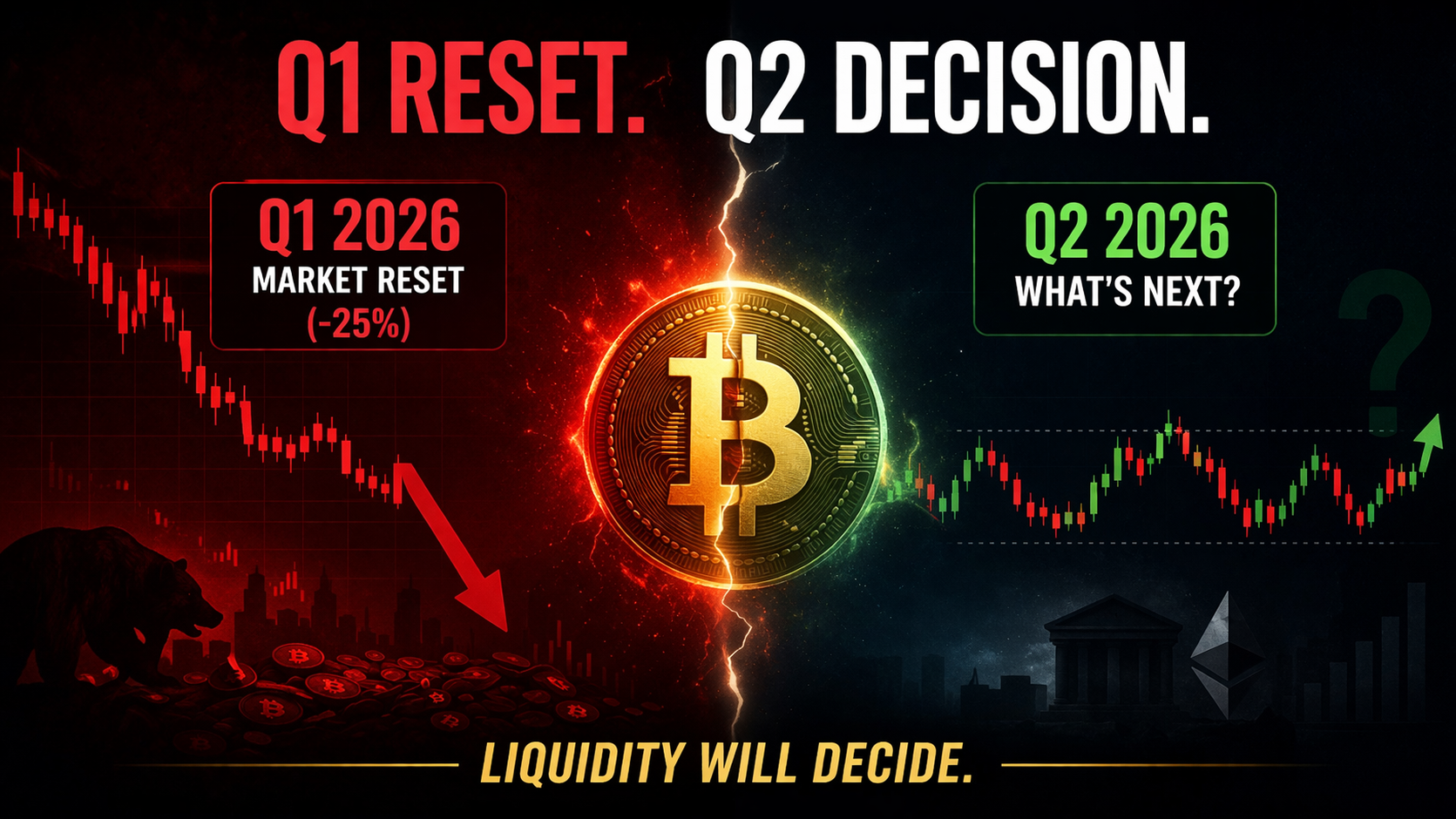
As we step into Q2 2026, the crypto market tells a clear story: Q1 wasn’t just a period of decline it was a structured reset across the entire ecosystem. From price action to sentiment and in
As we step into Q2 2026, the crypto market tells a clear story:
Q1 wasn’t just a period of decline it was a structured reset across the entire ecosystem.
From price action to sentiment and institutional behavior, the quarter revealed one key theme:
👉 The market is transitioning.
1. Bitcoin: From Strength to Reset
At the center of everything was Bitcoin.
The quarter began with strong momentum, with BTC trading near $88,000 and testing high levels of confidence.
But that strength didn’t last.
- BTC fell from ~$88.7K to ~$66.7K
- Total drawdown: ~-25%
- Sharpest drop: mid-January → mid-February (~-26%)
This wasn’t a chaotic crash.
It was a controlled deleveraging phase.
What this means
Bitcoin wasn’t collapsing — it was clearing excess leverage.
The aggressive positioning built up in late 2025 and early 2026 needed to reset.
And Q1 delivered exactly that.
2. Market-Wide Decline, Not Rotation
Zooming out, the broader crypto market confirmed the same narrative.
- Total market cap: ~$3.0T → ~$2.36T (~-21%)
- Lowest point: ~$2.17T (early February)
- BTC dominance: ~58% (mostly unchanged)
Key insight
This was not a rotation into altcoins.
It was:
👉 System-wide risk reduction
Bitcoin didn’t outperform significantly.Altcoins didn’t lead a new cycle.
Everything moved together.
3. Ethereum: A More Cautious Signal
While Bitcoin showed resilience, Ethereum revealed a more cautious side of the market.
- ETH dropped from ~$2.9K → ~$2.1K
- Total decline: ~-28%
But beyond price, the deeper signals were more important:
- ETH ETFs experienced consistent outflows (~$200M weekly at times)
- Recovery momentum was weaker compared to BTC
- Institutional interest appeared less aggressive
What this tells us
Ethereum acted as a higher-beta asset under pressure.
👉 When risk appetite weakens, ETH feels it faster👉 When confidence returns, ETH typically recovers later
This divergence matters going into Q2.
4. Sentiment & Positioning: Fear Peaks, Leverage Resets
Q1 wasn’t just about price.
It was about psychology and positioning.
Key signals:
- Fear & Greed Index dropped to Extreme Fear (early February)
- Large-scale liquidations hit leveraged traders
- Funding rates turned neutral to negative
- Open interest remained high (~$430B by end of March)
Interpretation
This combination points to one thing:
👉 Deleveraging without full capitulation
The market reduced excess risk,but speculative interest didn’t disappear.
That’s a critical distinction.
5. The Bigger Picture: A Transition Phase
Putting it all together, Q1 2026 was not:
- A full bull run
- A complete bear market
- A structural breakdown
Instead, it was a transition phase.
From:
- Easy momentum → selective opportunities
- High leverage → cautious positioning
- Confidence → discipline
6. What Q2 Depends On
As we move into Q2, the direction of the market will depend on one core factor:
👉 Return of demand
Three possible scenarios
1. Recovery PhaseIf macro conditions stabilize and liquidity returns:
- BTC leads
- ETH follows
- Market regains momentum
2. Consolidation PhaseIf uncertainty persists:
- Range-bound movement
- Accumulation by strong hands
- Low volatility before expansion
3. Deeper CorrectionIf macro pressure increases:
- Further downside
- Weak hands exit
- New base forms at lower levels
7. Final Insight
Q1 2026 delivered a message many traders needed:
👉 The market is no longer in “easy mode.”
Fast gains have been replaced by:
- Structure
- Liquidity awareness
- Strategic positioning
Closing Thought
The biggest mistake in Q2 will be chasing direction.
The real edge?
👉 Understanding where liquidity flows next
Because in this phase of the market:
It’s not about being fast.
It’s about being right at the right time.