Quantum Alliance News: Which Nine Crypto Groups Just Teamed Up? Nine blockchain organizations launched the Quantum Alliance on October 15, 2026. It is an open standards body that aims to defi
Quantum Alliance News: Which Nine Crypto Groups Just Teamed Up?
Nine blockchain organizations launched the Quantum Alliance on October 15, 2026. It is an open standards body that aims to define what post-quantum readiness means for networks, wallets and infrastructure.
This Quantum Alliance news lands as about 6.04 million BTC, roughly 30.2% of issued supply, sits quantum-exposed at rest.
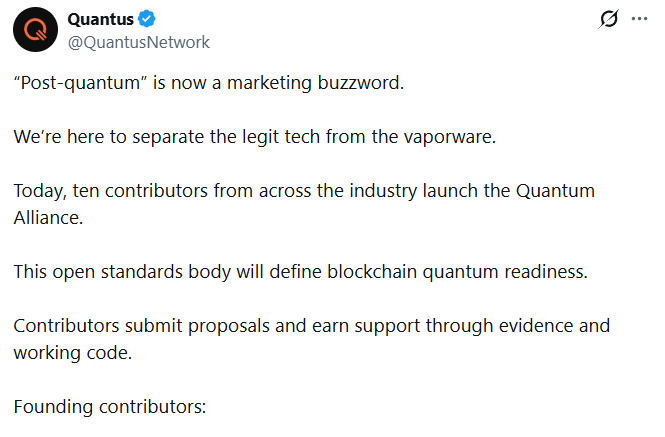
Source:Quantus Post on X
The founding members are Quantus, American Fortress, Intmax, Keystone, Midnight Foundation, Postquant Labs, Abelian, The Vault and Hacken. Ten individual contributors, mostly founders and senior executives, represent them.
Quantus announced the launch on X and called "post-quantum" a marketing buzzword the group wants to separate from working technology.
Why Are 6.04 Million Bitcoin Called Quantum-Exposed?
The 6.04 million BTC estimate comes from on-chain analysis that counts coins whose public keys are already visible. Structural exposure, where coins are exposed by design, accounts for 1.92 million BTC. Operational exposure, where a revealed key still sits on the same address, accounts for 4.12 million BTC.
The analysis says it is not a forecast of quantum timelines or a claim that exposed coins face immediate risk. That raises the obvious next question.
Can a Quantum Computer Actually Break Bitcoin Today?
No quantum computer able to run this attack exists today. Estimates are moving, though. Alliance members point to Google Quantum AI research from March that put an elliptic-curve break below 500,000 physical qubits.
They also cite an IonQ estimate from September of about 20,000 trapped-ion qubits and 26 days per attempt on Bitcoin's curve. These are estimates, not working machines. The gap between claims and proof is exactly what the Alliance wants to close.
What Will the Quantum Alliance Define First?
The first deliverable is a public definition of quantum readiness. It will cover transaction signatures, key management, consensus, zero-knowledge proof systems and peer-to-peer connections.
Open test criteria and benchmarks will follow, so teams can check their own code against the standard.
Who Will Verify a Quantum-Ready Claim?
Hacken, which will focus on verification,outlined the plan on its site. The aim is to replace unverified readiness claims with evidence that anyone can test.
Which Four Work Groups Start the Work?
Work begins in blockchain migration, post-quantum zero-knowledge systems, wallet security and cross-chain compatibility.
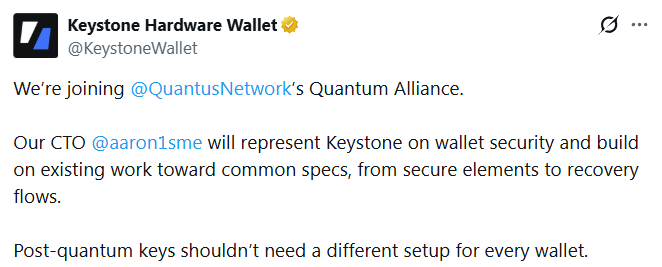
Keystoneconfirmed its role on X. Its CTO, Aaron Chen, will represent the company on wallet security, from secure elements to recovery flows.
Who Gets a Vote on Quantum Standards?
The Alliance follows the Internet Engineering Task Force model. Proposals advance through public evidence, rough consensus and working code.
Corporate size and token holdings carry no voting weight, and individual contributors can join. Everything the group produces will be published openly.
Expert Take: Can the Standard Reach Live Blockchains?
The data suggests the hard part is adoption, not definition. No single group can order a live blockchain to change its signature scheme, and the founders describe migration as a multiyear task.
The main uncertainty remains the arrival date of a capable machine. Windows cited in the founders' materials range from 2028 to around 2030.
Two signals matter most. The first is when the readiness definition and test criteria appear. The second is whether larger networks such as Bitcoin and Ethereum engage with the standard, which is not confirmed so far.
Corporate balance sheets now hold BTC too, as theTesla Bitcoin holdings value update shows, so custody standards reach beyond retail wallets.
Conclusion
The Quantum Alliance gives the industry a shared yardstick before a real threat arrives. Its first definition and test criteria will show whether "quantum-ready" becomes a claim that can be checked.
Until then, the 6.04 million BTC figure marks exposure, not an active attack. Further updates will appear incrypto news today coverage.
Disclaimer: This article is for information only and is not financial advice. Crypto assets are volatile and carry risk, and security estimates can change as research develops.