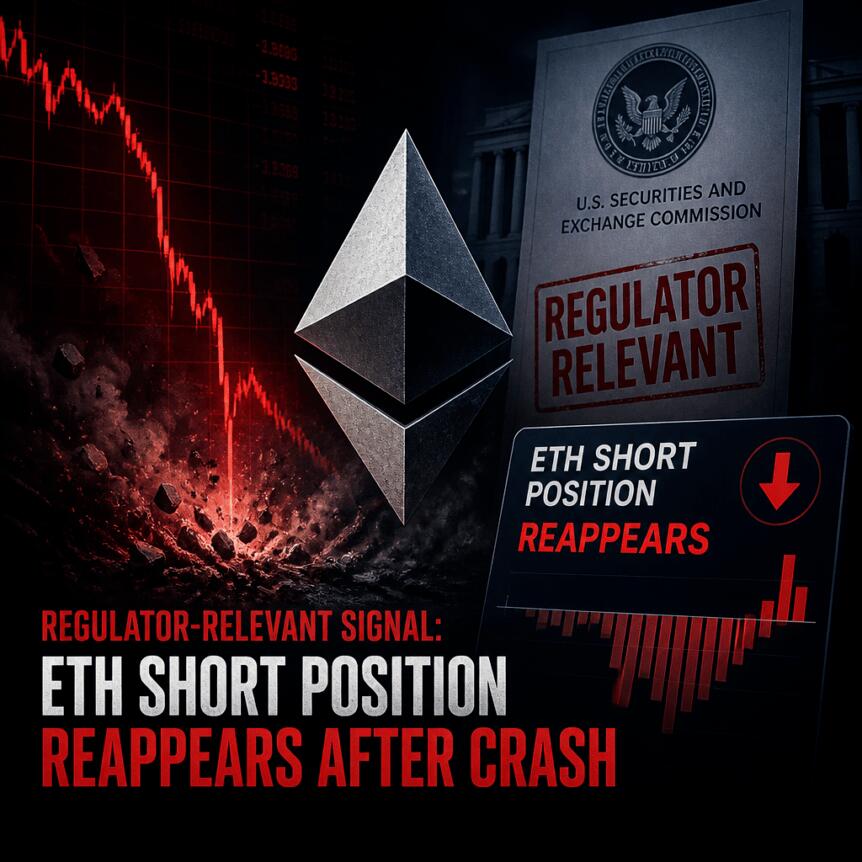
An Ethereum-linked wallet that previously took leveraged downside exposure during the October 2025 market turmoil has re-entered after an eight-month pause, opening a new 20x short position n
An Ethereum-linked wallet that previously took leveraged downside exposure during the October 2025 market turmoil has re-entered after an eight-month pause, opening a new 20x short position near a widely watched ETH support area. The activity underscores how some large, on-chain participants may respond to macro-driven drawdowns and internal ecosystem developments—both of which can shape liquidity and risk appetite for digital assets.
Key takeaways
- A wallet labeled 0xf83f…6728 opened a 20x leveraged ETH short with a notional value of about $19.72 million near the $1,500 support region.
- The short was reportedly entered at an average price around $1,565, with unrealized gains shown near $106,500 at the time of reporting.
- On-chain data indicates the same wallet last traded on Oct. 27, 2025, when it opened a short near $4,172 and later closed it near $4,133.
- While the new position is positioned for downside, the near-term chart setup includes a potential double-bottom scenario that could limit losses—or create liquidation risk if the market reverses sharply.
Large leveraged short returns near $1,500 support
On Friday, wallet 0xf83f…6728 initiated a 20x leveraged ETH short with an estimated notional size of $19.72 million, coinciding with Ether trading near the $1,500 support zone. ETH had reportedly fallen 18.25% over the prior two weeks, reflecting broader pressure on risk assets.
According to data compiled by Hyperbot, the position was opened at an average price around $1,565. At the time of publication, the wallet reportedly held nearly $106,500 in unrealized profit as ETH traded around the $1,550 area.
The decision to re-enter with high leverage is notable for institutional risk monitoring because leveraged derivatives positions can amplify market moves, increase systemic fragility around support levels, and accelerate forced deleveraging if price action moves against the trade. For compliance and risk teams, the key point is less about directional views and more about the risk mechanics: notional size, leverage, and collateral management determine exposure and potential cascading effects.
Ether’s bearish positioning was also linked in reporting to wider market conditions, described as a tech-led risk selloff that pressured Nasdaq and chip-linked equities. That broader backdrop can translate into reduced liquidity and higher volatility across crypto venues, particularly in periods where investors rebalance away from speculative assets.
Ecosystem and governance scrutiny adds another compliance lens
Alongside macro pressure, Ethereum-specific sentiment appeared to deteriorate in connection with renewed scrutiny of the Ethereum Foundation. Cointelegraph previously reported on issues including budget cuts, staff reductions, and a series of senior departures, each of which has the potential to affect stakeholder confidence in governance continuity and long-term development capacity.
While the wallet’s trade itself does not establish a direct causal link to those governance developments, the broader institutional context matters. Changes in organizational capacity and leadership can influence expectations about protocol development timelines, grant structures, and coordination across ecosystem actors—factors that may feed into risk premia and hedging behavior among sophisticated market participants.
For financial institutions assessing crypto exposure under internal risk frameworks, the key compliance-relevant point is that ecosystem governance developments can increase operational and reputational uncertainty. That uncertainty can affect counterparties, investment committee decisions, and the quality of risk disclosures—especially where holdings intersect with regulated markets, custody arrangements, or derivatives documentation.
Prior trade history: short near October 2025 crash top
The wallet’s current activity stands out due to its trading history. Transaction logs indicate that 0xf83f…6728 last became active on Oct. 27, 2025, when it opened an ETH short near $4,172 as volatility tied to the October crypto crash began to ease.
Hyperbot data cited in the report suggests the trader later exited near $4,133, realizing net profit of about $41,693 after roughly $5,263 in exchange fees. The earlier position provides a useful benchmark for pattern recognition: the wallet appears to have favored shorting into weakness using leverage, aligning with a consistent downside execution style.
However, the current trade differs in scale. The new position’s notional exposure is nearly $20 million, substantially larger than the notional size reported for the earlier trade, which would likely raise the stakes for risk management, margin requirements, and potential impact on liquidity during fast market moves.
Downside call faces potential reversal and liquidation risk
Despite the bearish rationale for the new short, the risk profile is not one-sided. As of Friday, technical structure described in the reporting included a potential double bottom forming in the $1,500–$1,512 area, where buyers reportedly stepped in twice during June. The pattern remained unconfirmed, but a strong rebound from that zone could shift short-term momentum.
The key technical level referenced was a neckline near $1,850. A decisive daily close above that level would, in the scenario presented, confirm the double-bottom structure and support a measured rebound toward roughly $2,190, based on the distance between the reported bottom and neckline.
From an institutional risk perspective, the most critical element is the potential interaction between technical reversal scenarios and the wallet’s leverage constraints. The report notes liquidation-related proximity near $2,150. If a bullish confirmation occurs without corresponding collateral top-ups or position reduction, the trader could face heightened liquidation risk—particularly in environments where volatility widens and spreads increase.
For compliance and monitoring teams, this highlights a broader theme relevant to derivatives markets: large leveraged positions can produce abrupt outcomes unrelated to fundamental valuation. Under risk governance frameworks—whether internal model risk controls or external regulatory expectations around market integrity—monitoring should prioritize position size relative to liquidity, margin dynamics, and how quickly liquidation thresholds could be reached under adverse price moves.
Closing perspective
The return of a high-leverage ETH short after an eight-month gap will likely keep attention on near-term support and any confirmation of potential reversal patterns. What to watch next is whether market structure stabilizes around the cited support region, and how derivatives margin conditions evolve if price moves accelerate—developments that can carry compliance, liquidity, and risk-management implications across regulated and institutional participation in crypto markets.
This article was originally published as Regulator-Relevant Signal: ETH Short Position Reappears After Crash on Crypto Breaking News – your trusted source for crypto news, Bitcoin news, and blockchain updates.