Ripple is taking a deeper bet on Africa’s cross-border payments market by buying an equity stake in Flutterwave, according to Bloomberg. The investment positions Ripple as a shareholder in on
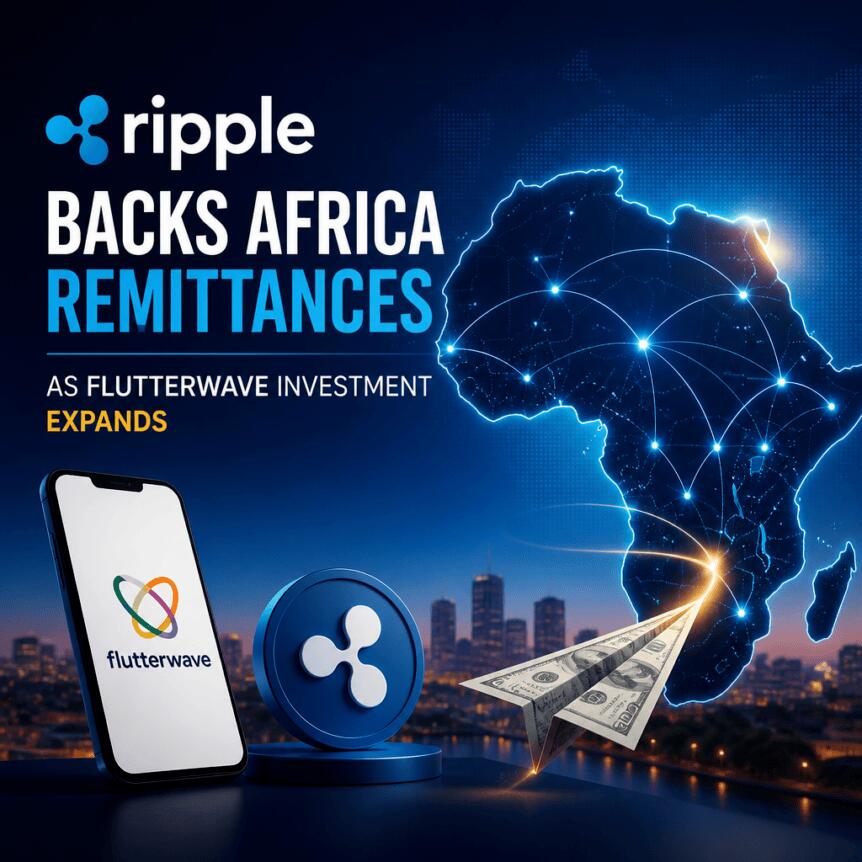
Ripple is taking a deeper bet on Africa’s cross-border payments market by buying an equity stake in Flutterwave, according to Bloomberg. The investment positions Ripple as a shareholder in one of Africa’s best-known fintechs while also setting up closer integration between Flutterwave’s payment rails and Ripple’s stablecoin and blockchain infrastructure.
Flutterwave CEO Olugbenga Agboola said the undisclosed round values the company at $3.3 billion, as reported by Bloomberg. While the financial terms were not fully detailed, the strategic direction is clear: Flutterwave will embed Ripple’s RLUSD stablecoin, Ripple Payments, and the XRPLedger to support faster and more cost-effective international transfers.
Key takeaways
- Ripple’s equity investment in Flutterwave makes it a shareholder rather than a commercial partner.
- Flutterwave plans to integrate RLUSD, Ripple Payments, and the XRPLedger for cross-border transactions.
- Both companies are aligning around stablecoin-based payments, reflecting broader growth in Africa’s remittance market.
- Prior Ripple moves—such as custody partnerships—suggest a sustained strategy to serve institutional and enterprise needs in the region.
Equity stake plus payments integration
The deal combines two different layers of involvement. On one hand, Ripple is investing in Flutterwave, giving it direct exposure to the fintech’s growth across Africa. On the other, Flutterwave is set to integrate Ripple’s stablecoin and payments tooling to improve the performance of cross-border transfers.
Flutterwave operates in 35 African countries, and the company has been expanding its digital asset services. As part of this broader expansion, Flutterwave has been building stablecoin payment capabilities—an approach consistent with the market demand for lower-cost international transfers.
In the latest step, Flutterwave will incorporate RLUSD alongside Ripple Payments and the XRP Ledger. The stated goal is to make cross-border payments both quicker and cheaper. For users and businesses, the practical impact is the promise of more efficient settlement for remittances and international transactions, particularly where traditional rails can be slow or expensive.
Ripple’s move also adds a governance-and-incentives angle. Equity exposure can change how companies think about long-term scaling, especially in markets where partnerships and integrations often require substantial engineering and operational investment.
Why Africa is becoming a stablecoin battleground
Ripple’s stake in Flutterwave comes as stablecoins gain traction in Africa’s payments landscape, driven largely by remittance demand and persistent pressure to cut transaction fees. Chainalysis reported in September 2025 that crypto adoption in sub-Saharan Africa rose 52% over a 12-month period, with more than $205 billion in onchain transactions recorded. At the time, the region ranked as the world’s third-fastest-growing crypto market.
That growth matters for payment networks because stablecoins are often easier to integrate into commercial flows than highly volatile crypto assets. By using dollar-denominated tokens, providers can reduce the friction of pricing and settlement, while also potentially lowering transfer costs.
The competitive field is already crowded. Circle, for example, has partnered with African fintech Sasai to expand USDC-based payment services across the region, with an emphasis on remittances. Ripple’s Flutterwave integration shows that this ecosystem building is not limited to a single issuer or blockchain—different networks are converging on similar customer needs.
Cost comparisons help explain the urgency. The World Bank estimates that sending a typical $200 remittance to sub-Saharan Africa costs recipients between $13 and $17 in fees. In contrast, the World Bank estimates that transfers using USDt (USDT) on Tron can cost as little as $0.50, while USDC on Ethereum can cost around $2.
These figures don’t guarantee outcomes for every corridor or user—fees depend on rails, liquidity, compliance, and provider pricing—but they underscore why stablecoin-enabled transfers are appealing in markets where fee compression has been a longstanding problem.
Ripple’s Africa strategy: from custody to payments rails
This investment appears to fit a larger pattern in Ripple’s Africa push. Last October, Ripple partnered with South Africa’s Absa Bank to provide digital asset custody solutions to institutional clients. That earlier effort targeted a different segment of the market—institutions needing custody—rather than day-to-day cross-border transfers.
By moving from custody to direct payments integration, Ripple is effectively broadening its route to adoption. Institutional custody can be a prerequisite for some enterprises, but consumer- and SME-focused payment experiences are what ultimately drive transaction volume. Flutterwave’s footprint across 35 African countries gives Ripple a path to scale stablecoin-based rails through an established payments distribution network.
For Flutterwave, the approach also looks like a way to upgrade infrastructure rather than only add new features. Integrating RLUSD, Ripple Payments, and the XRP Ledger suggests a more foundational change to how cross-border transfers are executed, with potential implications for speed, settlement efficiency, and operational cost.
What to watch next
The immediate question for market participants is how quickly Flutterwave will roll out the RLUSD and Ripple Payments integrations and what performance improvements users and merchants experience in practice. Beyond the technical integration, the key watch item is whether stablecoin-enabled transfers continue gaining share in African remittance corridors as competitors expand similar services and pricing pressure intensifies.
This article was originally published as Ripple Backs Africa Remittances as Flutterwave Investment Expands on Crypto Breaking News – your trusted source for crypto news, Bitcoin news, and blockchain updates.