Key Takeaways Rivian (RIVN) shares advanced 1% to close at $15.47 during Friday’s session, albeit on lighter-than-usual trading activity. Analysts maintain a consensus Hold stance with price
Key Takeaways
- Rivian (RIVN) shares advanced 1% to close at $15.47 during Friday’s session, albeit on lighter-than-usual trading activity.
- Analysts maintain a consensus Hold stance with price targets ranging from $17 to $19, suggesting potential upside from present levels.
- The company’s software and services segment generated $515 million in revenue last quarter with an impressive 42% gross margin, standing out in an otherwise loss-making operation.
- A strategic Uber collaboration could deliver up to $1.25 billion in capital tied to autonomous driving achievements, targeting a 10,000-vehicle robotaxi deployment by 2028.
- Market participants are monitoring Rivian’s September 29 appearance at the Evercore ADAS, AV & AI Forum for potential autonomy announcements.
Rivian Automotive shares gained 1% during Friday’s trading session, reaching an intraday peak of $15.65 before closing at $15.47. The session’s trading volume registered 44% below typical levels, indicating the advance occurred without substantial conviction from market participants.
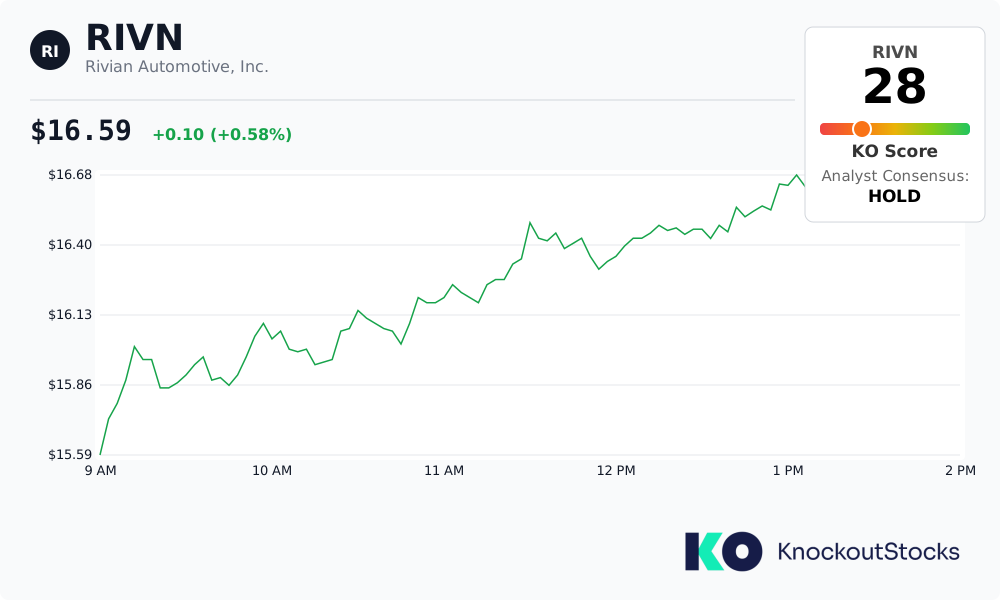 Rivian Automotive, Inc., RIVN
The equity has traded within a tight $15 to $16 corridor for several months, with its fifty-day moving average positioned at $15.98. This sideways pattern mirrors Wall Street’s divided perspective on the automaker’s trajectory.
Analyst sentiment breaks down to twelve Buy recommendations, nine Hold ratings, and seven Sell calls. This distribution translates to a consensus Hold designation with a mean price objective of $19.00, per MarketBeat intelligence.
A TipRanks compilation places the average analyst target at $17.13, representing roughly 11% appreciation potential from present trading levels. Regardless of the source, the takeaway remains consistent: Wall Street sees upward potential but lacks complete confidence.
Revenue Grows While Profitability Remains Elusive
Rivian’s latest quarterly results, unveiled July 30th, surpassed market expectations. The electric vehicle manufacturer reported an adjusted per-share loss of $0.63, outperforming the anticipated $0.66 deficit.
Total revenue climbed to $1.66 billion, marking a 27% year-over-year increase and exceeding the $1.52 billion analyst forecast. Despite this progress, profitability remains out of reach. The Street anticipates a full-year loss of $2.98 per share, while management projects adjusted EBITDA losses between $1.8 billion and $2.0 billion for the year.
These figures present a recognizable narrative for Rivian observers: expanding top-line growth, narrowing losses, yet profitability still remains distant.
Autonomy Software Emerges as Key Value Driver
Vehicle deliveries no longer represent the sole metric commanding investor attention. Rivian’s autonomous driving software division is emerging as a potentially standalone revenue generator.
On September 29, executives leading Rivian’s autonomy and artificial intelligence initiatives will present at the Evercore ADAS, AV & AI Forum. This appearance coincides with the company’s plans to introduce point-to-point assisted driving capabilities before year-end.
The R2 platform, which launched deliveries June 9 with a starting price of $57,990, currently offers hands-free driving assistance across 3.5 million miles of North American roadways. A more affordable R2 Standard variant, carrying a $44,990 price tag, is slated for 2027 availability.
Earlier this month, Rivian consolidated its R1 and R2 product lines onto a unified software architecture branded RivianOS 2. This integration should streamline over-the-air updates and potentially enable monetization through subscription-based features.
The economic rationale for software is becoming evident in financial results. Last quarter’s software and services division produced $515 million in revenue with a 42% gross margin, accounting for a significant portion of the $179 million in aggregate gross profit.
The Uber arrangement adds another dimension. The mobility platform has committed up to $1.25 billion in Rivian investment through 2031, conditional upon achieving specific autonomous driving benchmarks. Initial plans envision deploying 10,000 self-driving R2 robotaxis, with potential expansion to 40,000 units. Commercial launch is scheduled for 2028.
Executive stock sales have persisted recently. CFO Claire McDonough divested 13,144 shares in August at $14.50 per share, while insider Michael John Callahan sold 15,000 shares in September at $16.29. Both transactions occurred through predetermined trading arrangements.
Institutional investors maintain substantial ownership at 66.25%. Norges Bank and Bank of New York Mellon established fresh positions in recent periods, while Capital International Investors expanded its existing holdings.
Rivian’s current market valuation stands at $22.40 billion, with a price-to-earnings multiple of -6.00 and a beta coefficient of 1.62.
The post Rivian (RIVN) Stock: Why Autonomy Software Could Be the Game Changer appeared first on Blockonomi.