Blockchain technology continues to make its breakthrough in the world of traditional finance. This democratization is thanks to several crypto players and visionary tech geniuses. Robinhood h
Blockchain technology continues to make its breakthrough in the world of traditional finance. This democratization is thanks to several crypto players and visionary tech geniuses. Robinhood has just taken another big leap into this rapidly evolving universe. This bold bet could well pave the way for other established players. The paradox is particularly fascinating in this context: a centralized broker builds a decentralized infrastructure.
In brief
- Robinhood launched Robinhood Chain, an Ethereum layer 2 built on Arbitrum.
- Stock Tokens allow trading stocks 24/7 in over 120 countries.
- Robinhood Earn offers a 7% yield on USDG to U.S. users.
- Robinhood integrates AI trading via Agentic Accounts for its clients.
Robinhood Chain, the bold bet on tokenization
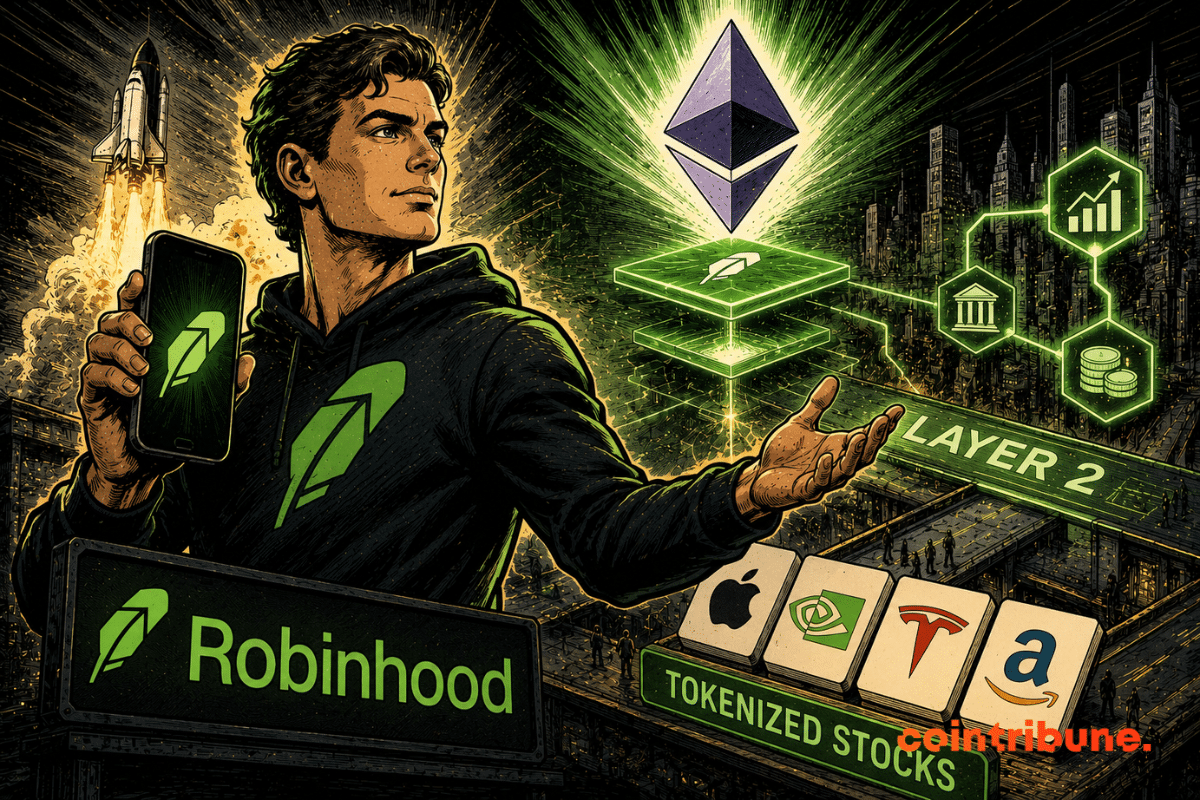
Robinhood, the company that just surpassed a billion in revenue, launched on July 1, 2026, the mainnet of Robinhood Chain, an Ethereum Layer 2 built on the Arbitrum stack. The network is designed for tokenized assets, DeFi, and AI-agent trading.
With launch partners like Uniswap, BitGo, and Chainlink, Robinhood is no longer just a simple broker. It is now becoming a major player in the global blockchain infrastructure.
Decentralized finance opens possibilities beyond what traditional finance can offer, but historically, it has required technical expertise to master.
Source: Johann Kerbrat, Robinhood, July 1, 2026.
The antinomy is clear: Robinhood, a figure of centralized finance, embraces decentralization. The broker deliberately blurs the boundaries between these two antagonistic worlds.
Tokenization, DeFi and AI: the three pillars of a total crypto ambition
Robinhood Chain is based on three major innovations that redefine modern finance. Stock Tokens allow trading Nvidia, Apple, or Google stocks 24/7. These tokenized assets are available in 120 countries and can be used as collateral in DeFi.
Robinhood Earn offers a 7% yield on USDG. A first for a traditional Wall Street broker. Agentic Accounts pave the way for autonomous trading by artificial intelligence.
Your 1st cryptos with CoinbaseThis link uses an affiliate program.But this immense ambition comes at a high price for the company involved. Robinhood cut 10% of its workforce, and its crypto revenue dropped by 34% in the first quarter.
The contradiction is deeply troubling for observers: the broker is innovating massively on tokenization while its accounts are in the red. The ethics of this strategy raise questions about investment priorities.
Is the dream of the “everything exchange” within reach?
Robinhood wants to become the single platform for all global financial assets. The broker deliberately blurs the lines between stocks, crypto, derivatives, and tokenized assets to create a unified ecosystem.
The arrival of dYdX with Arcus and the partnership with Bitget Wallet (90 million users) show that this ecosystem is rapidly being built.
“We bring together the best of traditional finance and DeFi, and in doing so, we extend financial ownership to every corner of the globe,” emphasizes Johann Kerbrat.
Yet regulation remains a major obstacle for this ambitious vision. Stock Tokens are not available in the United States, Robinhood’s domestic market. The market dialectic is in full effervescence: technological innovation encounters national legal frameworks.
Will Robinhood be able to achieve its dream of a global financial platform?
Key figures of Robinhood Chain
- 120 countries covered by Stock Tokens;
- 90+ tokenized stocks available;
- 7% APY on USDG via Robinhood Earn;
- 28 million Robinhood users;
- 90 million Bitget Wallet users.
Robinhood has made a bold bet on asset tokenization. Ethereum, which hosts this infrastructure, sets records for active addresses despite the weakness of its price. The infrastructure is solid, even if the native crypto struggles to attract investors.