Can Roodrai Turn Tokenized Stock Data Into Smarter Trading Signals? Another AI token, another bold promise. Anyone searching for this Roodrai review usually wants one answer: is the project r
Can Roodrai Turn Tokenized Stock Data Into Smarter Trading Signals?
Another AI token, another bold promise. Anyone searching for this Roodrai review usually wants one answer: is the project real, early, or risky?
Roodrai says its AI agents can read tokenized stocks on Robinhood Chain and turn that data into trading signals. $ROAI is the token behind it, and the presale is already running.
This Roodrai Review covers how the idea works, what the tokenomics show and where the risks sit. Every fact comes from the project's own published pages.
What Is Roodrai?
Roodrai is an AI agent layer built for Robinhood Chain. The project says its agents read tokenized stocks and real-world asset activity, then turn that data into trading signals. $ROAI is the token that funds development and gives access to those tools.
The site states that Roodrai is independent and not affiliated with Robinhood Markets, Inc.
The gap it targets is simple. Tokenized assets create fresh onchain data, but few tools read it like an analyst would.
How Does Roodrai Work?
Software agents monitor chain data, spot patterns and send alerts. The official Roodrai whitepaper splits the setup into three parts, and this Roodrai review follows the same order.
AI Agents and Market Data
Agents read three inputs nonstop: Chainlink price feeds for tokenized stocks, each token's multiplier, and onchain transaction flow.
A multiplier adjusts a token's price after dividends or splits. Reading it helps separate real price moves from adjustment noise, a detail every Roodrai Review should flag.
Robinhood Chain and Roodrai
The whitepaper says Robinhood Chain hosts tokenized equities and ETFs with native price feeds. Roodrai wants to be the intelligence layer on top of that data.
The project calls itself chain-first, not ported from elsewhere. That's a design claim, and this Roodrai review can't treat it as proof of results.
Trading Signals and AI Insights
Agents publish signals like momentum shifts and unusual flow. Holders get them on a dashboard, and a public API is planned. The rollout runs in phases: closed alpha, public beta, then general launch.
Signals are interpretations, not predictions. The whitepaper itself promises no returns.
What Is the $ROAI Token Used For?
For this Roodrai review, the official documents list a narrow set of uses:
Funds development of the signal layer
Gives access to dashboards, agent alerts, and builder API access as they ship
Pays referral rewards of 10,000 $ROAI per linked wallet, claimed at TGE
TGE, or token generation event, is when tokens are created and become claimable.
Staking, governance, and revenue sharing don't appear on the published pages. A fair Roodrai review shouldn't add to them.
Roodrai Tokenomics Explained
Metric
Details
Token
$ROAI
Total Supply
10 billion, no minting
Presale
12 stages, 42% of supply
Bonus Reserve
8%
Initial Price
$0.0010 (Stage 1)
Launch Target
$0.50 in Q3 2027
Token Utility
Signal layer access
Other Allocations
Liquidity 12%, treasury 12%, team 10% (vested), marketing 8%, exchanges 5%, burn 3%
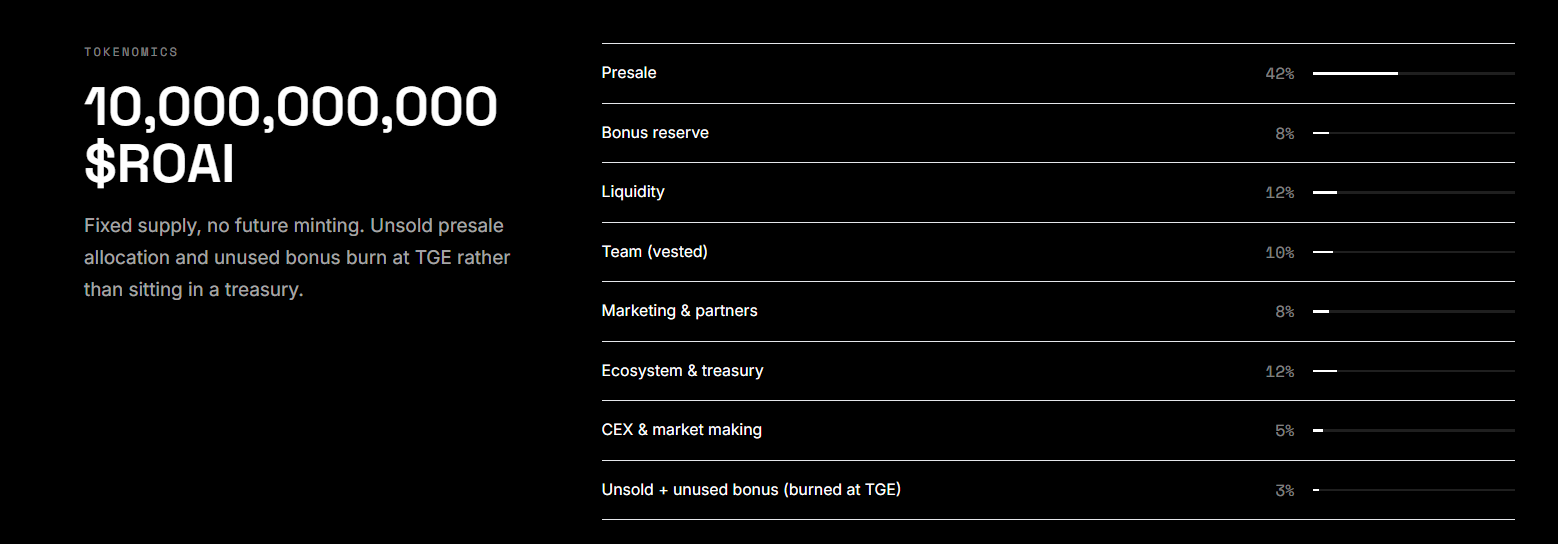
Source:Roodrai Tokenomic Page
Supply is fixed, and unsold presale and bonus tokens burn at TGE. The presale is the largest slice. Team tokens are labeled vested, but no schedule is published. Vesting is the schedule that controls when tokens unlock, so that gap matters.
At $0.50 and 10 billion tokens, fully diluted valuation (FDV) would reach $5 billion. FDV counts every token, while market cap counts only circulating supply. It's simple math, not a forecast, and this Roodrai Review treats the target as unproven.
Roodrai Presale: How Does It Work?
Prices rise from $0.0010 to $0.0032 across 12 stages, while the bonus falls from 20% to zero. Each stage targets $800,000, for $9.6 million in total.
As of 7 October 2026, Stage 1 is active with $0 raised. Stage figures change, so check the latest Roodrai presale data before relying on any number.
$100 in Stage 1 buys 100,000 $ROAI, plus a 20,000 bonus. Buyers pay in ETH, USDC, or USDT on Ethereum, or USDG on Robinhood Chain.
The minimum is $20 and the maximum is $100,000 per wallet per stage. The app enforces those limits, not the contract. Any Roodrai review of a presale should check these terms first.
How to Buy $ROAI
Open the official Roodrai website by typing the address yourself.
Connect a compatible wallet on the dashboard. The pages list no specific wallets, so verify first.
Pick the chain and payment token.
Enter an amount, $20 minimum.
Review the stage, price, bonus and network fee.
Confirm in your wallet.
Check your allocation. Tokens are claimed at TGE.
Roodrai Roadmap and Future Plans
This Roodrai Review treats these as plans, not delivered results.
Q4 2026: presale opens, whitepaper goes public, contracts go to audit.
Q1 2027: closed alpha, first exchange talks, stages 4 to 7.
Q2 2027: full audit report, public beta, stages 8 to 12.
Q3 2027: TGE and Robinhood Chain listing at a $0.50 target, API opens, exchange listings begin.
The site still lists Q3 2027 as the launch window.
What Makes Roodrai Different?
Chain-first focus on tokenized stocks and real-world assets
Multiplier-aware reading of price data
Signals instead of raw feeds
Presale totals readable from public contracts on both chains
A narrow focus brings depth but also dependence on one chain. In this Roodrai Review, these are design choices, not results.
Is Roodrai Legit or a Scam?
Neither label can be proven yet. Some things are verifiable: the official website, a whitepaper with full allocation, contract addresses on both chains, an audit page, a public roadmap, and X and Telegram channels.
Gaps remain. No team names appear on the pages reviewed, and no team vesting schedule is published. Audit signals also conflict. The audit page says the audit is complete, yet a status field reads "in progress" and the roadmap schedules the full report for Q2 2027.
Compare the structure with other active crypto presales to see what's normal. Paperwork isn't proof, so a Roodrai review can't call it a scam or a sure thing.
How Safe Is Roodrai? Key Risks to Know Before Buying $ROAI
This Roodrai Review starts with one rule: no presale is risk-free.
Roodrai Investment Risks
Presale risk: the token is unlisted, with no guaranteed value or listing
Volatility and thin liquidity after launch
Smart contract risk, even after an audit
AI signals can be wrong
Regulatory uncertainty around tokenized equities
Execution risk on every roadmap phase
What Should Investors Check?
Before buying, run through this Roodrai Review checklist:
Contract address: match it against the official audit page
Audit scope: it covers presale contracts only
Allocation and vesting: confirm percentages and ask for team lockups
Liquidity plans and team identities
Announcements: official channels only
Roodrai Review: Pros and Cons
This Roodrai Review summary keeps it simple.
Pros
Clear AI and blockchain angle tied to tokenized assets
Fixed 10 billion supply with no minting
Published whitepaper and public presale contracts
Staged presale with a stated roadmap
Cons
Early-stage product, not yet released
Unproven $0.50 launch target
Execution risk on every roadmap phase
Market volatility
AI signals aren't guaranteed
Conclusion
Roodrai is an early-stage AI agent project built around tokenized stocks on Robinhood Chain, with $ROAI funding and gating the signal tools.
Its sharp focus stands out. The biggest risk is distance: the product isn't built yet, and the $0.50 target sits far above the $0.0010 Stage 1 price.
The final Roodrai Review takeaway is simple. The project is documented but unproven. Check the audit status, the team and the vesting schedule next.
Disclaimer: This article is for information only and isn't financial advice. Crypto presales carry high risk, and you can lose all your money. Do your own research before you act.